By Charles Pitts
The gold market in 2026 has transitioned from a traditional safe-haven asset into a core strategic component for institutional and retail portfolios alike. With spot prices oscillating between $4,500 and $5,200 per ounce, the focus for market participants has shifted from simple price speculation to the underlying health and operational efficiency of the producers themselves.
As central banks continue to diversify away from the U.S. dollar: purchasing an estimated 800 tonnes of bullion in 2026 alone: gold mining stocks are being re-evaluated through a lens of margin sustainability rather than just production volume. Choosing the right equity in this environment requires a departure from “growth at any cost” and a move toward disciplined capital allocation, jurisdictional stability, and technological integration.
The 2026 Gold Macro Driver: A Structural Shift
The current bull market is not merely a reaction to temporary geopolitical flare-ups. It is driven by a structural shift in global finance. J.P. Morgan and other major financial institutions have revised their long-term forecasts, with many seeing gold stabilizing above $5,000/oz by year-end.
More Read

For mining companies, this pricing environment creates unprecedented operating leverage. When gold moves from $2,500 to $5,000, a producer with fixed costs sees their free cash flow expand exponentially. However, this “gold rush” has also introduced risks: labor inflation, rising energy costs, and a tightening regulatory environment for ESG compliance. To navigate these variables, investors must utilize a rigorous comparison framework.

1. The AISC Benchmark: Identifying the Low-Cost Leaders
In 2026, the single most important metric for evaluating gold mining stocks is the All-In Sustaining Cost (AISC). This figure includes not only the direct cost of mining and processing but also the capital required to maintain current production levels.
Historically, an AISC of $1,000/oz was the industry gold standard. In the current inflationary environment, the industry average has climbed toward $1,350/oz.
More Read

- Tier-1 Producers: Look for companies maintaining an AISC below $1,200/oz. These operations offer a significant margin cushion if the gold price undergoes a cyclical correction.
- High-Cost Producers: Companies with an AISC exceeding $1,600/oz are “leverage plays.” While they benefit most from a rising gold price, they are the most vulnerable to any price retracement.
Operational discipline is often seen in companies that successfully manage their project valuations through P/NAV analysis, ensuring that every ounce added to the mine plan is accretive to the bottom line.

A heavy-duty drill jumbo operating in a modern underground gold mine, highlighting the shift toward mechanized extraction.
2. Reserve Life and Grade: The Sustainability Factor
A mining company is only as valuable as the gold it has left in the ground. In 2026, the industry is facing a “reserve crisis.” Global primary gold head grades have declined to approximately 1.30 g/t, down from 1.50 g/t just a few years ago.
When comparing stocks, prioritize the following:
- Reserve Life: A minimum 10-year mine life is essential for a “Core” portfolio holding. Anything less than five years indicates a company that must engage in expensive M&A to survive: a risky strategy in a high-price environment where assets are overvalued.
- Replacement Ratio: Check if the company is replacing at least 100% of the gold it mines each year through exploration or strategic M&A activity.
- Grade Quality: Higher-grade deposits (anything over 2.0 g/t for open pit or 5.0 g/t for underground) typically correlate with lower AISC, as less rock must be moved and processed to produce a single ounce of gold.
3. Jurisdictional Risk: Mapping the 2026 Geopolitical Landscape
Where a mine is located is as important as what it produces. 2026 has seen a rise in “resource nationalism,” with several nations in South America and Africa increasing royalties or seeking greater state participation in mining projects.
- Low-Risk Jurisdictions: Nevada (USA), Western Australia, and Saskatchewan (Canada) remain the premier destinations for mining capital. Companies with over 70% of their production in these regions often trade at a premium valuation (P/NAV).
- Moderate to High Risk: Emerging markets can offer higher growth but come with the risk of permitting delays or tax changes. Investors should look for companies with established social licenses and strong community relations to mitigate these localized risks.

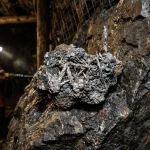
High-grade gold ore formations require specialized processing and provide the foundation for low-cost mining operations.
4. ESG and Technological Alpha: The Hidden Margin
ESG (Environmental, Social, and Governance) performance is no longer a secondary consideration. In 2026, it is a primary driver of cost reduction.
- Electrification: Companies replacing diesel haul trucks with electric fleets are seeing a 15-20% reduction in energy costs and significantly lower ventilation requirements in underground mines.
- Emissions Intensity: The industry average is currently 792 kg CO2e per ounce. Producers operating below this threshold are not only more sustainable but are also attracting a larger share of institutional capital, which often carries a lower cost of debt.
- Autonomous Operations: The use of remote-controlled machinery and AI-driven exploration is separating the technology leaders from the laggards. Modern control rooms now monitor fleet logistics in real-time to maximize uptime.

Modern mining control rooms use real-time data to optimize fleet logistics and improve safety standards.
5. Comparing the Tiers: Majors vs. Mid-Tiers
For a balanced 2026 portfolio, it is helpful to categorize gold mining stocks into three tiers:
The Majors (The “Steady Hands”)
Companies like Barrick Gold, which recently exceeded production guidance, and Newmont offer stability. They have diversified portfolios across multiple continents, massive reserve bases, and the scale to negotiate better prices on consumables. They typically pay consistent dividends, making them suitable for conservative investors.
The Mid-Tiers (The “Growth Drivers”)
The mid-tier sector is where the most significant valuation re-ratings occur. These companies typically produce between 300,000 and 1 million ounces per year. They are often the targets of the majors, leading to potential takeover premiums. In the 2026 market, mid-tiers with single-digit P/E ratios and high-grade assets are the primary focus of value investors.
The Royalty and Streaming Plays
For those seeking exposure to gold without the operational risks of mining (strikes, cave-ins, or cost overruns), royalty companies are an attractive alternative. By providing upfront capital for a percentage of future production, firms like those involved in recent silver and gold cornerstone deals offer high-margin, diversified exposure to the sector.
2026 Gold Mining Market Snapshot
Below is a comparative summary of the key performance indicators for the three primary tiers of gold mining equities in the current market.
| Metric | Tier-1 Majors | Mid-Tier Growth | Royalty/Streaming |
|---|---|---|---|
| Typical AISC ($/oz) | $1,250 – $1,350 | $1,150 – $1,450 | $0 – $500 (G&A only) |
| Dividend Yield | 3.5% – 5.0% | 1.0% – 2.5% | 1.5% – 3.0% |
| Reserve Life | 12 – 15 Years | 7 – 10 Years | N/A (Portfolio-based) |
| Primary Risk | Bureaucracy/Scale | Single-asset risk | Gold Price only |
| Jurisdiction | Global / Diversified | Often concentrated | Diversified |
Conclusion: The Selection Strategy
Choosing the best gold mining stocks for 2026 requires a focus on “quality over quantity.” As the gold price remains elevated, the market will eventually punish companies that let their costs spiral out of control or fail to replace their reserves.
The ideal 2026 candidate is a company with an AISC under $1,250, a reserve life exceeding 10 years, and a clear path toward decarbonization. Whether you favor the stability of the majors or the torque of the mid-tiers, the underlying fundamentals of cost control and jurisdictional safety remain the most reliable indicators of long-term performance in the mining sector.