By Charles Pitts

**SAGUENAY, QUEBEC : ** Rio Tinto has officially broken ground on its US$1.5 billion (C$2 billion) expansion of the AP60 aluminum smelter at its Complexe Arvida, marking a pivotal shift in North American metal production toward high-efficiency, low-carbon standards. The ceremony, held Monday at the Saguenay–Lac-Saint-Jean site, signals the start of a multi-year construction phase that will cement Quebec’s position as a global leader in sustainable primary metal supply.
The investment: one of the largest in the Canadian aluminum sector in a decade: focuses on the installation of 96 new AP60 potlines. Once fully operational, these units will add approximately 160,000 tonnes of primary aluminum capacity per year. This expansion, combined with the gradual phase-out of legacy potrooms at the same site, is designed to ensure the long-term viability of the Complexe Arvida while slashing the regional carbon footprint of one of the world’s most energy-intensive industries.
Technical Superiority: The AP60 Advantage
At the heart of the expansion is Rio Tinto’s proprietary AP60 smelting technology. Widely regarded as the industry benchmark for energy efficiency and productivity, the AP60 pots operate at higher amperages than traditional smelting cells, allowing for greater metal output with significantly lower greenhouse gas emissions.
When powered by Quebec’s vast hydroelectric grid, aluminum produced at the expanded Arvida facility is expected to emit just 1.6 tonnes of CO2 equivalent (tCO2e) per tonne of aluminum. For comparison, the global industry average currently sits at approximately 10.9 tCO2e, with coal-powered smelters in other jurisdictions often exceeding 15 tCO2e.
More Read

“Today’s groundbreaking is not just about expanding capacity; it is about future-proofing the industry,” a Rio Tinto spokesperson noted during the event. “The AP60 technology provides a scalable, low-carbon solution that aligns with the increasing demand from the automotive and aerospace sectors for traceable, green materials.”

Mining ESG Reporting Trends and Market Impact
This expansion reflects broader mining ESG reporting trends where institutional investors are prioritizing capital allocation toward projects with clear decarbonization pathways. For Rio Tinto, the Arvida project is a cornerstone of its 2050 net-zero ambition and its interim goal of reducing Scope 1 and 2 emissions by 50% by 2030.
The project is also a strategic response to the AI-energy nexus, as the rapid growth of data centers and clean energy infrastructure drives massive new demand for aluminum in electrical wiring, cooling systems, and structural components.
More Read
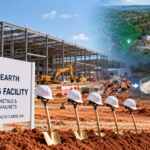

The installation of 96 new AP60 pots will significantly increase Rio Tinto’s low-carbon output capacity.
Economic and Local Employment Significance
The US$1.5 billion investment is projected to provide a substantial boost to the Quebec economy. During the peak of the construction phase, Rio Tinto estimates that more than 1,500 workers will be employed on-site. Once the expansion is commissioned: expected to reach full capacity by late 2026 or early 2027: it will support approximately 100 permanent, high-skilled roles.
The project also benefits from roughly C$113 million in financial support from the Quebec government, highlighting the strategic partnership between the provincial administration and the mining giant. This collaboration ensures that the Saguenay region remains the “Aluminum Valley” of the West, providing critical supply chain security for North American manufacturers.
| Metric | AP60 Expansion Details |
|---|---|
| Total Investment | US$1.5 Billion (C$2 Billion) |
| New Pot Capacity | 96 AP60 pots |
| Annual Output Increase | ~160,000 tonnes |
| Emissions Intensity | 1.6 tCO2e per tonne Al |
| Construction Jobs | 1,500+ (Peak) |
| Permanent Jobs | ~100 |
Global Supply Chain Dynamics
The groundbreaking comes at a time of tightening global aluminum supply. With energy costs remains volatile in Europe and environmental regulations tightening in China: the world’s largest producer: low-cost, hydro-powered smelting in Canada offers a competitive edge.
Industry analysts suggest that the Arvida expansion will help offset the production losses expected as older, less efficient smelters across North America reach the end of their operational lives. Furthermore, the integration of this facility with Rio Tinto’s upcoming aluminum recycling center at Arvida will create a “closed-loop” ecosystem, further enhancing the project’s ESG credentials.

Quebec’s hydroelectric grid is the key enabler for Rio Tinto’s low-carbon production strategy.
Looking Ahead: The Path to Commissioning
Following the groundbreaking, the project enters a high-intensity construction and installation phase. Rio Tinto has already begun procurement for long-lead items and is coordinating with local contractors to ensure the 2026 timeline is met.
The expansion is part of a larger trend in mining news where major miners are shifting from simple extraction to high-value, tech-integrated processing. By combining the AP60 expansion with the ELYSIS inert anode technology currently in the demonstration phase, Rio Tinto is positioning itself to eventually produce aluminum that is entirely carbon-free at the point of smelting.
For operators and investors, the Arvida groundbreaking represents a tangible commitment to the energy transition. It demonstrates that large-scale industrial decarbonization is not just a theoretical goal but a operational reality that is currently being built in the heart of Quebec.

Primary aluminum from the Arvida facility will target premium markets in the automotive and green energy sectors.