By Charles Pitts

The transition from diesel-mechanical fleets to fully electrified operations is no longer a speculative “green” ambition. In 2026, it is a calculated financial strategy. As global mining houses face the dual pressure of volatile fuel prices and tightening carbon regulations, the shift to zero-carbon mining is proving to be a catalyst for operational efficiency rather than just a compliance cost.
For decades, the diesel engine was the undisputed king of the mine site. However, the inherent inefficiencies of internal combustion: where roughly 60% of energy is lost as heat: are becoming harder to justify. Today’s deep-dive into mine electrification reveals that while the capital expenditure (CAPEX) for battery-electric vehicles (BEVs) remains higher than their diesel counterparts, the total cost of ownership (TCO) is rapidly tilting in favor of the electron.
The Economics of the Electron: Where Savings Live
The business case for electrification rests on three primary pillars: energy efficiency, reduced ventilation requirements, and simplified maintenance.
1. Energy Displacement and Efficiency
Electric motors are fundamentally more efficient than diesel engines, converting over 90% of energy into motion. In open-pit operations, the use of trolley-assist systems and regenerative braking allows haul trucks to capture energy on downhill runs, essentially “refueling” the battery for free. According to reports from the Canadian Climate Institute, switching from diesel to electricity replaces a volatile, high-cost commodity with a more stable utility, especially when paired with long-term Power Purchase Agreements (PPAs) for renewable energy.
More Read
2. The Ventilation “Bonus” in Underground Mines
In underground environments, electrification is a transformative lever for the bottom line. Diesel engines emit heat, particulates, and nitrogen oxides, requiring massive, energy-intensive ventilation systems to keep the air breathable. By removing the diesel engine, operators can reduce ventilation demand by up to 50%.

For a Tier-1 underground gold or copper mine, ventilation can account for 30% to 40% of total site energy consumption. Cutting this in half provides an immediate and permanent reduction in operating expenditure (OPEX).
3. Maintenance and Lifecycle Benefits
A diesel powertrain is a complex assembly of thousands of moving parts, filters, and fluids, all operating under extreme heat and vibration. An electric drivetrain is drastically simpler. With fewer failure points and reduced vibration, maintenance intervals are extended. Operators are reporting that electric fleets require significantly less unplanned downtime, which directly boosts site productivity.
More Read

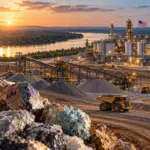
Open-pit operations are increasingly integrating electric rope shovels and trolley-assist haulage to mitigate diesel volatility.
Case Studies: From Pilots to Production
Major miners are leading the charge, moving past the “proof of concept” phase into full-scale fleet replacements.
- Newmont’s Borden Gold Mine: Located in Ontario, Canada, Borden is widely cited as the world’s first all-electric underground mine. By eliminating diesel, Newmont avoided the construction of a massive ventilation shaft, saving approximately $15 million in initial CAPEX and millions more in annual energy costs.
- Fortescue (FMG): The Australian iron ore giant has committed to “Real Zero” by 2030. In partnership with Liebherr, Fortescue is deploying a fleet of autonomous battery-electric trucks in the Pilbara. Their strategy relies on a massive build-out of “green electrons”: solar and wind infrastructure: to power the fleet, decoupling their cost structure from global oil markets.
- BHP and Rio Tinto: Both companies are collaborating with OEMs like Caterpillar and Komatsu to develop ultra-class battery-electric haul trucks. These units are being tested in Western Australia, where the focus is on “fast-charging” infrastructure that can keep a 250-tonne truck moving with minimal interruption to the duty cycle.
Comparative Operational Costs: Diesel vs. Electric (Estimated 2026 Basis)
| Metric | Diesel-Mechanical Fleet | Battery-Electric Fleet (BEV) | Impact |
|---|---|---|---|
| Energy Conversion | 30–35% Efficiency | 90–95% Efficiency | High Efficiency |
| Maintenance Cost | Base (100%) | 60–70% of Base | Lower OPEX |
| Ventilation Needs | 100% Flow Required | 40–50% Flow Required | Major Savings |
| Energy Cost | High/Volatile | Low/Stable (via PPA) | Predictability |
| Carbon Exposure | High ($/tonne CO2) | Zero/Low | De-risked |
The 2026 Equipment Supply Chain Outlook
As demand for electrification accelerates, the supply chain is reaching a critical inflection point. Original Equipment Manufacturers (OEMs) like Sandvik, Epiroc, and Normet have already released full suites of electric underground equipment. However, the transition faces two significant hurdles in 2026: battery cell availability and grid infrastructure.
Mining companies are now competing with the automotive sector for high-density lithium-ion cells. This competition has made the lithium price forecast a central concern for procurement officers. Furthermore, the “charging challenge” is immense. A single ultra-class electric truck can require megawatts of power to charge quickly. Mines in remote regions are having to become their own utility providers, building microgrids and massive battery energy storage systems (BESS) to manage peak loads.

Underground electrification relies on advanced drilling and loading equipment that eliminates diesel emissions at the rock face.
Workforce and Policy Drivers
The shift to electrification also necessitates a shift in the workforce-training landscape. Diesel mechanics are being retrained as high-voltage technicians, and mine planners must now account for “energy duty cycles” as much as “haulage cycles.”
On the policy front, carbon border adjustments and national carbon taxes are making diesel increasingly expensive. In jurisdictions like Canada and the EU, the “shadow price” of carbon is being integrated into all new project valuations. Electrification is no longer just about saving cents per liter; it is about future-proofing the asset against a world where carbon is a liability.

Modern electrification requires real-time data integration to manage battery health, charging schedules, and grid load.
The Path Forward: 2026 Outlook
For operators and investors, the message for 2026 is clear: electrification is a competitive necessity. Those who lag in adopting electric drivetrains risk being stranded with high-cost, high-emission assets that are increasingly difficult to finance.
The immediate focus for the industry is now moving toward the “Balance of Plant.” This includes the high-voltage cables, substations, and software needed to orchestrate a fleet of 50 or 100 electric trucks. As the equipment matures and the supply chain for critical minerals stabilizes, the “Electric Mine” will transition from a vision of the future to the standard of the present.
LinkedIn/X Shareable Snippet:
Mine electrification is moving from “green pilot” to “bottom-line priority” in 2026. With diesel engines losing 60% of energy to heat, the shift to electric drivetrains is slashing ventilation costs by 50% and maintenance by 30%. From Newmont’s all-electric Borden mine to Fortescue’s “Real Zero” push in the Pilbara, the industry is proving that net-zero is just good business. #MiningTechnology #EnergyTransition #NetZero #MineElectrification