By Penny Langford

The closure of Sherritt International’s Fort Saskatchewan refinery has sent a shockwave through the North American battery materials sector, effectively erasing the continent’s only significant domestic source of refined cobalt. As of June 2026, the facility remains offline, caught in a logistical and geopolitical deadlock that has left a "strategic vacuum" in the midstream supply chain.
For years, the Fort Saskatchewan refinery in Alberta was the silent backbone of regional critical mineral autonomy, processing mixed sulphides from the Moa joint venture in Cuba into high-purity nickel and cobalt. However, a catastrophic interruption in the feed from Cuba: exacerbated by a failed slurry pipeline and persistent fuel shortages in the Caribbean: has forced a total suspension of operations. The result is a North America that, for the first time in decades, finds itself with zero active, large-scale cobalt refining capacity.
The Breakdown: Why the "Moa-to-Canada" Bridge Collapsed
The crisis began in late 2025 when the 600-kilometer slurry pipeline at the Moa Bay site in Cuba suffered a structural failure. What initially appeared to be a routine maintenance issue quickly spiraled as Cuba’s domestic energy crisis deepened, making the procurement of parts and heavy fuel oil for reconstruction impossible.
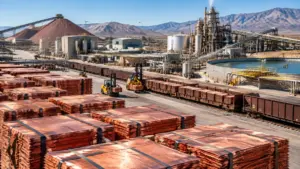
Sherritt’s reliance on this specific feed was its Achilles' heel. Unlike more modern facilities designed for feedstock flexibility, Fort Saskatchewan was highly tuned to the Moa concentrate. Without it, the plant’s massive stacks have gone cold. For North American manufacturers, particularly in the defense and aerospace sectors that rely on non-Chinese cobalt metal, the shutdown is more than a supply chain hiccup: it is a national security concern.
More Read



The Strategic Vacuum: North America’s 2026 Reality
The timing of the shutdown could not be worse. As the energy transition accelerates, the demand for cobalt in high-nickel EV batteries and stationary storage has continued to climb. While Indonesian supply has flooded the global market, nearly all of that material is diverted to Chinese refineries.
The loss of Sherritt removes approximately 3,000 to 4,000 tonnes of annual cobalt production from the Western balance sheet. In a global market of roughly 200,000 tonnes, this might seem marginal, but for the North American "closed-loop" ambition, it is devastating. Regional buyers who previously benefited from the "Made in Canada" label are now forced back into the arms of the London Metal Exchange (LME) spot market, where origins are murky and logistics are exposed to maritime chokepoints.
More Read

Who Steps in to Fill the Void?
With Sherritt sidelined, the industry has turned its eyes toward the two primary contenders for domestic midstream dominance: Electra Battery Materials and Jervois Global. However, neither has been able to provide an immediate solution in 2026.
Electra Battery Materials (Ontario)
Electra remains the Great White Hope for the Canadian supply chain. Its refinery in Temiskaming Shores, Ontario, is designed to be the first dedicated cobalt sulfate facility in North America. While the company secured a critical CAD 20 million investment from the Canadian government in May 2026 to accelerate construction, the reality on the ground is a waiting game. Commissioning is currently targeted for Q2 2027. Electra is "de-risked" in terms of capital, but it cannot produce a single gram of battery-grade sulfate for the remainder of this year.
Jervois Global (Idaho)
The situation at Jervois is even more complex. After a high-profile restructuring in 2025 that saw the company move into private hands, its Idaho Cobalt Operations (ICO) remain mothballed. Despite being a fully built, world-class primary cobalt mine, the facility cannot justify a restart at current price levels while competing with low-cost, ESG-opaque supply from the DRC and Indonesia. For now, Jervois’s refining strength remains concentrated in Finland (Kokkola), meaning North American customers are still importing across the Atlantic.

Market Snapshot: North American Cobalt Landscape (June 2026)
| Project/Asset | Operator | Status (June 2026) | Est. Annual Capacity | Impact of Sherritt Closure |
|---|---|---|---|---|
| Fort Saskatchewan | Sherritt Int. | Offline / Suspended | 3,500t (Mixed) | Created the domestic refining gap. |
| Ontario Refinery | Electra | Under Construction | 6,500t (Sulfate) | Strategic priority; Q2 2027 target. |
| Idaho Cobalt Ops | Jervois | Care & Maintenance | 1,900t (Concentrate) | Idled due to market pricing. |
| Madison Project | American Eagle | Exploration/Dev | N/A | Potential long-term domestic feed. |
The Strategic Cost of the Gap
The vacuum left by Sherritt has fundamentally changed the bargaining power of North American OEMs. Without a local refinery, the "Inflation Reduction Act" (IRA) tax credits become significantly harder to claim. To qualify for the $7,500 consumer credit, a specific percentage of battery minerals must be extracted or processed in the U.S. or a free-trade partner country. With Fort Saskatchewan down and Electra still a year away, the industry is looking at a "lost year" for compliant cobalt.
"We are seeing a bifurcated market," says one Toronto-based commodities analyst. "There is the global cobalt price, and then there is the 'North American Premium': the price you pay for the peace of mind that your metal didn't come from a Chinese-owned refinery in the DRC. That premium just hit a multi-year high because Sherritt was the only one actually delivering the goods."

2026 Outlook: Drivers and Risks
The base case for the remainder of 2026 is one of extreme volatility. While global prices have stabilized around $35,000/t, regional scarcity in North America is driving local premiums higher.
- The Bull Case: If the Moa slurry pipeline reconstruction faces further delays, or if the Canadian government forces an "emergency restart" through alternate feedstock subsidies, we could see a rush to secure any remaining stockpiles.
- The Bear Case: If Indonesian supply continues to aggressively undercut the market, domestic projects like Jervois may remain mothballed indefinitely, cementing the strategic vacuum as a permanent fixture of the North American landscape.
Conclusion: A Wake-Up Call for Midstream Policy
The Sherritt shutdown serves as a stark reminder that the "Energy Transition" is only as strong as its weakest link. For all the talk of copper demand forecasts and rare earth dominance, cobalt remains the volatile heart of the battery.
As we move through 2026, the focus must shift from merely "finding" minerals to "refining" them. Until the first batches of cobalt sulfate roll off the line in Ontario or the stacks at Fort Saskatchewan begin to smoke again, North America remains strategically exposed.
Social Media Snippet:
North America just lost its only significant cobalt refinery. With Sherritt’s Fort Saskatchewan facility offline, the continent faces a "Strategic Vacuum" in 2026. Who fills the void? We dive into the status of Electra, Jervois, and the rising cost of the midstream gap. #Cobalt #MiningNews #EnergyTransition #SupplyChain #CriticalMinerals