By Charles Pitts

BOISE, Idaho : Perpetua Resources has advanced its flagship Stibnite Gold Project with a wave of high-grade drilling discoveries, pairing its primary gold development with crucial domestic supplies of antimony and tungsten. As the company progresses through early-works construction following federal approvals, new assay results underscore the project’s dual role as both a commercial gold asset and a linchpin for U.S. critical-minerals security.
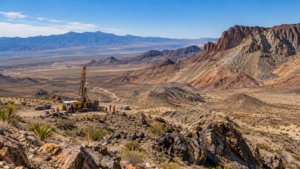
The ongoing 2026 drilling campaign, utilizing four drill rigs across the historic Idaho district, has already surpassed 5,800 meters of core completion toward an initial 10,000-meter program. Recent disclosures from the company reveal high-grade mineralization within permitted footprints, offering potential operational flexibility as project leadership navigates complex financing, environmental remediation, and ongoing legal challenges.
New Discoveries: Gold, Antimony, and Tungsten Intercepts
Recent exploration data highlights significant mineralization extensions across multiple zones within the Stibnite district. Between the Yellow Pine and West End reserve pits, drilling has identified a newly defined gold-tungsten zone known as the Clark Tunnel Fault Zone (CTFZ).
According to company technical reports, Hole SB597 returned 21.3 meters grading 3.2 grams per tonne (g/t) gold and 0.9% tungsten starting from a depth of 24 meters. Within that interval, a higher-grade core delivered 7.0 meters at 7.1 g/t gold and 0.3% tungsten from a 34-meter depth. Because the CTFZ lies within the currently permitted open-pit mining boundary, the discovery could be integrated into early mine scheduling if subsequent economic and metallurgical evaluations prove favorable.
More Read

Near-surface drilling also yielded high-grade gold-antimony intersections. Hole SB580 returned 6.4 meters grading 16.2 g/t gold and 1.7% antimony directly from surface, while Hole SB582 intercepted 15.0 meters at 6.3 g/t gold and 0.8% antimony from 11 meters depth.


Further south at the Hangar Flats deposit, historical records combined with recent core testing confirm lenses hosting between 5% and 13% antimony alongside 1% to 6% tungsten across narrow widths of 1 to 10 meters. One deeper intercept, Hole SB524, encountered 1.7 meters grading 10.5% antimony and 1.8% tungsten from 256 meters depth. These grades significantly exceed standard gold-only bulk mining averages and are central to Perpetua’s strategy to supply critical materials to defense and industrial sectors.
More Read

To evaluate these auxiliary deposits, Perpetua has submitted federal grant proposals aimed at expanding resource delineation, testing metallurgical recovery circuits, and completing comprehensive feasibility studies for antimony and tungsten co-production.
Project Status, Permitting, and Development Timeline
The Stibnite project reached a major regulatory milestone when the U.S. Forest Service (USFS) issued the Final Environmental Impact Statement (FEIS) and Final Record of Decision (ROD). Federal permitting was formally logged as complete on the FAST-41 dashboard. Following the posting of $139 million in construction-phase financial assurance, the USFS issued a Notice to Proceed, enabling early construction activities to commence.
Current early-works construction focuses on critical path infrastructure:
- Burntlog Route: Constructing a dedicated access road to bypass legacy transportation corridors and secure site logistics.
- Site Infrastructure: Upgrading worker housing facilities and staging heavy equipment.
- Powerline Integration: Advancing electrical grid connections required for future heavy extraction and processing machinery.
Perpetua reports approximately $45 million in direct contracts awarded to Idaho-based contractors and service providers for the summer construction phase.
+--------------------------+-------------------------------------------------------------+
| Milestone / Phase        | Target Window / Status                                      |
+--------------------------+-------------------------------------------------------------+
| Federal Permitting       | Completed (USFS ROD & FAST-41 Dashboard Finalized)          |
| Financial Assurance      | Posted ($139 million bonding secured)                       |
| Early Works Construction | Underway (Burntlog Route, site access, power infrastructure)|
| EXIM Bank Financing      | Targeted for 2026 loan closing                              |
| Peak Construction Labor  | 2027–2028 (Tailings storage facility & processing plant)    |
| First Commercial Output  | Targeted for 2029 (Gold production & U.S. defense antimony) |
+--------------------------+-------------------------------------------------------------+
Under the approved Plan of Operations, the combined construction, operation, closure, and reclamation cycle is projected to span approximately two decades. Project management teams are currently running a formal RFP process to select strategic offtake partners and a midstream antimony processor, with selections anticipated to solidify commercial revenue structures.
Strategic Importance: Antimony and Defense Supply Chains
Stibnite is positioned to become the sole domestic source of mined antimony in the United States, targeting an estimated lifetime production of roughly 115 million pounds. Proven and probable reserves currently stand at approximately 148 million pounds of antimony.
Unlike traditional single-metal operations, antimony recovery at Stibnite is integrated directly into gold processing circuits. To de-risk this supply chain, Perpetua, the U.S. Army, and the Idaho National Laboratory (INL) have established a critical-minerals pilot plant. The facility focuses on producing antimony trisulfide: the specific chemical compound utilized in military propellants, pyrotechnics, and munitions. This initiative aligns with broader national efforts to secure domestic supply chains for energy transition metals and critical minerals, mirroring trends observed across global commodity markets as detailed in recent Skillings Mining Intelligence analyses.

Key Risks Facing the Project
Despite regulatory clearance and strategic federal backing, Stibnite carries notable execution, environmental, and financial risks that could influence its ultimate timeline and operational metrics.
Legal and Permitting Challenges
Although primary federal approvals are established, legal friction persists. Special-interest conservation groups filed lawsuits challenging project authorizations. While the U.S. District Court for Idaho denied a motion for a preliminary injunction: allowing early-works construction to proceed: ongoing judicial reviews and potential appeals create lingering schedule uncertainty.
Concurrently, the Nez Perce Tribe maintains active opposition to the project, raising concerns regarding potential impacts on endangered salmon populations and watershed integrity within the South Fork Salmon River basin. Tribal opposition can influence state-level permitting conditions, water quality certifications, and long-term legal standing.
Environmental Remediation Liabilities
Stibnite is a brownfield site bearing the scars of nearly a century of historical gold, antimony, and tungsten mining, leaving behind uncontained tailings and spent heap-leach piles that contribute to ongoing water degradation. Perpetua operates under an Administrative Settlement Agreement and Order on Consent (ASAOC) with federal and state regulators, committing to early cleanup actions.
While the approved mine plan incorporates comprehensive site restoration: such as reprocessing legacy tailings to remove existing pollution sources: failure to meet stringent water quality benchmarks or manage waste rock effectively could trigger regulatory penalties, civil liabilities, or reputational setbacks.

Technical and Metallurgical Complexities
Integrating high-grade antimony and tungsten lenses into a primarily gold-focused extraction flowsheet introduces operational complexity. The newly identified CTFZ and Hangar Flats zones require further resource modeling, diamond drilling, and pilot-scale metallurgical testing. Processing multi-metal ores demands precise chemical separation to ensure marketable concentrate grades without depressing overall gold recoveries or inflating capital expenditures.
Financing and Capital Requirements
With total project capital requirements estimated between $1.3 billion and $4.0 billion depending on phased scope, Perpetua relies heavily on securing a proposed multi-billion-dollar export credit facility, notably linked to the Export-Import Bank of the United States (EXIM). Delays in finalizing this debt package or adverse shifts in credit markets could constrain construction momentum. Furthermore, industry-wide inflation affecting labor, steel, and heavy machinery continues to exert upward pressure on initial capital expenditure forecasts.
Outlook for Operators and Investors
The Stibnite project represents a critical test case for domestic critical-mineral development in the United States. By combining a multi-million-ounce gold reserve with a secure domestic supply of military-grade antimony, Perpetua Resources occupies a unique intersection of commercial mining and national security policy.
However, realizing the 2029 production target requires successfully navigating complex debt financing negotiations, satisfying rigorous environmental oversight, and managing technical integration across multi-commodity ore bodies. Industry observers and resource investors will closely monitor upcoming assay data releases, EXIM loan finalizations, and court rulings as construction enters its critical path phases.