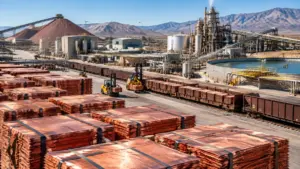
Lithium brine evaporation ponds in an arid South American basin.

By Mo Shine
Lithium prices rebound as supply buffers tighten
Lithium prices are rebounding in August as three forces converge: the continued shutdown of CATL’s Jianxiawo mine in Jiangxi, stronger demand from stationary energy storage, and accelerating inventory drawdowns across China’s battery-materials chain.
The rebound does not mean the market has moved cleanly from surplus to shortage. Traders are still weighing the possibility of a CATL restart against evidence that existing inventories are being consumed faster than expected. That tension has produced a volatile market in which permitting headlines can move prices sharply, even as the underlying supply-demand balance changes more gradually.
For the lithium price forecast 2026, the most important question is no longer simply how much new capacity has been announced. It is how quickly that capacity can produce compliant, battery-grade material: and whether it arrives before storage and electric-vehicle demand absorb the remaining inventory cushion.
More Read

The Reuters report on CATL’s Jianxiawo mine said the operation remained closed pending environmental approval. CATL has secured a safety production permit, but local authorities have confirmed that ore processing, crushing, loading and transport have not resumed.

That distinction matters. A permit milestone can reduce long-term uncertainty without adding a single tonne to near-term supply.
Jianxiawo keeps a large volume of supply offline
Jianxiawo is one of China’s most important hard-rock lithium operations. Published estimates vary, but the mine is generally assessed at between 60,000 and 65,000 tonnes of annual lithium carbonate equivalent capacity by Fastmarkets and other market participants. Other estimates place its potential output above 100,000 tonnes of LCE at a full run rate.
More Read

The range reflects differences in how analysts define capacity, recovery rates and the mine’s operating configuration. The broader conclusion is more consistent: Jianxiawo represents several percentage points of global supply and a materially larger share of China’s domestic production.
The mine’s original shutdown followed the expiry of its mining licence in August 2025. Since then, the project has moved through several regulatory steps, including land-use and safety approvals. However, the mine’s reclassification from ceramic clay to lithium ore under China’s revised mineral-resources framework requires additional environmental review.
The environmental impact assessment entered the public-consultation stage in July. That is progress, but it is not final operating approval.
The market has therefore been trading two different futures:
- A restart scenario, in which CATL eventually restores tens of thousands of tonnes of annual supply.
- A delay scenario, in which the mine remains offline through much of 2026 and possibly into 2027.
The first scenario weighs on prices before production returns. The second tightens the physical market before the market can respond with replacement supply.

Hard-rock spodumene mining infrastructure in Western Australia.
China’s policy shift favours disciplined capacity
The Jianxiawo situation is part of a broader change in China’s approach to the lithium-ion battery industry.
Regulators are moving away from rapid, volume-led capacity expansion and toward what officials describe as high-quality development. Revised industry guidelines place greater emphasis on technology, product quality, cost efficiency and the reduction of redundant projects.
That shift has two implications for lithium chemicals.
First, it may slow the rate at which low-cost or speculative capacity is brought online. New projects face higher standards, greater scrutiny and tighter environmental requirements. Existing producers are also under pressure to demonstrate compliance with resource, safety and quality rules.
Second, the policy change does not weaken demand for lithium carbonate or hydroxide. China continues to support battery manufacturing and energy-storage deployment, but growth is being directed toward higher-utilization and higher-quality facilities rather than unlimited nameplate expansion.
The Ministry of Industry and Information Technology’s battery-sector policy direction is therefore important to the forecast. It suggests that announced capacity should not automatically be treated as available supply. Some projects may be delayed, consolidated or removed, while high-quality producers gain a larger share of the market.
This is especially relevant for the carbonate-hydroxide divide. Lithium carbonate remains closely tied to lithium-iron-phosphate battery production, which is widely used in electric vehicles and grid storage. Lithium hydroxide is more closely associated with high-nickel cathodes. The two products are connected, but they are not perfectly interchangeable in the short term.
As storage expands, additional demand is likely to fall heavily on carbonate-based supply chains. That can tighten carbonate markets even if hydroxide availability appears more comfortable.
Storage demand is becoming a second demand engine
For years, lithium demand analysis focused primarily on electric vehicles. Energy storage is now becoming a second major demand engine.
China’s storage market is supported by grid investment, renewable-power integration and new capacity-pricing mechanisms. Industry announcements during the first half of 2026 included more than 65 planned energy-storage projects representing over 1,500 gigawatt-hours of potential capacity, according to market-policy reporting summarized in recent sector analysis.
Not every announced project will be built on schedule. However, the scale of the pipeline shows why storage demand can change the lithium balance faster than older forecasts assumed.
The Reuters analysis of the energy-storage boom highlighted the way stationary storage is strengthening the demand outlook for a market that had been weakened by oversupply and falling prices.
Storage also changes inventory behaviour. Cell manufacturers, cathode producers and converters that previously carried large buffers have had an incentive to operate with leaner stocks after the lithium-price collapse. That reduced working capital, but it also made the supply chain more exposed to disruptions.
The FIS Battery Metals Weekly framework points to this interaction between storage growth and declining inventories. If buyers continue drawing down stocks while mine supply remains constrained, the market can shift from apparent surplus to effective shortage without a sudden collapse in production.
That is the linkable data point for market participants: inventory is not only a measure of how much material exists; it is a measure of how quickly the supply chain can respond to new demand.

Industrial equipment used in lithium carbonate processing.
The deficit-versus-surplus debate
The lithium market can still produce a surplus in 2026 or 2027. Several new mines, expansions and conversion plants are expected to add supply. If CATL restarts Jianxiawo smoothly and other projects meet their schedules, the market could receive a substantial wave of additional material.
That is the basis of the bearish case.
The more constructive case rests on timing. New supply frequently arrives later than planned, ramps more slowly than nameplate capacity suggests, or produces material that requires qualification before battery customers can use it. At the same time, storage demand is scaling from a relatively small base and can grow faster than mature EV demand.
The Metal.com analysis of the Jianxiawo disruption described the role of inventory buffers in delaying the full effect of the shutdown. Those buffers can keep converters operating for a time, but their depletion makes subsequent supply losses more visible in spot prices.
This is why the 2027 supply wave remains a risk rather than a certainty. New tonnes may arrive, but the market must also account for:
- Permitting and environmental approvals.
- Construction and commissioning delays.
- Ramp-up and recovery rates.
- Product qualification by cathode and cell producers.
- The pace of storage deployment.
- Whether inventory is rebuilt or continues to fall.
Lithium price forecast 2026: scenario framework
The following framework uses battery-grade lithium carbonate prices in China, expressed in US dollars per metric tonne. These are analytical ranges rather than investment targets. Storage-growth and inventory assumptions are directional because public market data do not provide a single standardized global inventory measure.
| Scenario | 2026 lithium carbonate range | CATL capacity offline | Storage demand growth assumption | Inventory change | 2026–2027 balance |
|---|---|---|---|---|---|
| Bear case | US$12,000–17,000/t | Falls toward zero by late 2026 | 8–10% | Restocking resumes | Surplus as new supply arrives |
| Base case | US$18,000–25,000/t | 30,000–65,000 t LCE remains offline | 10–15% | Continued drawdown, then stabilization | Balanced to mild deficit |
| Bull case | US$26,000–32,000/t | Most or all capacity remains offline | 15% or higher | Accelerating drawdown | Deficit through 2027 |
| Structural-floor case | Around US$18,000/t | Delayed or partial restart | Sustained double-digit growth | Inventories remain historically lean | Risk-adjusted tight market |
The US$18,000 level should not be treated as a universally accepted cost floor. Cost-curve estimates cited in market commentary place the cash-cost floor for some producers closer to US$10,000–11,000 per tonne. An US$18,000 floor would instead represent a risk-adjusted structural floor supported by permitting uncertainty, thin inventories and sustained demand growth.
Earlier Skillings coverage of the lithium price forecast identified this possibility: prices could remain above the lowest-cost-based levels if supply discipline and demand growth offset the expected 2027 supply wave.
What could invalidate the forecast?
The principal downside risk is a faster-than-expected supply response. A compliant Jianxiawo restart, combined with strong output from Australian spodumene mines and new brine or conversion projects, could rebuild inventories and push prices toward the lower end of the forecast range.
Demand could also disappoint if electric-vehicle growth slows, storage projects are delayed by grid-connection constraints, or battery manufacturers reduce production to manage margins.
The upside risk is the opposite combination: Jianxiawo remains offline, new projects miss their ramp schedules, and storage demand grows quickly enough to absorb available material. In that case, the market could move into deficit even while headlines continue to describe a large future supply pipeline.
For operators and investors, the most useful tracker is not a single price target. It is the relationship between four moving indicators:
- CATL’s verified production restart and shipment data.
- Chinese carbonate inventory across producers, converters and warehouses.
- Storage deployment and battery shipment growth.
- The volume of new supply that has reached commercial qualification.
Until those indicators align, lithium prices are likely to remain headline-sensitive. The August rebound is therefore best understood as a repricing of near-term availability: not proof that the long-forecast supply wave has disappeared.
Shareable social snippet:
Lithium prices are rebounding as CATL’s Jianxiawo mine remains offline, storage demand accelerates and Chinese inventories draw down. The key 2026 question is whether the market reaches a mild deficit before the next supply wave arrives. Our scenario framework examines the US$18,000 structural-floor case and the risks through 2027.