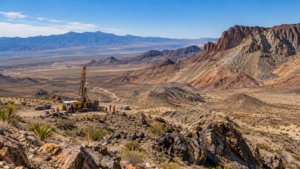
Koryx Copper drill rig at the Haib project in southern Namibia.

Koryx Copper (TSXV: KRY; NSX: KYX; US-OTC: KRYXF) has drilled its longest continuously mineralized intersection to date at the Haib copper project in southern Namibia, returning 969 metres of copper-bearing mineralization from surface.
The result from hole HM167 is expected to support an updated mineral resource estimate for Haib later this year, as the company moves toward the completion of a large exploration program and a prefeasibility study.
Koryx reported the 969-metre interval at 0.27% copper equivalent (CuEq). The reported assay components include 0.23% copper, 84 parts per million molybdenum and 0.021 grams of gold per tonne.
The hole was part of a batch of 19 holes covering 8,586 metres. Koryx said the drilling intersected thick mineralization across the program, reinforcing the scale and continuity of the Haib porphyry system.
More Read

“With this batch, our infill drilling is nearing completion, and results continue to trend to the upside ahead of the expected late 2026 mineral resource update,” President and CEO Heye Daun said in a company release.
HM167 extends Haib’s record for continuous mineralization
The HM167 result is significant because the mineralization begins at surface and continues for almost one kilometre down the drill hole. Such an interval does not, by itself, establish an economic deposit or determine the eventual mine plan, but it provides important information about the thickness and continuity of the mineralized system.

The result also exceeds several earlier long intersections reported from Haib. Previous drilling included:
| Drill hole | Reported interval | Grade |
|---|---|---|
| HM167 | 969 m from surface | 0.27% CuEq |
| HM155 | 831 m from surface | 0.27% CuEq |
| HM112 | 602 m | 0.32% CuEq |
| HM121 | 495 m | 0.31% CuEq |
Koryx has also reported narrower, higher-grade zones within the broader porphyry mineralization. Hole HM185 returned 236 metres grading 0.51% copper within a broader 413-metre interval grading 0.37% copper. Hole HM177 returned 30 metres grading 1.06% copper from eight metres depth, including two two-metre intervals above 4% copper.
More Read

Those higher-grade zones are relevant to the resource model because they can influence the distribution of grade shells, potential mining phases and processing assumptions. The next resource estimate will need to incorporate the new drilling alongside geological interpretation, density data, metallurgical results and the company’s selected reporting cut-offs.

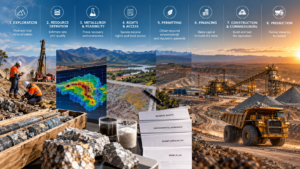
Copper-bearing drill core from exploration and resource-definition work.
Resource update is the next major milestone
Koryx is nearing completion of a 52,000-metre drilling program at Haib. The campaign is designed to infill areas of the existing resource, improve confidence in the geological model and test for additional mineralization outside the current modelled zones.
The March resource cited in industry coverage contains:
- 744 million indicated tonnes grading 0.28% copper, 63 ppm molybdenum and 0.02 grams of gold per tonne.
- 579 million inferred tonnes grading 0.24% copper, 66 ppm molybdenum and 0.02 grams of gold per tonne.
- Approximately 4.61 billion pounds of contained copper in the indicated category.
- Approximately 3.05 billion pounds of contained copper in the inferred category.
The new drilling could affect both the size and confidence of the resource. Infill holes may convert material from inferred to indicated resources where spacing and geological continuity are sufficient. Expansion holes may add tonnes outside the current resource boundary, while some holes could also lead to local changes in grade or the limits of the modelled mineralized zones.
Koryx has identified several holes as potential contributors to resource growth. The company said HM173 extended higher-grade copper farther west than previously modelled, while HM171 intersected higher-grade zones outside the existing resource. Hole HM162 also returned 56 metres grading 0.35% copper in previously unmodelled mineralization.
The company expects to release the updated resource estimate late in 2026. That estimate is expected to provide the foundation for the next stage of economic and engineering work.
Haib’s scale matters for project design
Haib is a large porphyry copper-molybdenum system in Namibia’s //Karas Region, near the South African border. Koryx describes it as one of Africa’s largest porphyry copper systems and one of the country’s most advanced undeveloped copper projects.
The deposit has a long exploration history involving major mining companies including Rio Tinto, Falconbridge and Teck. It is also regarded as one of the world’s oldest-known porphyry copper deposits, adding geological significance to an asset that Koryx is now evaluating for modern large-scale development.
The project’s location near existing infrastructure is an important consideration. Large porphyry deposits typically require substantial capital for mining fleets, concentrator facilities, power, water, roads and export logistics. The viability of Haib will therefore depend not only on the size and grade of the resource, but also on infrastructure access, process recoveries, operating costs and the regulatory framework in Namibia.

Exploration infrastructure in the arid landscape of southern Namibia.
Koryx’s 2025 preliminary economic assessment outlined a potential open-pit operation producing an average of approximately 88,000 tonnes of copper annually over a 23-year mine life. The study estimated initial capital expenditure of US$1.56 billion and an after-tax net present value of US$1.35 billion at an 8% discount rate, using a copper price assumption of US$9,500 per tonne.
Those figures remain study-stage estimates and are subject to change. A future prefeasibility study is expected to update the mine plan, capital requirements, operating assumptions, metallurgical performance and development schedule.
Metallurgy and licensing remain key risks
Koryx is continuing metallurgical test work and processing trade-off studies at Haib. For a porphyry copper project, recovery rates, concentrate quality, grinding requirements and the treatment of molybdenum and gold byproducts can materially affect project economics.
The company has also applied to convert Haib’s exploration licence into a mining licence. Environmental approvals, land access, water availability, power supply and permitting will be among the factors watched by investors and policymakers as the project advances.
Haib’s potential scale creates both an opportunity and a development challenge. A large open-pit project could require significant infrastructure and financing, while copper prices, construction costs and availability of equipment would influence the timing and returns of any future development decision.
The market backdrop remains relevant. Copper is central to electric grids, renewable power infrastructure, electric vehicles and industrial equipment, but new mines often require long lead times and face permitting, capital and technical constraints. Skillings’ copper price forecast for 2026 examines how supply growth, demand from electrification and project delays are shaping the outlook.
What investors will watch next
Koryx’s near-term milestones are concentrated around the resource and engineering pipeline:
- Completion of the 52,000-metre drill program.
- Publication of the updated Haib mineral resource estimate.
- Completion of metallurgical and processing studies.
- Progress on the mining licence application.
- Release of the prefeasibility study expected in the fourth quarter.
- Further definition of higher-grade zones and potential resource extensions.
The HM167 result gives Koryx a strong headline interval ahead of those milestones, but the broader resource model will matter more than any single hole. Decision-makers will be looking for evidence that the long intersections translate into coherent, mineable volumes; that higher-grade zones have sufficient continuity; and that metallurgy supports the proposed processing route.

Metallurgical testing will help determine the processing route and recovery assumptions for Haib.
The company’s shares trade in Canada under KRY, in Namibia under KYX and on the US over-the-counter market under KRYXF. As an exploration and development company, Koryx remains exposed to drilling results, resource revisions, permitting, financing, construction costs and changes in copper prices.
The latest drilling does not establish a construction decision, but it strengthens the geological case for continued evaluation. With 969 metres of continuous mineralization in HM167, Koryx has added another large-scale data point as it prepares to update the Haib resource and advance the project toward prefeasibility.
For broader coverage of copper exploration, project development and market strategy, see Skillings’ copper mining intelligence coverage.