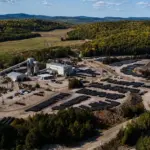
New Mexico’s arid Grants mineral belt is one of the United States’ historic uranium-producing regions.

By Charles Pitts
Americas Uranium Corp. has agreed to acquire a 100% interest in the Treeline uranium project in New Mexico, adding a historically explored property in the Grants mineral district as the United States works to rebuild domestic nuclear fuel supply.
The Vancouver-based company said Wednesday that it entered into a mineral property purchase agreement with Verdera Energy Corp. and its subsidiary, NM Energy Holding Corp. The transaction covers the Treeline property in Cibola and McKinley counties and remains subject to customary closing conditions, including Canadian Securities Exchange approval.
Americas Uranium said the acquisition supports its strategy of building a portfolio of uranium assets in North America. The company plans to review historical drilling and technical information before determining an exploration program aimed at evaluating the property under current reporting standards.
More Read

The agreement provides for a US$100,000 cash payment and C$2 million in Americas Uranium shares. Ninety percent of the share consideration is scheduled to be issued in stages over 36 months after closing, according to the company announcement.

Treeline project sits in historic New Mexico uranium district
Treeline is located within the Grants uranium district, a region that stretches across parts of western New Mexico and has a long record of uranium exploration and mining.
The property consists of unpatented mining claims, fee mineral rights, and certain leased surface and mineral rights. Americas Uranium will acquire the project through NM Energy Holding Corp., subject to existing and newly granted royalties.
More Read

Historical technical information reviewed by Axiom Exploration Group identifies two principal mineralized trends on the property:
| Historical trend | Reported extent | Geological significance |
|---|---|---|
| North Trend | About 2,000 feet long and 175 feet wide | Northwest-southeast mineralized zone |
| South Trend | About 3,250 feet long and 50–150 feet wide | Longer mineralized trend with additional exploration potential |
The company said uranium mineralization identified to date on Treeline occurs within the Poison Canyon sandstone. Uranium in the surrounding district is also associated with the Westwater Canyon Member of the Morrison Formation, one of the region’s principal uranium-bearing geological units.
Historical mining has taken place near the property, including at the San Mateo and Chill Wills mines. Americas Uranium cautioned, however, that mineralization or production at nearby operations does not establish the presence of an economic deposit at Treeline.

Sandstone drill core and field instruments are used to reassess historical uranium exploration data.
Historical estimate is not a current mineral resource
The Treeline project includes a historical estimate of approximately 1.02 million pounds of uranium oxide, or U₃O₈. The estimate was calculated in 1978 and later summarized in a 2005 technical report.
Americas Uranium said the estimate does not meet current National Instrument 43-101 requirements. The company is not treating it as a current mineral resource or mineral reserve, and a qualified person has not completed sufficient work to classify it under present-day standards.
That distinction is central to the next stage of the project. Before the historical figure can be used in a modern resource estimate, the company will need to verify the underlying drilling, geological assumptions, sampling methods, analytical results and estimation procedures.
Axiom’s recommended work program includes:
- Compiling and digitizing historical drill-hole data.
- Developing an updated geological and resource model.
- Conducting reverse-circulation and diamond drilling.
- Gamma logging new and selected historical holes.
- Twinning historical drill holes along the North and South trends.
- Reassessing drill cuttings and core with modern analytical methods.
- Testing extensions of the known mineralized zones.
The program is designed first to establish what information can be relied upon and what additional drilling would be needed to potentially define a current mineral resource.
Transaction includes royalties and expansion rights
Under the agreement, Verdera will receive a 1.5% royalty on the Treeline property. Americas Uranium will have the right, but not the obligation, to purchase one-third of that royalty for C$400,000 after closing.
The property is also subject to an existing 2% net proceeds royalty on uranium and a 2% net smelter returns royalty on other minerals, pursuant to a royalty deed between Verdera and enCore Energy Corp. dated May 15, 2025.
Americas Uranium will receive a right of first refusal over specified additional property interests surrounding Treeline. That provision could give the company an opportunity to expand its land position in the district if Verdera seeks to sell or transfer the surrounding interests.
The staged share payments will be based on a deemed price of C$0.285 per share for the first issuance. Later issuances will be calculated using the 10-trading-day volume-weighted average price before each payment date, subject to applicable Canadian Securities Exchange rules.
The shares will be subject to a four-month-and-one-day hold period from closing. The agreement also includes a 19.99% beneficial ownership limitation on shares issued to Verdera.
U.S. uranium output is recovering from a low base
The acquisition comes as U.S. uranium production begins to recover after years of limited domestic output.
According to the U.S. Energy Information Administration, U.S. mines produced about 1.388 million pounds of U₃O₈ in 2025, more than double the 2024 total and the highest annual level since 2016. Total production from U.S. uranium production facilities, including mines and other sources, was about 2.1 million pounds in 2025, according to data cited in the company’s announcement.
Production remains concentrated in in-situ recovery operations, particularly in Wyoming and Texas. At the end of 2025, the United States had one operating conventional uranium mill, White Mesa in Utah, while other mills remained on standby.
The EIA’s quarterly production data show that output can vary significantly from quarter to quarter. That volatility reflects the early stage of the current production recovery, as operators restart facilities, expand wellfields and work through permitting, labor and processing constraints.
U.S. reactor operators continue to rely heavily on imported uranium and foreign fuel-cycle services. Mining is only the first step in the nuclear fuel chain; uranium must also be converted, enriched and fabricated into fuel assemblies before it can be used in a reactor.
The gap between domestic mine production and reactor requirements is one reason policymakers and companies are seeking to expand U.S. uranium production and processing capacity.
What the acquisition signals for domestic fuel security
The Treeline agreement does not immediately add uranium to U.S. supply. The project must still close, undergo additional technical work and secure any required permits before it could advance toward development.
Its importance is therefore strategic rather than near-term. The transaction adds another exploration property to a U.S. uranium pipeline at a time when federal policy is placing greater emphasis on nuclear generation and secure fuel supply chains.
The United States has set an objective of expanding nuclear generating capacity over the coming decades. In June, the U.S. Department of Energy also announced a conditional loan commitment intended to support procurement of long-lead components for new AP1000 reactors. Those initiatives could increase pressure on the domestic fuel sector, although reactor construction and mine development operate on different timelines.
New Mexico’s role in that strategy is largely prospective. Wyoming currently anchors U.S. uranium production, while the Grants district remains significant because of its geological endowment, historical infrastructure and established mining record. Future New Mexico projects may still face challenges involving permitting, water management, reclamation, processing capacity, community engagement and capital.
For Treeline, the immediate test will be whether historical mineralization can be confirmed and converted into a modern, compliant resource estimate. Until that work is completed, the project’s historical 1.02 million-pound figure should be viewed as an exploration reference point rather than a measure of current reserves or mineable supply.
Nicholas Luksha, president and chief executive officer of Americas Uranium, said the company’s focus would now be on advancing the historical work and determining the drilling required to evaluate the project under current NI 43-101 standards.
The transaction adds to a broader wave of uranium activity across North America, where companies are targeting past-producing districts and dormant assets in response to renewed interest in nuclear power. For policymakers and fuel buyers, those projects may eventually broaden domestic supply. For operators, the path from historical estimate to production remains dependent on verification, permitting, infrastructure and economics.
Americas Uranium expects to complete the Treeline transaction in the coming weeks, subject to the required approvals and customary closing conditions.
Related coverage
- Americas Uranium Corp. announcement on the Treeline acquisition
- U.S. uranium production data from the Energy Information Administration
- U.S. uranium production by quarter
- U.S. uranium mining and nuclear fuel supply context
- Skillings Mining Intelligence coverage

In-situ recovery infrastructure is central to the current U.S. uranium production base.

Processing capacity remains a critical link between uranium mining and finished nuclear fuel.