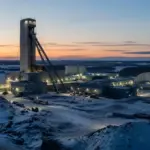
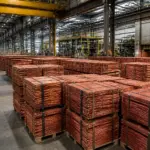
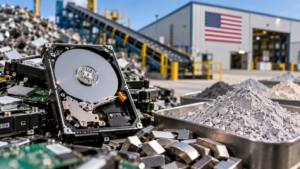
Salton Sea geothermal infrastructure and lithium development landscape in California’s Imperial Valley.

By Charles Pitts
The latest lithium price forecast 2026 is being shaped by a supply question that extends beyond mines, refineries and battery demand: which projects can secure permits, water and community acceptance?
That question has become more urgent in California’s Lithium Valley. A state appeals court has sent the environmental review for Controlled Thermal Resources’ Hell’s Kitchen lithium and geothermal project back to Imperial County, finding that the record did not adequately demonstrate a reliable long-term water supply or address how industrial water use could affect air quality around the shrinking Salton Sea.
The ruling does not end lithium development in the region. It does, however, make the timing of new U.S. supply less certain. For a market moving from surplus toward balance, delays at large projects could support prices even as producers elsewhere expand.
More Read

Lithium price forecast 2026: a wide market range
Lithium carbonate prices have recovered from the lows of the previous cycle, but forecasts remain unusually dispersed. Recent analyst views range from continued oversupply at below $10,000 per tonne to a tight-market outcome approaching $30,000 per tonne.

Fastmarkets has raised its 2026 lithium carbonate forecast to approximately $23,800 per tonne, citing stronger demand from energy storage and slower supply growth. BMI has also moved its forecast higher, with recent estimates around $20,100 per tonne for lithium carbonate and $19,600 per tonne for lithium hydroxide.
More cautious projections remain. A Reuters survey summarized by market sources placed the potential 2026 range at roughly 80,000 to 200,000 yuan per tonne, reflecting uncertainty over project ramp-ups, electric vehicle demand and stationary storage.
More Read

Goldman Sachs, by contrast, has maintained a much more bearish view, with a forecast near $8,900 per tonne based on the expectation that new supply will continue to outpace consumption.
The disagreement is therefore less about whether lithium demand will grow than about how quickly new capacity can be delivered.
2026 lithium carbonate scenario framework
The following framework is designed for operators, investors and procurement teams assessing exposure to battery-grade lithium carbonate. It is an analytical range, not a consensus price target.
| Scenario | 2026 market balance | Lithium carbonate range | Main assumptions |
|---|---|---|---|
| Bear | Surplus of 80,000–120,000 tonnes LCE | $12,000–$17,000/t | Smooth project ramp-ups, slower EV growth, rapid DLE progress and aggressive supply expansion |
| Base | Balanced to mild deficit, from a 22,000-tonne deficit to a 20,000-tonne surplus | $18,000–$25,000/t | Continued EV adoption, strong battery storage demand and mixed project execution |
| Bull | Deficit of 50,000–80,000 tonnes LCE | $26,000–$32,000/t | Delays at major greenfield projects, rapid grid-storage growth, restocking and limited new supply |
The base case remains the most useful planning range because it accommodates both a modest surplus and a modest deficit. It also reflects the market’s current sensitivity to operational news: a single large project delay may not create a global shortage, but several delays can quickly remove the buffer between balance and deficit.
For additional context, Skillings’ earlier lithium market analysis placed the market’s central range between $18,000 and $25,000 per tonne, with energy storage emerging as a significant source of incremental demand.
Why Lithium Valley matters to the U.S. supply outlook
The Salton Sea region is not a conventional lithium mining district. Developers aim to extract lithium from hot geothermal brines brought to the surface during power generation. In the proposed closed-loop model, brine would be processed for lithium and other minerals before being reinjected underground.

Industrial brine-processing infrastructure representative of direct lithium extraction facilities.
Controlled Thermal Resources says each Hell’s Kitchen stage could produce approximately 25,000 tonnes of lithium hydroxide monohydrate and 50 megawatts of geothermal power. Its longer-term plan describes seven stages, representing up to 175,000 tonnes of lithium capacity and 350 megawatts of power.
The wider Salton Sea resource is potentially larger. A Lawrence Berkeley National Laboratory assessment estimated that the region contains enough lithium resource to support hundreds of millions of electric vehicle batteries, although resource size is not the same as economically recoverable production.
That distinction is central to the U.S. outlook.
The United States remains a small lithium producer relative to Australia, Chile, Argentina, China and emerging African suppliers. New domestic projects could improve regional supply security, reduce reliance on imported chemicals and support battery manufacturing. But unless Salton Sea projects move from demonstration and permitting into sustained commercial production, they are unlikely to materially change global supply balances in 2026.
For the price market, the immediate significance of Lithium Valley is therefore not the tonnes it will produce this year. It is the tonnes that may be delayed beyond the market’s planning horizon.
The legal dispute turns on water, not only lithium
The Hell’s Kitchen litigation was brought by Comité Civico del Valle and Earthworks. The groups argued that Imperial County’s environmental impact review did not adequately address water use, air quality, hazardous materials and tribal cultural resources.
A lower court initially rejected the challenge, allowing the project to proceed. The appellate court later reversed parts of that decision and ordered further work on the environmental review.
According to the California appellate opinion and reporting by CalMatters, the court found insufficient evidence that the Imperial Irrigation District could supply the project for its expected operating life. The decision also faulted the review for failing to adequately consider future Colorado River allocation cuts.
That matters because Imperial County depends heavily on the Colorado River for freshwater. Agriculture is the dominant water user, while the Salton Sea itself is shrinking as inflows decline. Exposed lakebed can carry contaminants as airborne dust, creating additional public-health concerns in nearby communities.
The legal question is consequently broader than whether Hell’s Kitchen can obtain water for its processing equipment. Regulators must also assess how future water constraints could affect the lake, air quality and other users over the life of the project.

The Salton Sea and Imperial Valley industrial corridor, where water availability is central to project approvals.
Environmental groups say the decision validates concerns that long-term water assumptions were not supported by sufficient evidence. Imperial County and the developer have defended the project’s potential economic and energy benefits, while county officials review the ruling and consider next steps.
The practical result is a less certain permitting pathway. Even if the environmental documents are revised and approved, financing, construction and technology scale-up remain separate milestones.
What the delay means for the global market
Hell’s Kitchen was never expected to supply a substantial share of global lithium in 2026. Its initial proposed output would be meaningful for a U.S. project, but small relative to global demand approaching 1.5 million tonnes of lithium carbonate equivalent.
The impact is more important at the margin.
Recent industry estimates put 2026 global supply near 1.58 million tonnes LCE and demand between approximately 1.48 million and 1.55 million tonnes LCE. Those figures imply a narrow surplus, balance or deficit depending on the assumptions used.
A project delay removes one expected source of future supply. If Australia, South America, China and Africa deliver planned expansions smoothly, the market may still remain adequately supplied. If other projects experience permitting, financing or technical problems, the lost capacity becomes more consequential.
This is why U.S. legal risk belongs in a global lithium price model. It does not determine the benchmark price on its own, but it changes the probability of the market reaching the bear-case surplus.
The opportunity for U.S. lithium miners
For U.S. operators, the legal setback is also a competitive signal. Domestic projects may command strategic value because automakers, battery manufacturers and policymakers want supply chains that are less exposed to geopolitical disruption.
But strategic importance cannot replace project fundamentals.
Developers will need to demonstrate:
- A credible water supply under long-term Colorado River constraints.
- Permits that withstand judicial review.
- Commercially proven extraction performance.
- Clear management of hazardous materials and process waste.
- Credible air-quality and community-impact mitigation.
- Financing that can withstand construction delays and price volatility.
Projects that can meet those requirements may benefit from domestic offtake demand and policy support. Projects that rely on optimistic assumptions about water, technology or timing may struggle even in a higher-price environment.
The Skillings analysis of lithium extraction innovation examines why direct lithium extraction could reduce land requirements and processing times, while also highlighting the challenge of moving from pilot-scale performance to reliable commercial operations.
Outlook: higher prices, but permits set the pace
The most defensible lithium price forecast 2026 remains a base range of approximately $18,000 to $25,000 per tonne for battery-grade lithium carbonate, with upside toward $30,000 if demand accelerates and project delays multiply.
The downside case has not disappeared. A smooth supply response, weak macroeconomic growth or slower battery demand could still push prices toward the low-to-mid teens or below.
What has changed is the market’s understanding of supply risk. Lithium Valley was promoted as a major domestic answer to U.S. critical-minerals dependence. The legal challenge shows that large-scale supply must clear a more demanding test: not only whether lithium exists underground, but whether water, air-quality and community impacts are fully addressed above ground.
For operators and investors, the key indicators are now project-specific:
- Revised environmental review: Does it quantify water availability under realistic Colorado River scenarios?
- Construction evidence: Has the project moved beyond announcements into financed, permitted execution?
- Technology performance: Can DLE produce battery-grade material consistently at commercial scale?
- Market balance: Are energy-storage demand and EV growth absorbing new supply faster than producers can add it?
Until those questions are answered, Hell’s Kitchen is more likely to influence the 2026 lithium market through delayed supply expectations than through actual production.