Adjacent copper operations and shared infrastructure are becoming strategic assets as miners compete for scale, supply and processing capacity.

By Charles Pitts
Copper is moving from being one commodity in a diversified mining portfolio to the central organizing principle of industry strategy. The proposed Anglo American-Teck merger, First Quantum Minerals’ renewed commitment to Taca Taca in Argentina and Glencore’s potential partnership around its Democratic Republic of Congo copper-cobalt assets all point to the same conclusion: future supply is becoming valuable long before a mine reaches production.
The trend extends beyond copper. Energy Fuels’ completed acquisition of Australian Strategic Materials (ASM) links rare earth processing, metals and alloy production across several jurisdictions. Boliden’s agreed takeover of a controlling stake in Nexa Resources expands a European base-metals group into Latin American zinc and silver.
Together, the transactions show how mining M&A is evolving. Buyers are not simply purchasing tonnes in the ground. They are competing for long-life assets, processing capacity, infrastructure, permitting positions, offtake rights and exposure to critical minerals.
More Read

The consolidation case is built on scarcity
The latest M&A cycle is being driven by a widening gap between projected demand and the pace of new mine development. Electrification, grid expansion, data centers, defense procurement and industrial investment are increasing the strategic importance of copper, while permitting, construction and infrastructure constraints make new supply difficult to deliver.

Recent analysis from S&P Global Market Intelligence identified approximately $52.7 billion in qualifying mining M&A across 50 deals, with copper-focused transactions accounting for about $30.8 billion. The figures are heavily influenced by the Anglo-Teck combination, but that concentration is itself significant: a small number of large transactions are reshaping the sector’s competitive benchmarks.
For operators and investors, the implication is that valuation is increasingly tied to strategic position rather than current production alone. A permitted expansion near existing infrastructure, a processing plant that can accept third-party feed or a project located in a politically aligned jurisdiction can command a premium even before construction begins.
More Read

Anglo-Teck sets the scale benchmark
The proposed merger of Anglo American and Teck Resources remains the defining transaction in the current copper consolidation cycle. The all-share combination is valued at approximately $53 billion and is expected to create a company with more than 70% exposure to copper and annual production of roughly 1.35 million tonnes.
The companies are still awaiting final regulatory approval in China. They have said the transaction is expected to close within the previously announced window of September 2026 to March 2027. Shareholder and Canadian federal approvals have been secured, while integration planning has advanced through the appointment of a future executive leadership team, according to Anglo American.
The industrial logic is concentrated in Chile, where Teck’s Quebrada Blanca and Anglo American’s Collahuasi are adjacent or complementary assets. The companies estimate approximately $800 million in annual pre-tax recurring synergies by the end of the fourth year after completion. They also identify potential average annual EBITDA synergies of $1.4 billion from 2030 to 2049 through operational integration and optimization of the two copper operations.
Those estimates are not guaranteed outcomes. They depend on regulatory approvals, partner cooperation, execution and the ability to combine infrastructure and mine plans without disrupting production. Still, the proposed combination illustrates what buyers are willing to pay for: established assets, a large copper pipeline and the possibility of creating a regional operating district rather than managing isolated mines.
The deal also raises the competitive threshold for other producers. A larger Anglo-Teck would have greater purchasing power, technical capacity and balance-sheet flexibility to pursue development projects. That could encourage peers to seek their own scale transactions, but it could also increase competition for a limited pool of high-quality copper assets.

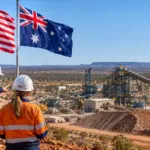
Large-scale infrastructure is increasingly part of the valuation case for copper assets.
First Quantum keeps Taca Taca in the competition
First Quantum’s Taca Taca project in Salta province, Argentina, shows how a major undeveloped asset can become strategically important even while its owner continues to assess financing and permitting.
The company’s 2026 NI 43-101 technical report outlines approximately $4.23 billion in initial development capital for a 40 million-tonne-per-year operation. A planned expansion to 60 million tonnes per year would require an additional $1.02 billion, bringing total development capital to approximately $5.25 billion.
The project is designed for a 35-year mine life and is expected to produce average annual copper of 291,000 tonnes during its first 10 years, with peak output of 323,000 tonnes. First Quantum reports an after-tax net present value of $5.92 billion at an 8% discount rate, based on a copper price assumption of $4.50 per pound, alongside an after-tax internal rate of return of 19.3%.
The numbers underline both the opportunity and the risk. The project’s NPV is highly sensitive to copper: a 10% change in the base copper price assumption changes NPV by approximately $1.47 billion, or 25%. The capital requirement is also substantial, and the company has said it will evaluate the sanction decision in light of its financing plan, balance sheet and other operations.
That makes Taca Taca more than a development project. It is a potential partnership, minority-sale or acquisition platform for companies seeking long-life copper exposure without starting at the exploration stage. First Quantum’s decision to retain, finance or share ownership of the project will influence the next phase of copper M&A.
Glencore adds a geopolitical dimension
Glencore’s proposed transaction with the U.S.-backed Orion Critical Mineral Consortium shows how strategic supply considerations are changing the structure of mining deals.
Under the nonbinding memorandum of understanding, Orion could acquire a 40% stake in Glencore’s interests in Mutanda Mining and Kamoto Copper Company, or KCC. The proposal implies a combined enterprise value of approximately $9 billion, while Glencore would retain operational control. Orion would also gain rights to appoint nonexecutive directors and direct the sale of its share of production to nominated buyers.
According to Glencore’s announcement, the two assets produced a combined 247.8 kilotonnes of copper and 33.5 kilotonnes of contained cobalt in 2025.
The proposed structure combines equity investment, offtake security and government-backed critical-minerals policy. It also gives Glencore a way to monetize part of the value of its DRC portfolio while maintaining operational control and exposure to future expansion.
For valuation purposes, the transaction signals that strategic buyers may pay for more than reserves and operating cash flow. Access to copper and cobalt from a major producing region, alignment with U.S. supply-chain policy and the ability to build a broader African Copperbelt platform all contribute to the asset’s strategic value.
The risks remain material. The transaction is subject to due diligence, binding documentation and regulatory approvals. DRC fiscal policy, export rules, infrastructure, community relations and permitting will continue to influence the value of the assets.

Producing copper-cobalt assets are attracting strategic capital because they combine immediate output with supply-chain relevance.
Rare earths and zinc show the broader pattern
Energy Fuels’ acquisition of ASM demonstrates that consolidation is also moving downstream. The completed transaction valued ASM’s equity at approximately A$447 million, or about US$300 million. ASM shareholders received Energy Fuels shares and a special dividend of up to A$0.13 per ASM share, implying approximately A$1.60 per ASM share under the agreed terms.
The acquisition combines Energy Fuels’ White Mesa Mill in Utah with ASM’s Korean Metals Plant and the Dubbo rare earths and critical minerals project in Australia. The Korean facility has approximately 1,300 tonnes per year of NdFeB alloy capacity, with an expansion to 3,600 tonnes per year planned.
The strategic objective is vertical integration: connecting feedstock and oxide separation with metals and magnet-alloy production outside China. As Energy Fuels said in its completion announcement, the combined platform is intended to span the mine-to-metal and alloy chain.
Boliden’s agreed acquisition of Votorantim’s 64.68% controlling stake in Nexa Resources applies a different model. The all-share transaction implies approximately $15.29 per Nexa share, about $1.31 billion in upfront consideration and a total Nexa equity value of approximately $2.03 billion. The implied enterprise value is about $3.67 billion.
Boliden will issue 0.250 shares for each Nexa share transferred. A subsequent cash tender offer for minority shareholders is expected to use the same exchange ratio and Boliden’s share price before closing. The transaction is expected to close in the first quarter of 2027, subject to approvals.
Nexa would expand Boliden’s zinc and silver exposure and add operations in Brazil and Peru. The deal also creates potential smelting, marketing and geographic-diversification benefits, although it exposes Boliden to new jurisdictional, operational and integration risks.
Mining M&A deals: what the transactions signal
| Transaction | Primary commodity | Structure | Strategic asset | Main valuation question |
|---|---|---|---|---|
| Anglo American-Teck | Copper | Proposed all-share merger | Chilean copper scale and growth pipeline | Can integration deliver projected synergies? |
| First Quantum-Taca Taca | Copper, gold, molybdenum | 100%-owned development project | 35-year resource and expansion capacity | Who funds approximately $5.25 billion of development capital? |
| Glencore-Orion | Copper, cobalt | Proposed 40% strategic stake | Producing DRC assets and offtake rights | How should geopolitical access be priced? |
| Energy Fuels-ASM | Rare earths | Completed acquisition | Mine-to-metal and alloy chain | Can vertical integration capture downstream value? |
| Boliden-Nexa | Zinc, silver | Controlling stake acquisition | Latin American mines and processing footprint | Will scale offset integration and jurisdictional risk? |
The common thread is asset competition. Mining companies are seeking copper growth, but they are also buying optionality across processing, infrastructure, jurisdiction and supply chains. That makes headline transaction value an incomplete measure of strategic worth.
For decision-makers, the most important metrics will be execution-related: capital intensity, permitting progress, partner alignment, production reliability, realized metal prices and the ability to convert geological resources into saleable products.
The next phase of consolidation may therefore involve fewer transformational mergers and more targeted stakes, joint ventures, offtake agreements and processing combinations. The companies that control the most difficult bottlenecks : especially copper capacity and non-Chinese critical-minerals processing : are likely to remain at the center of the market.
Related Skillings analysis: Copper records M&A, sequencing and streaming discipline and Royalty and streaming deals: why they reshape mining finance.