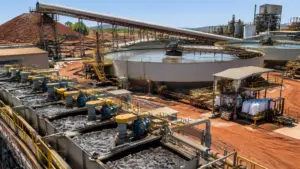
Africa holds more than a quarter of the world’s known critical-mineral reserves, according to McKinsey. The continent has particularly large deposits of platinum-group metals, tantalum, cobalt and chromium, along with significant shares of manganese, graphite and copper.

The United Nations Office of the Special Adviser on Africa puts Africa’s share at about 30% of global reserves of critical energy-transition minerals, including cobalt, copper, graphite, lithium, manganese, nickel, platinum-group metals and rare earth elements.
Yet geological wealth has not translated into an equivalent position in global processing, manufacturing or investment.
That gap is central to Africa’s critical-minerals challenge. The continent has resources that are increasingly important to energy and technology supply chains. But turning those resources into sustained economic value requires much more than mining.
It requires exploration, infrastructure, capital, processing capacity, skills and access to markets.
More Read
Africa Has the Resources. Exploration Still Lags
Africa’s mineral endowment is substantial.

More than 60% of the world’s platinum-group metal, tantalum, cobalt and chromium reserves are located on the continent, according to McKinsey. Africa also holds about 37% of global manganese reserves, 25% of graphite reserves and 10% of copper reserves.
The UN identifies the DRC’s cobalt, Zambia’s copper, Zimbabwe’s lithium and South Africa’s platinum-group metals and manganese as important parts of the regional mineral base.
More Read
But Africa’s resource picture is still incomplete.
McKinsey estimates that annual exploration spending in Africa averaged about $1.2 billion over the past five years, compared with $2 billion in Australia and $2.2 billion in Canada. The lower level of exploration may help explain why some minerals remain relatively underrepresented in Africa’s known reserves.
That creates an important distinction between known reserves and geological potential.
Africa may hold significant resources that have not yet been fully identified or evaluated. But discovering them requires sustained exploration capital, geological data and projects capable of attracting further investment.
The DRC Shows Why Processing Matters
The DRC illustrates the difference between producing a mineral and capturing value from it.
The country is a major source of cobalt and also has substantial copper resources. But the economic opportunity extends beyond mine output.
The UN cites the DRC as an example of the potential from local processing. It reports that the value of the country’s cobalt increased almost threefold through local processing, with processed cobalt exports reaching $6 billion in 2022 compared with $167 million for unprocessed cobalt.
Those figures illustrate the potential value of moving further along the supply chain. They do not mean that processing alone explains the entire difference in export value.
That distinction matters.
Processing can allow producing countries to retain a greater share of mineral value, but it also requires capital, energy, technical expertise and access to customers.
Infrastructure Can Determine Project Economics
This is where Africa’s critical-minerals opportunity becomes a mining-finance issue.
A deposit does not become a mine simply because its geology is attractive.
Projects need roads, railways, ports, electricity, water and other supporting infrastructure. Processing facilities add further requirements, particularly for reliable and affordable power.
McKinsey estimates that nearly 40% of Africa’s key mineral producers are landlocked. Many therefore depend on long and costly transport routes to ports, including rail systems with limited capacity. The firm also identifies infrastructure, logistics and operating inefficiencies as factors that increase costs for African mines compared with global peers with similar ore quality.
For investors, those costs affect project economics.
A deposit may contain high-grade ore, but the investment case also depends on how much capital is needed to develop the mine, connect it to infrastructure and transport its output to market.
Capital Is Not Reaching Every Deposit
The financing gap is visible in Africa’s critical-minerals project pipeline.
McKinsey’s MineSpans data identifies a $9 billion critical-minerals project pipeline across Africa. Less than 10% has secured financing or progressed to construction and feasibility stages, according to the firm. Investment is concentrated in a relatively small number of large, tier-one assets that can absorb risk and offer scale.
This creates a difference between mineral potential and investable supply.
Large deposits can attract capital because their scale can help offset development risks. Mid-tier deposits may struggle to secure funding even when their grades are attractive if infrastructure, regulatory, financing or execution risks reduce expected returns.
The result is that Africa’s mineral endowment can be much larger than the pipeline of projects capable of reaching production.
Regional Infrastructure Could Change the Equation
One response is to develop mining assets as part of regional infrastructure and processing networks rather than treating every project as a standalone operation.
McKinsey argues that clustering nearby mining operations and sharing infrastructure can spread costs and create more investable regional ecosystems. Its analysis indicates that integrating investments and sharing infrastructure such as ports and processing plants could increase ore production volumes by up to 5% and reduce unit production costs by about 20%.
The Lobito Corridor illustrates the principle.
The corridor links mineral-producing areas of the DRC and Zambia with Angola’s Atlantic port. For mining companies, infrastructure of this kind can provide an additional route to international markets while supporting wider regional trade.
The significance extends beyond transport.
Shared infrastructure can reduce the amount of capital that individual projects need to carry on their own. That can affect the economics of deposits that might otherwise struggle to attract financing.
Processing Requires Power, Skills and Investment
Moving further downstream presents another challenge.
Smelters, refineries, chemical plants and manufacturing facilities require reliable energy, technical skills, financing and access to markets. Building one facility does not automatically create a competitive industrial ecosystem.
The UN has highlighted the employment gap in Southern Africa. Minerals account for about 10% of SADC’s GDP, 25% of its exports and 20% of government revenues, but the sector accounts for only about 7% of direct employment. The UN argues that processing, manufacturing and technology development could create broader economic benefits.
There are also potential cost advantages in some downstream activities.
A 2021 BloombergNEF study commissioned by the Economic Commission for Africa and partners estimated that a 10,000-tonne battery-precursor plant in the DRC could cost about $39 million, roughly one-third of the estimated cost of a comparable facility in the United States.
The figure demonstrates potential cost competitiveness. It does not establish that every African processing project would be commercially viable.
India-Africa Cooperation Is a Proposal, Not Yet a Framework
India is also part of the wider discussion around African mineral value chains.
A Vivekananda International Foundation analysis has argued that Indian companies could explore mining and metal-processing opportunities in the SADC region, including energy minerals and base metals such as copper, aluminium, nickel and cobalt.
That should be treated as a policy and business proposal, not as evidence of an established India-Africa critical-minerals framework.
The potential significance for African producers would depend on what future partnerships bring to the value chain. Investment in processing, technology, infrastructure and skills would have a different economic effect from arrangements focused primarily on securing raw-material supply.
Any such development would require specific commercial projects or government agreements.
Reserves Are Only the Starting Point
Africa’s critical-mineral endowment gives the continent a strategically important position in global supply chains. But reserves alone do not create mines, processing industries or manufacturing capacity.
The gap between geological wealth and economic value is shaped by exploration spending, infrastructure, project financing, power, skills, regulation and market access.
That makes Africa’s critical-minerals opportunity a capital-allocation and industrial-development challenge as much as a geological one.
The continent does not necessarily need to process every mineral or manufacture every final product domestically. But greater participation in commercially viable stages of the value chain could allow producing countries to retain more economic activity from their resources.
For Africa, the critical question is therefore not simply how much mineral wealth lies underground.
It is how much investable, productive and higher-value activity can be built around that wealth above ground.