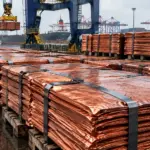
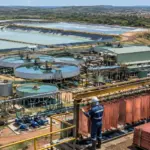
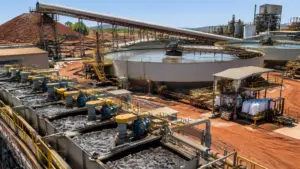
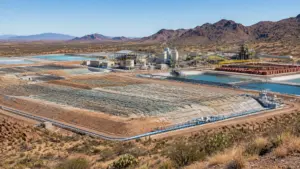
Brazilian ferronickel processing infrastructure similar to the assets involved in MMG’s proposed acquisition of Anglo American’s nickel business.

By Charles Pitts
The European Commission has issued a formal statement of objections to MMG over its proposed acquisition of Anglo American’s Brazilian nickel business, warning that the transaction could restrict European access to low-carbon ferronickel and raise costs for stainless steel producers.
The Sept. 16 action is a significant escalation in the Commission’s review, but it does not mean the deal has been blocked. MMG now has until Nov. 30, 2026, to respond to the concerns and offer remedies, according to Reuters reporting and European Commission documents.
The case places a Brazilian mining transaction worth up to $500 million at the intersection of merger control, critical minerals policy and Europe’s effort to protect industrial supply chains from potential geopolitical disruption.
More Read

Commission raises ferronickel supply concerns
The Commission’s objections center on the market for low-carbon ferronickel, an alloying material used by stainless steel producers to add nickel, strength and corrosion resistance.

The regulator’s preliminary view is that the Brazilian assets hold substantial market power in a concentrated supply market where European customers have limited alternatives. Following a change in ownership, the Commission said MMG could have an incentive to redirect some ferronickel away from European buyers and toward affiliated stainless steel producers in China.
That possibility could leave European stainless steel manufacturers facing higher input costs, reduced supply security or less favorable product quality. The Commission has also raised concerns about the effect on the ability of European producers to compete in domestic and global markets.

The concerns are preliminary. A statement of objections sets out the regulator’s case and gives the company an opportunity to respond. It is not a final finding that the transaction violates European Union merger rules.
Reuters reported the Commission’s antitrust warning on Sept. 16.

The proposed transaction includes operating ferronickel assets and development projects in Brazil.
What MMG agreed to buy
MMG agreed in February 2025 to acquire Anglo American’s Brazilian nickel business for an aggregate consideration of up to $500 million. The package includes $350 million in upfront cash and up to $150 million in contingent payments linked to nickel prices and development decisions.
The business includes the Barro Alto and Codemin ferronickel operations, along with the Jacaré and Morro Sem Boné development projects. MMG said at the time that the operating assets produced about 40,000 tonnes of nickel a year in ferronickel.
The company described the acquisition as a way to expand its geographic footprint, diversify its base-metals portfolio and enter Brazil. It also highlighted the assets’ position on the lower end of the nickel cost curve and their use of electricity sourced from renewable generation.
MMG is listed in Hong Kong and majority-owned by China Minmetals, a Chinese state-owned company. That ownership structure has become central to the European review, even though the assets themselves are located in Brazil.
The MMG transaction announcement said completion was subject to competition and other regulatory clearances.
Why ferronickel matters to European steelmakers
Ferronickel is primarily used in stainless steel production, which accounts for a large share of global nickel demand. Stainless steel typically contains between 8% and 10% nickel, according to MMG, although the exact composition varies by grade and application.
For European producers, the issue is not simply the volume of nickel available globally. It is whether suitable material can reach mills at competitive prices, with consistent quality and sufficient reliability.
The Commission’s earlier Phase II investigation identified the Brazilian assets as an important source of low-carbon ferronickel for European customers. It said alternative suppliers were limited and that a diversion of supply could affect both production costs and the competitiveness of European stainless steel.
In its November 2025 investigation notice, the Commission said the target business included two operating ferronickel facilities and two greenfield projects. It also said the proposed acquisition could give MMG the ability to favor downstream group activities over European customers.
The issue reflects a broader shift in how governments assess mining transactions. A deal can now face scrutiny not only because of traditional measures such as market share and pricing power, but also because of ownership, supply-chain resilience and the strategic importance of the commodity.
Skillings has previously examined how midstream refining constraints are becoming a wider critical minerals risk. The MMG case illustrates how those concerns can move directly into merger reviews.
MMG proposes long-term supply commitments
MMG has indicated that it is willing to guarantee long-term ferronickel supplies to European customers as part of its effort to secure approval.
Troy Hey, MMG’s executive general manager of corporate relations, told Reuters that the company was prepared to do what was necessary to support the European market while investing in and expanding the Brazilian operations.
The proposal is expected to focus on supply commitments rather than a change in ownership. In remarks reported by Mining Weekly, Hey said MMG wanted European customers to be in as good or better a position than they had been under Anglo American.
The Commission has historically treated long-term supply guarantees as behavioral remedies because they govern how a company operates after a transaction. Such commitments can be difficult to monitor and enforce over many years, particularly when market conditions, production levels or customer demand change.
A structural remedy, such as selling a minority stake or separating part of the business, could address the regulator’s concerns more directly. MMG has argued that such a solution could limit its ability to invest quickly in the Brazilian operations and develop the two greenfield projects.
The Commission will assess whether any proposed commitments are sufficiently specific, enforceable and durable to address the risks identified in the statement of objections.
Key facts in the regulatory review
| Issue | Details |
|---|---|
| Buyer | MMG, majority-owned by China Minmetals |
| Seller | Anglo American |
| Assets | Barro Alto, Codemin, Jacaré and Morro Sem Boné in Brazil |
| Transaction value | Up to $500 million |
| Product at issue | Low-carbon ferronickel |
| Main concern | Potential diversion of supply from European buyers |
| Proposed remedy | Long-term ferronickel supply commitments |
| Current status | Statement of objections issued; no final prohibition |
| Remedy timetable | MMG has until Nov. 30, 2026, to offer remedies |
What happens next
MMG can respond to the Commission’s objections in writing and request an oral hearing. It can also submit revised commitments aimed at maintaining access for European customers.
The Commission will then decide whether the proposed remedies address its concerns. Possible outcomes include clearance, conditional clearance with binding commitments or prohibition if the regulator concludes that competition risks cannot be resolved.
The statement of objections does not predetermine the final decision. It does, however, show that the review has moved beyond an initial assessment and that the Commission considers the potential supply risk material enough to require formal action.
For MMG, the timetable creates pressure to demonstrate that it can control the Brazilian assets without weakening European supply. For Anglo American, the delay extends the uncertainty surrounding the divestment of a business it agreed to sell as part of a broader portfolio reshaping.
For European stainless steel producers, the case highlights the limited number of suppliers able to provide low-carbon ferronickel at scale. It also shows how ownership links and downstream relationships are becoming central considerations in transactions involving nickel and other critical minerals.
The final decision is expected by Nov. 30, 2026. Until then, the acquisition remains under review and the Brazilian nickel business remains subject to the existing regulatory conditions attached to the transaction.

Ferronickel is a key nickel-bearing input for stainless steel manufacturing.