By Penny Langford

The global copper market is entering a transformative phase as the rapid expansion of artificial intelligence (AI) data centers collides with long-standing mining supply constraints. By 2026, this intersection is projected to create a structural supply deficit that could reshape commodity valuations and industrial strategy. While the energy transition: driven by electric vehicles (EVs) and renewable energy: has been the primary narrative for copper demand, AI workloads are emerging as a powerful, secondary "black swan" driver that requires significantly more copper than traditional cloud computing.
Market analysts now project that the shift toward gigawatt-scale AI campuses will require hundreds of thousands of additional tonnes of copper annually. Combined with production disruptions at major mining operations, the industry is bracing for a multi-year supply shock.
The Gigawatt-Scale Reality of AI Power
Traditional data centers have long been staples of the copper market, but AI-specific facilities operate on a different scale of energy density. A standard hyperscale data center might draw between 20 MW and 50 MW of power. In contrast, the next generation of AI-focused campuses being planned for 2026 and beyond are targeting capacities of 100 MW to 1 GW.
This escalation is driven by the extreme power requirements of AI chips, such as the NVIDIA H100 and Blackwell architectures. These processors require massive power delivery systems and cooling infrastructure, both of which are copper-intensive. In 2026, global data center electricity demand is expected to reach a critical juncture where grid capacity becomes the primary bottleneck for AI growth.
More Read

Table 1: Estimated Global Data Center Copper Demand (2025–2026)

| Metric | 2025 Forecast | 2026 Forecast |
|---|---|---|
| Total Data Center Copper Demand | 1.1 Million Tonnes | ~1.3 Million Tonnes |
| Incremental AI-Driven Demand | 0.25 Million Tonnes | 0.475 Million Tonnes |
| Average Global Supply Deficit | 0.1 Million Tonnes | 0.3 – 0.6 Million Tonnes |
| Global Mine Supply Growth | 0.8% | 1.3% |
Sources: J.P. Morgan, Morgan Stanley, S&P Global, Goldman Sachs.
Quantifying Copper Intensity: Why AI is Different
The copper intensity of a data center is often measured in tonnes of copper per megawatt (t/MW) of power capacity. For the electrical infrastructure alone: including busbars, switchgear, transformers, and power cables: AI facilities require approximately 20 to 40 t/MW.
More Read


An ultra-class mining haul truck operating at an open-pit mine site.
When accounting for the entire facility: including servers, high-speed networking cables, and massive cooling systems: the intensity can surge to between 60 and 300 t/MW. Hyperscale AI campuses designed for GPU clusters are particularly metal-heavy. For example, a single 500 MW AI campus could effectively lock up 30,000 to 50,000 tonnes of copper in its construction and hardware.
The 2026 Supply Gap: A Convergence of Risks
As demand accelerates, the supply side of the copper market is facing significant headwinds. Goldman Sachs recently downgraded its global mine supply growth forecast for 2026 to just 1.3%. This stagnation is the result of several factors that are coming to a head simultaneously.
- Operational Disruptions: Major assets like the Grasberg complex in Indonesia, operated by Freeport-McMoRan (FCX), have faced technical and logistical challenges that have removed hundreds of thousands of tonnes from near-term supply projections.
- Declining Ore Grades: At legacy mines owned by BHP and Rio Tinto, the percentage of copper per tonne of moved earth is steadily falling. This requires more energy and higher capital expenditure just to maintain flat production levels.
- Permitting and Lead Times: The average time to bring a new "greenfield" copper mine from discovery to production now exceeds 15 years. This ensures that the supply response to the 2026 demand spike will have to come from existing brownfield expansions rather than new discoveries.

Underground mining operations featuring a heavy-duty drill jumbo at the rock face.
For a deeper dive into the specific assets affected, see our analysis on the copper deficit 2026 and stocks to watch.
Strategic Outlook: BHP, Freeport, and Rio Tinto
The major diversified miners are positioning themselves as the ultimate beneficiaries of this supply-demand mismatch. In 2026, the revenue mix for companies like BHP and Rio Tinto is expected to pivot further toward copper, as iron ore faces volatility and copper prices remain supported by the AI-energy nexus.
BHP CEO Mike Henry has noted that the structural challenges of grade decline and permitting delays will keep the copper market tight through the end of the decade. Similarly, Rio Tinto has reported double-digit increases in copper production as it ramps up the Oyu Tolgoi underground mine in Mongolia, specifically targeting the anticipated shortfall.

A massive industrial electrical transformer and substation components at a data center construction site.
For investors and operators, 2026 represents a year where the "copper-to-compute" ratio becomes a critical metric. As technology companies compete for limited grid power, the cost of the underlying physical infrastructure: led by copper: will play a larger role in the total cost of ownership (TCO) for AI data centers.
Conclusion: The Strategic Imperative
The multi-year copper supply shock of 2026 is no longer a theoretical projection; it is a mathematical certainty based on current project pipelines and the pace of AI adoption. With a projected deficit of up to 600,000 tonnes, the industry must navigate a landscape of elevated prices and supply chain fragility.
As the mining industry adapts to this new demand profile, the focus will shift toward efficiency and secondary supply (recycling). However, the scale of the AI build-out suggests that primary mine production will remain the bottleneck for the foreseeable future. Those who secure their copper supply chains now will be the ones who lead the AI revolution in 2026.
Stay updated on related commodity trends with our lithium price forecast 2026 and our ongoing coverage of base metal mining developments.

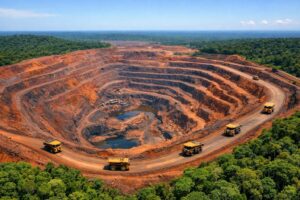
Large-scale open-pit mining operation at sunrise featuring haul trucks and electric shovels.