By Penny Langford
The industrial landscape of 2026 is being fundamentally rewritten by the convergence of two massive capital cycles: the expansion of generative AI and the revitalization of nuclear energy. As hyperscalers: the handful of tech giants dominating cloud and AI infrastructure: race to secure the compute power necessary for next-generation models, they have encountered a physical bottleneck that software cannot solve. That bottleneck is the power grid.
The “AI-Energy Nexus” is no longer a theoretical concept; it is a multi-billion dollar reality. Data centers, once seen as mere warehouses for servers, are now the primary drivers of industrial power demand. According to recent market analysis, global data center electricity consumption is projected to grow by 175% by 2030. To meet this demand while adhering to strict carbon-free energy (CFE) targets, Microsoft, Google, and Amazon are pivoting away from intermittent renewables like wind and solar and toward the only source of scalable, 24/7 baseload power: nuclear energy.
Specifically, the industry is betting on Small Modular Reactors (SMRs). This shift is transforming hyperscalers from simple power purchasers into active mining financiers and infrastructure developers, a move that is profoundly impacting the global mining sector and the uranium market outlook.
More Read

The 24/7 Carbon-Free Imperative
For the past decade, the tech sector was the world’s largest buyer of renewable energy certificates. However, the intermittent nature of solar and wind creates a mismatch with the 99.999% uptime required by AI data centers. When the sun sets or the wind dies down, these facilities must rely on the grid, which often burns natural gas or coal.

To solve this, hyperscalers are shifting their procurement strategy to “24/7 Carbon-Free Energy.” This means every megawatt-hour of electricity consumed must be matched by a megawatt-hour of carbon-free production on the same grid, at the same time. SMRs provide the solution. Unlike traditional large-scale reactors that take a decade or more to build, SMRs are designed to be manufactured in factories and shipped to the site, offering a modular, scalable approach that aligns with the rapid rollout of data center clusters.

More Read

The £2.6 Billion Push: Hyperscalers as Financiers
In early 2026, the industry witnessed a landmark development with the announcement of a £2.6 billion ($3.2 billion) strategic financing push led by a consortium of tech giants and government entities. This initiative is designed to de-risk the first commercial deployments of SMR technology in the UK and North America.
This isn’t just about buying electricity; it’s about direct equity investment in the upstream supply chain. Hyperscalers are increasingly acting as “mining financiers,” providing the off-take agreements and capital injections necessary for junior mining companies and nuclear tech startups to break ground. This trend is mirrored in recent uranium royalty mergers, where massive deals are being struck to consolidate the supply of fuel needed for these new reactors.
For the mining industry, this is a seismic shift. Traditionally, mining companies relied on bank debt and institutional investors. Today, a new class of “strategic investors” from the tech sector is entering the market, eager to secure long-term access to critical minerals like uranium, copper, and specialized cooling alloys.
Uranium: The Fuel of the Intelligence Age
The proliferation of SMRs has placed immense pressure on the uranium supply chain. With dozens of modular reactors planned for deployment over the next decade, the demand for high-assay low-enriched uranium (HALEU) is set to skyrocket.
As noted in our recent uranium price forecast for 2026, the supply gap is reaching a breaking point. Years of underinvestment in new mines, coupled with geopolitical instability in key producing regions, have left the market vulnerable. Hyperscalers are recognizing this risk and are moving to secure long-term supply directly from Tier-1 jurisdictions like Canada, the United States, and Australia.

In the United States, projects like UEC’s Burke Hollow are being closely watched as bellwethers for the industry’s ability to ramp up domestic production. These projects are no longer just speculative mining ventures; they are strategic assets in the global AI race.
The Infrastructure Convergence
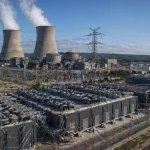
The AI-Energy Nexus also requires a massive overhaul of physical grid infrastructure. SMRs are unique because they can be co-located with data centers, significantly reducing the transmission losses associated with long-distance power lines. However, the complexity of these “power hubs” requires sophisticated engineering and massive amounts of industrial hardware.
From heavy-duty electrical transformers to advanced cooling systems, the scale of the required machinery is unprecedented. This is creating a secondary boom for equipment manufacturers and service providers in the resources sector. For instance, the demand for copper: essential for both the electrical grid and AI servers: is reaching new heights, leading to significant market shifts like the Peru copper shock reported earlier this year.

Regulatory Winds and Global Competition
While the financial and technical momentum behind the SMR-AI partnership is strong, regulatory hurdles remain. Permitting for nuclear sites, even for small reactors, is a complex process that varies wildly by jurisdiction. However, 2026 has seen a notable shift in policy.
The UK’s launch of its Advanced Nuclear Framework and the U.S. government’s streamlined permitting for HALEU production are clear signals that policymakers view the AI-Energy Nexus as a matter of national security. Governments are beginning to realize that the nation with the most efficient, carbon-free energy grid will likely lead the world in AI development.
This geopolitical competition is also driving a “sovereignty” movement in mining. As Western nations look to decouple their energy supply chains from rivals, the focus on domestic extraction and processing of critical minerals has intensified. Hyperscalers, with their global reach and deep pockets, are becoming key allies in this effort.
The Path Forward: 2026 and Beyond
The betting on SMRs by hyperscalers is not just a trend; it is the beginning of a new industrial era. The integration of nuclear power and data processing creates a virtuous cycle where cheap, reliable energy fuels the AI that, in turn, helps optimize the very power grid it relies on.
For operators, investors, and policymakers in the mining sector, the message is clear: the tech giants are no longer just customers of the digital economy; they are the new architects of the physical energy supply chain. The £2.6 billion push is likely just the opening salvo in a decade-long capital expenditure cycle that will redefine the boundaries of mining, energy, and technology.
As we move through the remainder of 2026, the focus will remain on the execution of these first-of-a-kind SMR projects. Success will depend on the mining industry’s ability to provide the raw materials: uranium, copper, and more: at the scale and speed required by the silicon valley titans. The AI-Energy Nexus is here, and it is powered by the earth’s most energy-dense minerals.
Market Snapshot: Uranium and Nuclear Indicators 2026
| Indicator | Current Status (April 2026) | 12-Month Trend |
|---|---|---|
| Uranium Spot Price | $112.50/lb | Up 18% |
| HALEU Production Capacity | Expanding (US/UK) | Accelerating |
| SMR Projects Under Construction | 14 Global | Up from 6 in 2024 |
| Hyperscaler Nuclear Investment | £3.8B Total (est.) | High |
| Copper LME Stocks | 165,000 tonnes | Declining |
Source: Skillings Mining Intelligence & Global Commodity Desk Reports