By Salini Krishnan

The hills of Greenbrier County, West Virginia, are traditionally synonymous with the "smokeless" metallurgical coal that once fueled the American steel industry. Today, those same hills are being repositioned as the epicenter of a new industrial offensive: the domestic recovery of Rare Earth Elements (REEs).
With a $150 million private investment led by Flash Metals USA and GreenMet, a new processing hub in Rupert is transforming millions of tons of coal waste into a strategic reserve. This project does more than just revitalize a local economy; it represents a tactical shift in the United States’ efforts to decouple its defense and energy sectors from Chinese mineral monopolies.
The $150 Million Pivot: From Tailings to Technology
For decades, coal tailings and slurry were viewed by operators as an environmental liability and a logistical bottleneck. However, the geology of the Appalachian Basin contains significant concentrations of critical minerals, including neodymium, praseodymium, and dysprosium: elements essential for high-strength permanent magnets, fighter jet components, and electric vehicle motors.
The Rupert hub is designed as a central node in a "hub-and-spoke" processing network. While it will initially consume the estimated 10 million tons of tailings at the Greenbrier Smokeless Coal Company site, its reach is intended to be global. According to project filings and public statements from partners like AmForge Corporation, the facility will process feedstocks not only from West Virginia but also from allied jurisdictions including Canada, Greenland, and Cameroon.
More Read

This $150 million investment is notably 100% privately funded. In an era where many critical mineral projects rely heavily on federal grants, the Flash Metals-led initiative signals a high level of commercial confidence in the scalability of domestic REE recovery.

Flash Joule Heating: The Recovery Breakthrough
The technical foundation of the West Virginia hub rests on "Flash Joule Heating" (FJH), a process originally developed at Rice University. Traditional REE extraction often involves labor-intensive chemical leaching and high environmental footprints. FJH offers a more surgical alternative.

More Read

The process involves passing a high-voltage pulse of electricity through the coal waste, rapidly heating the material to approximately 3,000 Kelvin (over 4,900°F) in milliseconds. This thermal shock vaporizes the host material and liberates the embedded minerals, which can then be separated and refined.
By utilizing this "army-grade" recovery method, the facility can achieve high yields from feedstocks that were previously considered too low-grade to be economically viable. This technology is a critical component of the U.S. strategy to match the cost-efficiencies of overseas competitors while maintaining stricter environmental standards.
Regional Revitalization and the Job Market
The economic impact on Greenbrier County is substantial. The project is expected to create 250 direct, high-skilled jobs once fully operational. For a region that has navigated the volatility of the coal markets for a century, the transition to critical minerals processing offers a sustainable industrial future.

"This isn't just about cleaning up the environment; it's about rebuilding an industrial base," says one local development official. The hub-and-spoke model also implies a multiplier effect for the regional economy. As "spoke" facilities across the state begin pre-processing waste for the Rupert hub, the logistics, maintenance, and auxiliary services sectors in West Virginia are expected to see a parallel uptick in demand.
National Security: Breaking the Monopoly
The geopolitical stakes of the Rupert hub cannot be overstated. Currently, China controls over 85% of the world’s rare earth processing capacity. This concentration of power has allowed Beijing to use mineral exports as a diplomatic lever, most notably during trade disputes.
By establishing a domestic processing center that can handle a variety of feedstocks, the U.S. is creating a "surge capacity" for critical minerals. The GreenMet-coordinated project has already secured offtake agreements for international materials, including manganese from Canada’s Woodstock project. This international collaboration ensures that the Rupert facility remains a high-volume, economically resilient anchor for the North American supply chain.
For a broader perspective on the global rare earth race, industry observers are tracking similar high-scale projects like Viridis Mining’s Colossus Upgrade and Meteoric Resources’ Caldeira, which are pushing the boundaries of ionic clay recovery in the Southern Hemisphere.
Market Snapshot: The Critical Minerals Landscape
As the Rupert hub moves toward full capacity, the broader market for critical minerals remains in a state of rapid evolution. Below is a look at the domestic production targets compared to current import reliance.
| Mineral Category | Current U.S. Import Reliance | Primary Use Case | Strategic Significance |
|---|---|---|---|
| Heavy Rare Earths | 100% | Defense Systems, Lasers | Extreme; China-dominated |
| Light Rare Earths | 75% | EV Motors, Wind Turbines | High; Domestic supply growing |
| Manganese | 100% | Steel, Battery Cathodes | Critical for infrastructure |
| Antimony | 82% | Munitions, Flame Retardants | High national security risk |
Data-Driven Operations: The Control Room
The sophistication of the Rupert facility is mirrored in its operational oversight. Unlike traditional coal processing, REE recovery requires real-time monitoring of thermal gradients, mineral concentrations, and environmental emissions.

The use of integrated data platforms allows operators to optimize the Flash Joule Heating cycles based on the specific mineralogy of the incoming feedstock. This level of precision is what enables the facility to process disparate materials: from Appalachian coal slurry to Greenlandic minerals: within the same industrial framework.
2026 Outlook: A New Standard for Domestic Mining
As we move into the latter half of 2026, the success of the West Virginia hub will serve as a litmus test for the "waste-to-wealth" movement in American mining. If Flash Metals USA can maintain the projected throughput and purity levels, the model will likely be replicated across other coal-producing regions in Pennsylvania, Kentucky, and Wyoming.
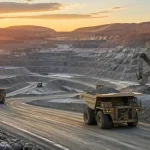
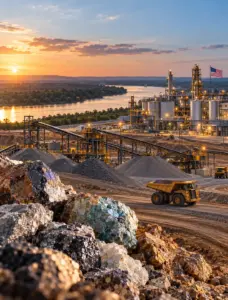
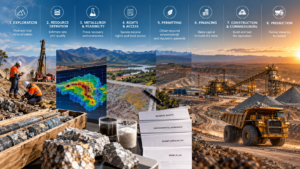
The integration of advanced logistics and ultra-class machinery is already visible on-site, illustrating the scale of the transition.

The Greenbrier County project is more than a local success story; it is a blueprint for how legacy industrial states can leverage their historical infrastructure to meet 21st-century strategic needs. By turning environmental liabilities into national security assets, West Virginia is anchoring the U.S. supply chain in a way that is both economically sound and geopolitically necessary.
Share this Insight:
- LinkedIn: West Virginia is no longer just "coal country": it's the new anchor for U.S. Rare Earth Element security. A $150M private investment in Greenbrier County is turning coal waste into critical defense assets. #RareEarths #Mining #SupplyChain #WestVirginia #NationalSecurity
- X (Twitter): BREAKING: The $150M Rupert REE Hub in WV is set to process millions of tons of coal waste into critical minerals. 250 jobs + breaking the China monopoly. #CriticalMinerals #FlashMetals #MiningNews