By Charles Pitts

The global landscape for strategic resources has shifted from a market-driven commodity cycle into a state-directed geopolitical race. As of July 2026, the consolidation of supply chains is no longer merely an industrial objective but a cornerstone of national defense and economic sovereignty. While the previous decade was defined by corporate M&A, the current era is characterized by the rise of “sovereign mining” units and multi-billion-dollar government interventions designed to secure the rare earths supply chain 2026.
In the first half of 2026, the tension between major powers reached a new inflection point. China, the dominant force in midstream processing, recorded a 6.4% decline in rare earth exports. This contraction is not necessarily a sign of weakening production, but rather a deliberate prioritization of domestic high-tech manufacturing and the systematic chokepoint management of heavy rare earth elements (REEs). For Western policymakers and investors searching for critical minerals stocks to buy 2026, the message is clear: the era of unencumbered global trade in strategic metals has ended.
China’s Sovereign Mining Strategy: The Rise of Guangyan International
Beijing has responded to Western “de-risking” efforts by centralizing its outbound investment apparatus. Under the direct supervision of the National Development and Reform Commission (NDRC), China has launched Guangyan International Investment (also known as Vast Rock International). This entity serves as a centralized “sovereign mining unit” designed to consolidate overseas critical minerals access.
With a registered capital of approximately 60 billion yuan (US$8.3 billion), Guangyan is not a typical state-owned enterprise. It functions as a strategic coordinator for giants like China Minmetals and Jinchuan Group, providing co-investment capital and compliance frameworks for high-stakes projects in Africa and Latin America. Since the early 2000s, Chinese firms have spent over $100 billion on outbound mineral M&A, but Guangyan represents a pivot toward deeper, state-integrated control.
More Read

The goal is to move beyond raw ore acquisition. Beijing is focusing on the specific chokepoints of separation, metallization, and magnet production. By tightening the grip on these midstream processes, China maintains leverage even as new mines come online elsewhere.


Rare earth separation remains a primary technological chokepoint in the global supply chain.
The US Defense Response: Rebuilding the Domestic Midstream
The United States has countered this centralization by leaning heavily on defense-industrial policy. The Department of Defense (DOD) is now a primary financier of the domestic minerals circuit, treating refinery capacity as a “ready-to-deploy” military asset.
More Read

In a landmark move, the US DOD awarded $25 million to ReElement Technologies to scale rare earth refining. This facility is part of a broader strategy to utilize modular, rapid-deployment refining technology that can handle both virgin ore and recycled materials. Simultaneously, USA Rare Earth has achieved a breakthrough in producing high-purity dysprosium: a critical heavy rare earth: from magnet scrap, addressing one of the most significant vulnerabilities in the US defense supply chain.
This domestic push is mirrored by aggressive “mineral diplomacy” in the Global South. The US has committed over $1 billion to critical minerals projects in Latin America, focusing on lithium and copper. These investments are increasingly tied to the AI energy nexus mining stocks, where the massive power requirements of data centers are driving a secondary surge in copper and battery metal demand.
Allied Diversification: MP Materials and the “Friend-Shoring” Pivot
The strategy of “friend-shoring” is yielding tangible results in 2026. MP Materials, which operates the Mountain Pass mine in California, has fundamentally altered its sales strategy. Historically, MP sent much of its concentrate to China for processing. Today, the company is increasingly bypassing the Chinese market, securing long-term offtake agreements with Japan and Korea.
This shift is part of a coordinated effort by the US and its Pacific allies to build a parallel supply chain. By providing non-Chinese sources of neodymium-praseodymium (NdPr) to Japanese and Korean magnet makers, the US is effectively insulation its allies from potential export bans or price spikes originating from Beijing.
Global South Leverage: The Rise of Resource Agreements
The geopolitical landscape is further complicated by the rising leverage of resource-rich nations in the Global South. According to UNCTAD, there have been 73 new international agreements related to critical minerals signed since 2022. These are no longer simple trade deals; they are comprehensive strategic partnerships that include technology transfer, infrastructure development, and ESG-compliant processing facilities located at the source.
Countries like Tanzania and Brazil are demanding more than just royalties. They are seeking to move up the value chain, as seen in Tanzania’s $396 million graphite processing gambit. This trend of “onshoring” the first stages of processing is adding a new layer of complexity to global logistics.

Raw ore samples represent the foundational challenge: complex mineralogy that requires state-level investment to refine.
2026 Market Snapshot: Critical Minerals and Rare Earths
The following table highlights the current pricing and supply dynamics for key strategic materials as of July 2026.
| Commodity | 2026 Price Trend | Key Driver | Supply Risk Level |
|---|---|---|---|
| Neodymium (Nd) | Bullish | EV & Defense Magnets | High (Chinese Chokepoint) |
| Dysprosium (Dy) | Stable | US Domestic Recycling | Moderate |
| Lithium Carbonate | Recovering | AI Data Center Power Needs | Moderate |
| Copper | Bullish | Grid Modernization | High (Underinvestment) |
| Antimony | Volatile | Defense/Flame Retardants | High (Export Restrictions) |
The 2026 Outlook for Investors and Operators
For the mining industry, the takeaway for the remainder of 2026 is that geopolitics is now a primary factor in valuation. Companies that can demonstrate a “clean” supply chain: one that avoids sanctioned jurisdictions and utilizes domestic refining: are commanding a premium.
The realloys 100m financing deal and the continued expansion of Meteoric Resources in Brazil illustrate that capital is flowing toward projects that align with the US-allied security logic. Conversely, projects reliant on Chinese processing may face increasing regulatory hurdles in Western markets.
The race for supply chain security is no longer a sprint; it is a long-term structural reorganization of the global economy. As defense spending continues to fuel demand, the winners will be those who can navigate the complex intersection of mining, technology, and sovereign policy.

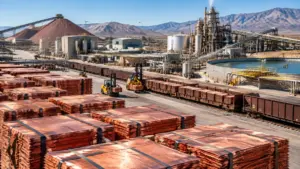
Global trade in critical minerals is increasingly governed by state-to-state strategic agreements.