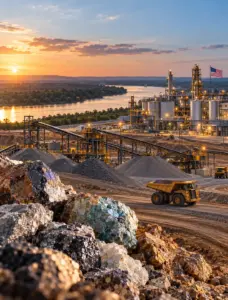
Modern mineral processing plant at sunrise highlighting advanced mining technology and efficient facility design.

By Penny Langford
The persistent volatility of the critical minerals market has reached a critical juncture in early 2026. Following the price collapses of lithium and rare earths in 2024 and 2025, Western policymakers have recognized that conventional subsidies alone are insufficient to counter the industrial dominance and pricing power of Chinese state-backed entities. The result is a significant shift in transatlantic policy: the emergence of the “Price Floor Strategy.”
That shift became more explicit on April 24, when U.S. Trade Representative Jamieson Greer and European Commissioner Maroš Šefčovič released a joint Action Plan that framed critical minerals cooperation as a strategic supply-chain defense plan rather than a conventional trade agreement. The document sharpened the focus on resilience, processing security, and coordinated responses to price disruption across key non-Chinese supply chains.
This coordinated effort between the United States, the European Union, and Japan aims to establish a “preferential trading area” for critical minerals. By utilizing border-adjusted price floors and adjustable tariffs, the alliance seeks to de-risk Western projects from the threat of predatory pricing and oversupply. For investors and operators in the lithium market and rare earth sectors, this development represents a fundamental change in project economics.
More Read

The Preferential Trading Area: Building the “Minerals Club”
In February 2026, a Ministerial meeting of the Mineral Security Partnership (MSP) involving 54 nations and the EU laid the groundwork for what officials are calling a “preferential trading area.” The objective is to decouple Western supply chains from Chinese market distortions by creating a protected economic zone for critical minerals produced under high environmental, social, and governance (ESG) standards.

The April 24 Action Plan released by Greer and Šefčovič effectively moved that concept from broad diplomacy toward operational trade defense. Rather than treating minerals access as a narrow tariff issue, the plan positioned supply security as part of a wider industrial and geopolitical response to concentrated refining power and state-backed price pressure. In practical terms, that means policy is being designed to defend project economics across allied supply chains, especially where Chinese oversupply has undermined investment returns.
The strategy hinges on two primary mechanisms:
More Read

- Border-Adjusted Price Floors: A minimum price is established for key commodities like lithium carbonate, NdPr oxide, and cobalt. If the global market price falls below this floor due to external oversupply or dumping, an adjustable tariff is triggered at the border to ensure the landed price remains at the “floor” level.
- Adjustable Tariffs: These serve as the enforcement mechanism. Unlike static tariffs, these are dynamic, increasing as global spot prices drop, effectively shielding domestic producers from the impacts of price wars.
A central implication of the Action Plan is that these border-adjusted floors are not simply about raising prices. They are designed to stabilize non-Chinese supply by preserving a minimum economic return for projects operating in higher-cost Western jurisdictions. Mining industry commentary from Money of Mine has described the concept as creating a “guaranteed margin” for Western producers, a framing that captures why developers and refiners are watching the policy closely.
Mexico has already emerged as a key early adopter, signing a bilateral action plan in February 2026 to coordinate on these trade mechanisms. This agreement is expected to serve as a blueprint for the broader US-EU-Japan negotiations, which were set on an accelerated 30-day timeline following the G7 Critical Minerals Action Plan.

Large-scale lithium mining evaporation ponds in a high-altitude desert setting.
De-Risking the Rare Earth Supply Chain
The strategic focus has shifted heavily toward processing and refining capacity. As of April 2026, the alliance is prioritizing “politically durable” infrastructure over raw mining alone. A prime example is the roadmap signed between Japan and France, which provides direct support for rare earth supply chains linked to the Caremag refining project in France.
Scheduled to begin operations in late 2026, the Caremag project is designed to process heavy rare earths like dysprosium and terbium. These minerals are essential for high-performance permanent magnets used in electric vehicle (EV) motors and defense applications. Under the new price floor strategy, projects like Caremag and Ucore’s Louisiana facility would benefit from price stability, ensuring that their higher-cost Western operations remain viable even if global prices are suppressed by subsidized competition.
Market Snapshot: Critical Minerals (April 2026)
The following table outlines the current market landscape and the proposed floor prices currently under negotiation by the US-EU task force.
| Commodity | Current Spot Price (USD/kg) | Proposed Floor Price (USD/kg) | 2026 Outlook |
|---|---|---|---|
| Lithium Carbonate | $16.50 | $22.00 | Bullish (Policy Support) |
| NdPr Oxide | $62.00 | $75.00 | Moderate (Oversupply Risks) |
| Cobalt (Sulphate) | $28.00 | $35.00 | Neutral |
| Copper (LME) | $9.80 | N/A (Market-Driven) | Strong Demand |
| Dysprosium Oxide | $245.00 | $280.00 | High Strategic Priority |
Data sourced from Skillings Mining Intelligence and G7 Trade Working Group reports.
The Pivot to “Layered Policy”
The transition toward these price floors has not been without friction. In early February 2026, the Trump administration initially signaled a retreat from direct price support, citing legal complexities and a lack of immediate Congressional funding for long-term financial commitments.
However, this gave way to a more sophisticated “layered policy” approach. Instead of the government acting as a buyer of last resort (which carries massive fiscal risk), the focus shifted to the “preferential trading area” model. By using trade policy and border adjustments, the cost of price stabilization is effectively passed to the market through tariffs, rather than onto the taxpayer through direct subsidies.
The April 24 Greer-Šefčovič Action Plan reinforced that structure by treating pricing policy as part of a supply-chain defense architecture. In that framework, border-adjusted floors function less like a classic protectionist tariff and more like a defensive mechanism to maintain operating margins for strategically important producers and processors outside China.
This approach is intended to circumvent the legal hurdles of government-set pricing while still providing the “margin gravity” necessary for project finance. For junior miners, this is a game-changer. The ability to model long-term cash flows based on a guaranteed price floor significantly lowers the cost of capital and allows for more aggressive development timelines.

Inside a modern rare earth element refining facility featuring high-tech industrial tanks.
Economic Impact on Project Finance
For investors, the price floor strategy addresses the “valley of death” between exploration and production. Western projects often struggle to secure debt financing because lenders are wary of the price volatility inherent in the lithium and rare earth markets.
By establishing a floor, the MSP nations are providing a synthetic offtake guarantee. If a project can demonstrate that its all-in sustaining cost (AISC) is below the price floor, it becomes a significantly more attractive candidate for traditional project finance. We are already seeing this impact with the NexGen Energy investment, where policy-driven market stability is encouraging large-scale capital deployment into strategic assets.
Furthermore, the integration of modern mining technologies, such as AI-optimized mineral processing and automated haulage, is helping Western operators reduce their AISC closer to the proposed price floors. The combination of technological efficiency and policy protection is creating a new competitive edge for non-Chinese supply chains.

Industrial shipping port loading containers marked for critical mineral transport.
2026 Outlook: Risks and Trajectory
As we move toward the second half of 2026, the success of the Price Floor Strategy will depend on the cohesion of the US-EU-Japan alliance. There are three key risks to monitor:
- WTO Compliance: While the “preferential trading area” is designed to be WTO-consistent under national security exceptions, it will likely face legal challenges from China and other non-member nations.
- Implementation Speed: The 30-day negotiation timelines are ambitious. Any delay in the rollout of adjustable tariffs could leave Western projects exposed to another period of price volatility.
- Inflationary Pressures: Higher mineral prices (maintained by floors) could increase the cost of EV batteries and renewable energy infrastructure, potentially slowing the energy transition if not managed carefully.
Despite these risks, the trajectory is clear. The era of “unprotected” critical mineral markets is ending in the West. The move toward a structured, tariff-protected trading zone is the most significant development in mining policy since the passage of the Inflation Reduction Act.

High-detail mineral analysis laboratory featuring a robotic arm handling samples.