2026 Lithium Power Map : Early Access Open ($59) | Get the latest sector data and secure your copy here: https://skillings.short.gy/LithiumPreSale

The global race for resource security has reached a fever pitch as the United States formalizes a massive $30 billion strategic initiative to decouple its high-tech and defense supply chains from adversarial influence. Announced during the 2026 Critical Minerals Ministerial, this mobilization of government-backed capital marks the most aggressive domestic industrial policy in decades. At the heart of this push is a twofold mission: aggressive international diplomacy to secure bilateral supply frameworks and a streamlined domestic permitting process designed to bring critical assets: like Eagle Nuclear’s Aurora Uranium Project: into production at record speed.
The stakes for this “Strategic Sovereignty” initiative could not be higher. As of early 2026, the energy transition and the burgeoning artificial intelligence sector remain heavily dependent on mineral processing concentrated within Chinese borders. This vulnerability was highlighted by recent export controls on gallium, germanium, and antimony, which sent shockwaves through the semiconductor and defense sectors. In response, the U.S. administration has moved from rhetorical concern to fiscal intervention, deploying the full weight of the federal balance sheet to de-risk junior mining and processing projects.
The $30 Billion War Chest: Project Vault and Beyond
A central pillar of the new strategy is “Project Vault,” a $10 billion direct loan program established to create a strategic reserve for critical minerals. Unlike traditional stockpiles, Project Vault is designed to act as a market stabilizer, providing a guaranteed floor for domestic producers who often face price suppression from state-subsidized international competitors.
Beyond the strategic reserve, the administration has allocated an additional $20 billion toward a combination of bilateral frameworks and domestic processing grants. To date, the U.S. has signed 11 new bilateral critical minerals frameworks with key resource nations, including Argentina, Peru, and Uzbekistan. These agreements are not merely diplomatic gestures; they include specific provisions for infrastructure development and financing through the newly formed Forum on Resource Geostrategic Engagement (FORGE).
More Read



“We are moving past the era of globalization that ignored the geography of origin,” noted a senior trade official during the Ministerial. “Security of supply is now the primary metric of economic health. If we cannot process it here or with trusted allies, we do not truly own the technology it builds.”
Eagle Nuclear and the Aurora Project: A Case Study in Expedited Permitting
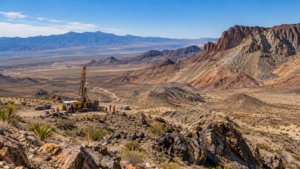
While the $30 billion investment provides the “carrot” for industry, the “stick” is a radical overhaul of the regulatory landscape. A primary beneficiary of this shift is Eagle Nuclear and its Aurora Uranium Project. Located in the McDermitt Caldera, a region increasingly recognized as a global hotspot for energy-critical minerals, Aurora represents a vital link in the U.S. nuclear fuel cycle.
More Read

To ensure the project reaches production within the current decade, Eagle Nuclear has partnered with SLR, a global leader in environmental and engineering consultancy, to navigate the complex federal permitting landscape. Crucially, the Aurora project is being positioned for inclusion under FAST-41 (Fixing America’s Surface Transportation Act), a federal program designed to improve the transparency and predictability of the environmental review process for high-priority infrastructure projects.
By leveraging the FAST-41 framework, Eagle Nuclear and SLR aim to cut years off the traditional permitting timeline. The Federal Permitting Improvement Steering Council (FPISC) provides a coordinated “Permitting Dashboard” that holds federal agencies accountable to strict deadlines. For a uranium project like Aurora, which is essential for the fuel requirements of small modular reactors, this expedited path is a strategic necessity.
Geopolitical Realities: The China Dependency
The urgency of the Aurora project and the broader $30 billion push is underscored by the current state of global mineral dependency. The U.S. currently relies on China for nearly 95% of its gallium and up to 80% of its germanium. The table below illustrates the critical gaps the U.S. is attempting to bridge through the “Strategic Sovereignty” initiative.
| Mineral | Current U.S. Import Reliance | Primary Source Processing | 2026 Strategic Goal |
|---|---|---|---|
| Gallium | 95%+ | China | 30% Domestic / Ally Sourcing |
| Germanium | 80% | China | 40% Domestic Recovery |
| Uranium | 50%+ | Russia/Kazakhstan | 75% Allied/Domestic Supply |
| Antimony | 60%+ | China/Russia | Establish Strategic Reserve |
| Rare Earths | 70%+ | China | 50% Domestic Refining |
The integration of AI into mineral pricing: a program developed by the Pentagon: is another tool being used to counter market manipulation. By setting reference prices and enforcing them through adjustable tariffs, the administration hopes to shield projects like Aurora from the “margin gravity” that has historically killed domestic mining incentives. This approach is explored in depth in our Uranium Price Forecast 2026.
The Role of SLR and Modern Mining Standards
The partnership between Eagle Nuclear and SLR highlights a critical shift in how mining projects are developed in the 2020s. It is no longer enough to have a high-grade deposit; projects must demonstrate rigorous adherence to ESG (Environmental, Social, and Governance) standards to secure federal backing and community support.

SLR’s involvement focuses on streamlining the Environmental Impact Statement (EIS) process while ensuring that technical studies meet the high bar required for FAST-41 projects. This includes everything from hydrological modeling to biodiversity assessments. In an era where regulatory shocks can derail projects, having a sophisticated regulatory strategy is as important as the extraction technology itself.
Impact on the Lithium and Battery Nexus
While uranium is a cornerstone of the current strategy, the lithium sector remains the most visible battleground. The McDermitt Caldera, where the Aurora project is situated, also hosts some of the world’s largest lithium deposits. The U.S. Department of Energy (DOE) has already issued billions in conditional commitments for lithium processing facilities, including projects focused on the global battery revolution.
The $30 billion initiative explicitly links these commodities. The goal is to create “energy hubs” where lithium extraction, uranium mining, and modular reactor deployment occur in geographical proximity, reducing logistical costs and carbon footprints.
Analysis: Can Policy Overcome Market Forces?
The primary risk to the “Strategic Sovereignty” push is not a lack of capital, but the speed of execution. Critics argue that even with FAST-41, the U.S. regulatory system is ill-equipped to compete with the rapid development cycles seen in non-democratic jurisdictions. Furthermore, the reliance on AI-driven pricing models is untested and could lead to market distortions if not managed with surgical precision.
However, for operators and investors, the message is clear: the U.S. government is now a permanent, high-stakes stakeholder in the domestic mining industry. The de-risking of junior miners through Project Vault and the prioritization of projects like Aurora signal a shift from a “hands-off” market approach to a managed industrial strategy.
As we look toward the remainder of 2026, the success of Eagle Nuclear’s permitting process will serve as a bellwether for the entire industry. If the Aurora project can successfully navigate the FAST-41 dashboard and break ground, it will provide a repeatable blueprint for the dozens of other projects currently in the domestic pipeline.

Future Outlook and Strategic Implications
The road to mineral independence is long and capital-intensive. The $30 billion currently on the table is likely only the first tranche of a multi-decade investment cycle. Investors should look closely at projects that sit at the intersection of high strategic value and advanced permitting status.
The combination of federal loans, AI-backed pricing, and expedited permitting represents a “New Deal” for American mining. For companies like Eagle Nuclear, the challenge now shifts from securing capital to operational execution under the intense scrutiny of a national security mandate.
Linkable Hooks for Industry Citation:
- The $10B Project Vault: A first-of-its-kind direct loan program for domestic mineral reserves.
- FAST-41 Integration: How Eagle Nuclear and SLR are using federal dashboards to bypass traditional permitting bottlenecks.
- FORGE Initiative: The successor to the Minerals Security Partnership, chaired by South Korea.
- AI Mineral Pricing: A Pentagon-led program to establish reference prices for gallium and germanium.
For more intelligence on the shifting landscape of global mineral supply chains, explore our latest analysis on Barrick’s Strategic Reset and the 44B M&A Surge.