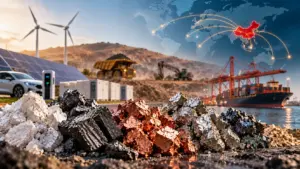
Chile’s refining milestone is concentrated in lithium hydroxide, not the country’s entire critical-minerals processing base.

By Charles Pitts
Chile is entering 2026 with a significant expansion in critical-minerals processing, but the headline requires an important distinction: the country’s overall refining capacity is not documented as doubling. The clearest milestone is in lithium hydroxide, where planned capacity rises from about 40,000 tonnes per year to 100,000 tonnes per year : more than 2.5 times the earlier baseline.
The expansion strengthens Chile’s position in battery-material supply chains while exposing a wider divide in the country’s minerals strategy. Lithium chemicals are gaining processing capacity, whereas copper : Chile’s largest mining industry : still has substantial unused smelting capability and faces increasingly difficult economics for new facilities.
For refiners, the question is therefore not simply how much nameplate capacity Chile adds. It is whether operators can secure feedstock, energy, water, technology and competitive treatment terms. For investors, the distinction between announced capacity, effective throughput and finished battery-material production will be critical.
The capacity milestone is real : but narrower than the headline
Chile’s lithium-processing system is dominated by production from the Salar de Atacama. SQM has expanded lithium carbonate capacity in Chile to approximately 210,000 tonnes per year, with a further increase to roughly 240,000 tonnes per year expected by late 2026 or early 2027, according to industry reporting and market research.

The sharper increase is in lithium hydroxide. Capacity is expected to rise from approximately 40,000 tonnes per year to 100,000 tonnes per year. That represents a gain of 60,000 tonnes per year and a capacity increase of 150% over the earlier base.
These figures refer to nominal chemical-processing capacity, not necessarily annual production. Actual output depends on brine availability, recovery rates, plant reliability, product specifications, maintenance and market demand.
More Read
| Processing segment | Earlier reported capacity | 2026–27 reported capacity | Indicative change | What it means |
|---|---|---|---|---|
| Lithium hydroxide | 40,000 t/y | 100,000 t/y | +150% | The clearest doubling-plus milestone |
| Lithium carbonate | 210,000 t/y | 240,000 t/y | +14% | Incremental expansion of an established base |
| Chilean lithium output | 64,100 t in 2025 | 67,300 t forecast for 2026 | +5% | Production growth is slower than nameplate capacity |
| Copper smelting utilization | : | About 60% of potential | : | Existing assets have unused capacity |
| Chilean share of global smelted copper | 13.3% in 1990 | 4.2% in 2025 | Down sharply | Chile remains a major concentrate producer but has lost smelting share |
Sources: International Council on Clean Transportation, Mining Weekly/Reuters, and industry reporting cited in the research.
The contrast between capacity and output is important. Chile’s projected lithium production increase in 2026 is modest compared with the expansion in chemical-processing capacity. That suggests the country may have additional headroom in its plants, but it also means investors should not treat every tonne of announced capacity as an immediate increase in saleable product.
Lithium gives Chile a midstream advantage
Chile already performs an important step that many mining jurisdictions are still trying to develop: it converts lithium-bearing brine into battery-grade chemicals domestically.
The country’s lithium industry is therefore more advanced than a simple mine-to-export model. Lithium carbonate and lithium hydroxide can enter cathode-material supply chains, even though much of the further conversion into cathodes, cells and battery packs occurs outside Chile.
An ICCT analysis of Chile’s lithium value chain estimates that announced lithium-production capacity could increase from 42,000 tonnes in 2024 to 64,000 tonnes in 2030 and 79,000 tonnes in 2035. The report also estimates that producing lithium-iron-phosphate cathode materials for Latin American demand could generate up to $1.1 billion in annual revenue by 2030, with potential employment of 900 to 1,700 jobs.
Those figures describe an opportunity rather than an operating domestic cathode industry. Chile’s policy challenge is to move from lithium chemicals into higher-value products without undermining its environmental credentials or losing cost competitiveness.
The National Lithium Strategy and the country’s broader critical-minerals agenda seek to encourage that transition. However, the public strategy framework does not establish a single, quantified 2026 target for total lithium refining capacity or domestic cathode production.
Copper is a utilization story before it is an expansion story
Copper presents a different industrial problem.
Chile has Latin America’s largest copper-smelting capacity, but its plants are operating at approximately 60% of potential output, according to Chilean copper commission Cochilco. At the same time, Chile’s share of global smelted copper production has fallen to 4.2% in 2025 from 13.3% in 1990, despite the country accounting for about 23% of global copper concentrate production.
That gap has become more important as concentrate markets tighten. Lower ore grades, mine disruptions and delays to new projects have reduced the availability of feedstock. Meanwhile, new smelters : particularly in Asia : are competing for the same concentrate. Treatment and refining charges have moved close to zero or into negative territory, squeezing smelter margins.
In a Reuters report published by Mining Weekly, Cochilco said Chile should improve the performance of existing smelters before building new ones.
That position changes the investment case. A reliable modernization project that lifts utilization may create more value than a new facility with high capital costs and uncertain concentrate supply. Cochilco also estimates that planned smelters, mainly in Asia, could add 8.2 million tonnes per year of processing capacity by 2041. That would intensify competition for concentrate and make operational efficiency increasingly important.
Chile’s 2026 copper pipeline remains focused primarily on mines and concentrators. Several projects are expected to reach milestones during the year, but those developments should not be confused with new copper-refining capacity. The distinction is central to any assessment of the copper supply outlook.

Copper’s near-term opportunity is higher utilization of existing smelters, not an immediate doubling of national refining capacity.
Policy is moving faster than project delivery
Chile’s National Critical Minerals Strategy, launched in January 2026, identifies copper and lithium among the country’s priority minerals and emphasizes production, responsible mining, value addition, international cooperation and enabling infrastructure.
The strategy is important for investors because it establishes policy direction. It does not, however, provide a plant-by-plant schedule showing how many tonnes of copper cathode, lithium carbonate or lithium hydroxide will be added in 2026.
That leaves project-level execution as the main test. For lithium, Codelco’s growing role through its partnership with SQM provides a longer-term platform for state participation in the Salar de Atacama. Other projects, including Maricunga and Salares Altoandinos, are expected to contribute meaningful production and processing capacity mainly after 2030.
For copper, the policy challenge is more immediate. New processing projects must compete against existing facilities that may be underutilized, higher-cost Asian capacity and a global market in which concentrate availability is tightening.
Canada and Chile’s expanding critical-minerals partnership also illustrates the direction of travel. In August, Natural Resources Canada said the two countries were advancing cooperation on investment, mining technology, skills, water management, decarbonization and supply-chain resilience. The agreement between Codelco and MacLean Engineering to test underground-mining technologies at El Teniente is one example of how technology and operational efficiency may support Chile’s minerals ambitions.
Base, bull and bear framework
The capacity data support three broad scenarios for refiners and investors.
Base case: lithium expands, copper utilization improves gradually
In the base case, Chile reaches or approaches the reported 100,000 tonnes per year of lithium hydroxide capacity and expands lithium carbonate capacity toward 240,000 tonnes per year. Actual production rises more slowly as plants ramp up and market conditions remain uneven.
Copper smelter utilization improves incrementally, but low treatment charges limit the profitability of aggressive new capacity additions. Chile remains a major concentrate exporter, with China continuing to receive a large share of shipments.
Implications: established lithium processors benefit from operating scale, while copper refiners prioritize reliability, maintenance and cost reduction. Investors focus on utilization and cash-flow conversion rather than headline capacity.
Bull case: Chile captures more downstream value
In the bull case, lithium chemical capacity ramps efficiently, domestic producers secure preferential-price arrangements for value-added projects, and Chile attracts cathode or precursor investment. Better permitting, renewable electricity and improved water-management technology support new processing projects.
Copper smelters also raise utilization materially, allowing Chile to retain more value from its concentrate production and reduce exposure to overseas processors.
Implications: Chile becomes a more integrated regional supplier of battery materials and refined copper. The greatest upside would come from successfully converting existing lithium chemical capacity into a broader battery-material ecosystem.
Bear case: capacity remains underutilized
In the bear case, lithium demand or pricing weakens, projects face delays, or environmental and community concerns slow expansion. Nameplate capacity rises, but production remains below potential.
For copper, negative or near-zero treatment charges persist while aging plants require major capital expenditure. New facilities are deferred, and Chile continues exporting concentrate even as it retains unused domestic smelting capability.
Implications: refiners face margin compression, while investors place greater weight on operating costs, contract structures, water availability, permitting risk and balance-sheet resilience.
What refiners and investors should monitor
Four indicators will determine whether Chile’s refining milestone becomes a broader supply-chain shift:
- Actual lithium chemical output versus nameplate capacity. The gap will show whether expansion reflects genuine production growth or simply additional installed equipment.
- Copper smelter utilization and treatment charges. Higher utilization is positive only if plants can operate profitably amid tight concentrate markets.
- Progress beyond carbonate and hydroxide. Cathode precursors, LFP materials and recycling would indicate deeper domestic value addition.
- Water, energy and permitting performance. Chile’s arid northern regions make environmental execution a commercial issue, not only a regulatory one.

The next test is whether Chile can turn lithium chemical capacity into a broader domestic battery-material chain.
Chile’s refining story is therefore substantial, but segmented. The country can credibly claim a more than doubling milestone in lithium hydroxide capacity, while its copper industry is still deciding whether to modernize existing smelters before committing to new ones.
For decision-makers, the central lesson is straightforward: capacity announcements matter, but utilization, product mix and downstream integration will determine how much value Chile captures from its critical minerals.