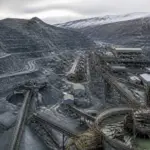
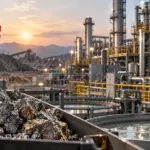
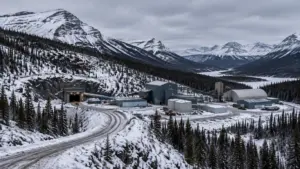
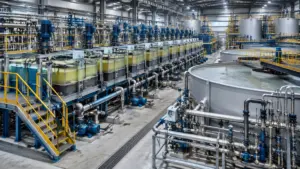
Industrial processing infrastructure illustrates the midstream capacity targeted by Project Dynamo.

By Penny Langford
The U.S. government’s role in rare-earth financing is moving beyond broad policy commitments and toward project-level structures, although the capital is not yet fully committed.
Aclara Resources said the U.S. Export-Import Bank has issued a non-binding Letter of Interest to consider up to $750 million for Project Dynamo, a planned rare-earth separation, metals and alloys facility at the Port of Vinton in Louisiana. The announcement follows the completed acquisition of Brazil’s Serra Verde by USA Rare Earth, creating another government-backed route to non-Chinese supplies of magnetic rare earths.
Together, the developments show how the critical minerals supply chain in 2026 is being financed: through a combination of government lending, long-term offtake, strategic investment, commercial credit and equity. They also show the distance between policy support and operating capacity.
EXIM’s $750 million signal is not a final loan
Aclara’s Project Dynamo is designed to process mixed rare-earth carbonate from the company’s South American projects and convert it into separated oxides, metals and alloys. The planned products include neodymium-praseodymium, dysprosium, terbium, samarium, gadolinium and yttrium.

Those materials are used in high-performance permanent magnets and have applications across electric mobility, robotics, advanced manufacturing, power generation and defense-related technologies.
According to Aclara’s announcement, EXIM indicated that potential financing could cover up to $750 million of project costs, with a repayment tenor of up to 15 years under the bank’s Make More in America initiative.
The distinction between a Letter of Interest and committed debt is important for mining finance.
| Project Dynamo financing point | Announced position | Why it matters |
|---|---|---|
| Potential EXIM financing | Up to $750 million | Could anchor the project’s long-term financing package |
| Indicative repayment tenor | Up to 15 years | Longer tenor may improve project debt capacity |
| Financing instrument | Non-binding Letter of Interest | Not a final approval or funding commitment |
| Facility location | Port of Vinton, Louisiana | Places separation and alloying capacity inside the United States |
| Target status | Construction-ready by year-end | Engineering, permitting and technical validation remain material |
| Planned feedstock | Mixed rare-earth carbonate | Links U.S. processing to projects in Brazil and Chile |
Aclara said the company is completing basic engineering and key permitting activities. It is also demonstrating proprietary solvent-extraction technology at Virginia Tech and advancing molten-salt electrolysis for metals and alloys in Chile.
The company’s target is to make the Louisiana facility construction-ready by the end of 2026. That milestone would be significant, but it would not eliminate technology, permitting, construction, commissioning or customer-qualification risk.
The EXIM process remains subject to due diligence, application, underwriting, authorization and documentation. The bank’s interest therefore represents strategic validation rather than a completed financing package.

Separation, metallization and alloying are the midstream stages targeted by Project Dynamo.
USA Rare Earth adds a producing asset to the financing story
A second development has moved further along the project cycle.
USA Rare Earth completed its combination with Serra Verde Group on Sept. 3, according to the company’s investor-relations announcement. The transaction, valued at approximately $2.8 billion, included $300 million in cash and 126.849 million newly issued USA Rare Earth shares.
The deal gives USA Rare Earth control of the Pela Ema rare-earth operation in Brazil’s Goiás state. Serra Verde entered commercial production in 2024 and has outlined plans to increase output as the operation ramps up.
The transaction is different from Aclara’s Louisiana project in an important respect: it combines government-backed support with an operating mine and processing facility rather than a greenfield separation plant that still requires construction.
Earlier disclosures cited a $565 million U.S. International Development Finance Corp. financing package for Serra Verde’s expansion and optimization. A separate offtake structure included a $750 million Department of War investment in a special-purpose vehicle intended to purchase production. A bank facility of up to $500 million was also described as working capital support for rare-earth purchases.
These commitments should not be treated as a single subsidy or as identical forms of capital. They serve different purposes:
- DFC financing supports the mine and processing operation.
- The offtake vehicle provides a long-term buyer structure.
- Bank credit supports working capital.
- USA Rare Earth’s equity issuance funds part of the acquisition consideration and expands the shareholder base.
The combination gives USA Rare Earth a producing source of neodymium, praseodymium, dysprosium and terbium, while the company continues to pursue downstream magnet manufacturing in the United States.

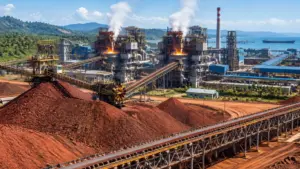
Serra Verde’s Brazilian operation gives USA Rare Earth exposure to an operating ionic-clay asset.
Why the midstream remains the financing bottleneck
The financing activity reflects a structural weakness in the rare-earth market. Mining capacity outside China is expanding, but separation, metallization, alloying and magnet production remain heavily concentrated.
The International Energy Agency has reported that China accounted for about 91% of refined rare-earth output and approximately 94% of sintered permanent-magnet production in 2024. The figures cover different stages of the supply chain, but the conclusion is consistent: access to ore does not guarantee access to usable magnet materials.
That is why projects such as Project Dynamo are being evaluated not only as chemical-processing facilities but as strategic infrastructure.
For operators, the financing case depends on more than resource size. Lenders and government agencies will also examine:
- Feedstock security: whether upstream projects can provide reliable carbonate or concentrate.
- Technology scale-up: whether laboratory or pilot systems can achieve stable industrial performance.
- Product qualification: whether separated oxides, metals and alloys meet customer specifications.
- Permitting and environmental controls: particularly for chemical separation and waste management.
- Offtake quality: whether customers will commit to purchasing material at commercial scale.
- Construction and commissioning risk: including cost escalation, equipment availability and workforce capability.
This is the point at which policy-backed capital can be decisive. Government support may lower financing barriers, but it does not replace technical proof or long-term customers.
Gold, silver and rare earths: a broader hard-asset trade
The rare-earth deals also sit within a broader expansion of the hard-asset trade.
Gold and silver remain the traditional monetary and inflation-sensitive metals. Rare earths, copper, lithium and nickel are industrial and strategic inputs tied to electrification, defense, data centers, power infrastructure and advanced manufacturing.
The investment characteristics differ. Gold and silver can be held through physical products, funds, royalty companies and established producers. Rare-earth exposure is more commonly accessed through developers, producers, processing companies and specialty industrial businesses. That creates greater sensitivity to project execution, technology and policy.
The distinction matters as capital moves from a narrow precious-metals theme toward a wider mining-finance complex. Government-backed transactions can give critical-minerals projects a form of strategic value that is not fully captured by near-term commodity pricing.

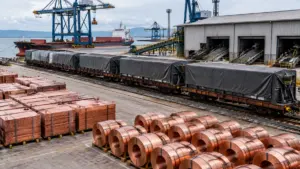
Capital is increasingly connecting traditional precious metals with strategic mineral supply chains.
Critical minerals supply chain 2026: base, bull and bear cases
The following framework is intended to help operators, lenders and policymakers assess the next stage of the market. It is a scenario tool, not a price target or investment recommendation.
| Scenario | Financing environment | Project outcome | Market implication |
|---|---|---|---|
| Base case | EXIM completes further diligence, but funding closes only after engineering, permitting and technical milestones | Project Dynamo advances toward construction; Serra Verde focuses on integration and ramp-up | Government-backed capital supports selective non-Chinese supply, but new capacity grows gradually |
| Bull case | EXIM converts its interest into committed financing and additional offtake and commercial debt follow | Louisiana construction begins on schedule, Serra Verde expands successfully and downstream magnet capacity grows | Security premiums and customer demand improve project economics across rare earths and other critical minerals |
| Bear case | Financing approval is delayed or reduced; technical demonstrations, permits or offtake agreements fall behind | Construction slips, costs rise or production ramps more slowly than planned | Buyers remain dependent on concentrated processing networks, while early-stage projects face higher capital costs |
The base case is the most relevant for near-term planning. Strategic support is clearly expanding, but the sector still needs projects to pass several gates before capital becomes productive capacity.
What mining-finance teams should monitor next
The next evidence will come from project execution rather than announcement size.
For Aclara, the key milestones are the conversion of EXIM’s non-binding interest into a definitive financing process, completion of permitting, validation of separation technology and progress toward construction readiness.
For USA Rare Earth, attention will shift to integration, Serra Verde’s production ramp-up, operating costs, recovery rates and the ability to deliver material into the government-backed offtake structure.
More broadly, investors and policymakers should track the growth of non-Chinese separation and alloy capacity, the qualification of new material with magnet manufacturers, and the durability of government support across administrations.
Skillings’ coverage of the rare-earth supply chain and processing bottleneck provides additional context, while the rare-earths section tracks the sector’s project and policy developments.
The central shift in 2026 is clear: U.S. government support is beginning to attach itself to specific mines, plants, offtake structures and financing packages. But the decisive test will be whether those commitments produce reliable, qualified material at commercial scale.
LinkedIn snippet
U.S. government backing for rare earths is moving from broad policy to project-level finance. EXIM is considering up to $750 million for Aclara’s Louisiana facility, while USA Rare Earth has completed its approximately $2.8 billion Serra Verde acquisition. The next test is execution: technology, permitting, offtake and commercial-scale production.
X snippet
EXIM is considering up to $750M for Aclara’s Louisiana rare-earth facility, while USA Rare Earth has completed its $2.8B Serra Verde acquisition. The financing story is advancing; but technical validation, permits, offtake and commissioning remain the key risks.