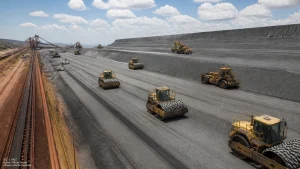
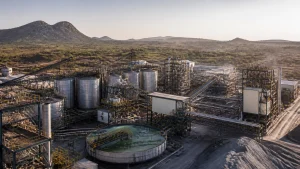
Egypt’s bold ambitions to position itself as a premier Egypt mining hub are taking shape, as the Ministry of Petroleum and Mineral Resources unveils a sweeping five-year plan to revamp its mining sector. Led by Minister Karim Badawi, the initiative aims to increase the mining industry’s contribution to GDP from under 1% to between 5% and 6% by 2030.

From Resource-Rich to Resource-Powered
At the center of the reform is a shift in strategy—from extracting raw materials to building a vertically integrated industry. “Our goal is to maximize the value of Egypt’s natural resources through local production and global export,” Minister Badawi said during a press briefing. “This is about transforming Egypt into a competitive, export-driven Egypt mining hub.”
By expanding mineral-based manufacturing and fostering domestic processing capabilities, Egypt seeks not only to capture more value internally but to generate a steady stream of foreign currency amid broader economic reforms.
Related News
- Solaris Secures $200M from Royal Gold to Advance Warintza Copper-Gold Project in Ecuador
- BASF Strengthens R&D in Copper Hydrometallurgy Amid Global Push for Sustainable Mining
- Hindalco Secures Future Fuel Supply with EMIL Mines Acquisition
- Arizona Lithium Accelerates Prairie Project After $4.25M Raise, Regulatory Win
Governance Reform at the Core
The transformation is anchored in overhauling the Egyptian Mineral Resources Authority (EMRA), which will be restructured into a commercially-oriented entity. The revamped EMRA will feature improved digital systems, streamlined licensing, and modern regulatory frameworks designed to appeal to international investors.
“Modernizing subsoil management is key,” said Badawi. “It will enable us to unleash the full potential of our mineral wealth.”
This restructuring aligns with Egypt’s broader state reform agenda and follows international best practices aimed at fostering transparency, investor confidence, and sustainable resource use.

Five-Year Mining Plan: Key Pillars
The newly released roadmap sets a strategic course for Egypt’s mining future, including:
- Expanding geological surveys and digital mapping
- Accelerating exploration permits for strategic minerals
- Establishing industrial mining clusters for downstream activities
- Training and localizing mining expertise
- Improving port and rail infrastructure for export logistics
The plan is already underway, with support from global partners and initial exploration deals signed with Australian and Canadian firms in early 2025.
Strategic Geography as an Asset
Egypt’s location provides a unique advantage. Bordered by the Red Sea and the Mediterranean, and sitting at the crossroads of Africa, the Middle East, and Europe, the country is positioned to serve as a logistics and production nexus.
“We have the ports. We have the railways. We have the energy. Now, we are building the systems,” said Badawi, referring to the infrastructure enhancements supporting the Egypt mining hub strategy.
Sector Outlook and Global Trends
The timing of Egypt’s initiative is critical. With global demand for critical minerals—including copper, rare earths, and phosphates—on the rise due to the energy transition, Egypt’s untapped reserves have become more attractive. The World Bank and African Development Bank have both flagged Egypt as a high-potential mining economy in the MENA region.
Badawi also acknowledged global investor interest: “There’s momentum now. We must capitalize on it while ensuring that environmental and social standards are upheld.”