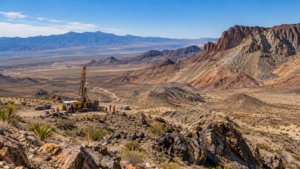
An exploration drill rig works across the arid terrain of Arizona’s Copper Creek district.

By Charles Pitts
Faraday Copper’s latest drilling at its Copper Creek project in Arizona has extended shallow copper mineralization and identified additional oxide material, strengthening the company’s case for a potential copper cathode pathway as it prepares to expand the district through the expected end-September acquisition of BHP’s San Manuel property.
The results come from a broader 22.5-kilometre drilling program, with results released so far from 76 holes and remaining assays still pending. The program is testing near-surface mineralization, oxide zones and targets outside the current resource area as the company works toward a future resource update and technical study.
The latest results do not establish an operating mine or a completed economic project. They do, however, provide additional geological information on areas that could support a staged development concept, particularly where shallow oxide mineralization may be amenable to heap leaching, solvent extraction and electrowinning, or SX-EW.
More Read

Shallow results add weight to American Eagle
The latest near-surface results came from several target areas, including American Eagle, Copper Giant East, Near the Pole breccia and ground north of Childs Aldwinkle, where Faraday is testing oxide, breccia and porphyry-style mineralization around and beyond the current resource footprint.

At American Eagle, hole FCD-26-184 returned 20 metres grading 0.52% copper, while FCD-26-183 returned 31 metres at 0.25% copper. The area contains multiple breccia bodies and porphyry occurrences that Faraday has been evaluating for potential near-surface resource growth, though further drilling, metallurgy and engineering work would be required before any economic conclusions can be drawn.
| Area | Drill hole | Key interval | Relevance |
|---|---|---|---|
| Copper Giant East oxide area | FCD-26-190 | 100.8 m at 0.22% Cu | Shallow oxide mineralization |
| Copper Giant East oxide area | FCD-26-180 | 56 m at 0.20% Cu; 28 m at 0.28% Cu | Oxide and near-surface continuity |
| Copper Giant East oxide area | FCD-26-181 | 74 m at 0.16% Cu | Broad lower-grade oxide interval |
| Near the Pole breccia | FCD-26-185 | 14.3 m at 0.56% Cu | Breccia-hosted mineralization |
| North of Childs Aldwinkle | FCD-26-163 | 40 m at 0.32% Cu; 21.4 m at 0.46% Cu | Step-out mineralization north of resource |
| American Eagle | FCD-26-184 | 20 m at 0.52% Cu | Near-surface breccia target |
| American Eagle | FCD-26-183 | 31 m at 0.25% Cu | Shallow porphyry-breccia mineralization |
Oxide interval supports a possible cathode route
The most important results for the company’s cathode strategy came from Copper Giant East, where Faraday reported broad shallow oxide intercepts.
More Read

Hole FCD-26-190 returned 100.8 metres at 0.22% copper, FCD-26-180 returned 56 metres at 0.20% copper and 28 metres at 0.28% copper, and FCD-26-181 returned 74 metres at 0.16% copper.
These are exploration intercepts rather than an economic mine plan. Still, broad oxide intervals matter because they can help define material that may ultimately be tested for heap leaching, solvent extraction and electrowinning, or SX-EW, in a future technical study.
Acid-soluble copper is relevant because it can indicate the presence of oxide and secondary copper minerals that may be recoverable through leaching. At Copper Creek, Faraday has identified minerals including chrysocolla, malachite and tenorite in shallow zones.
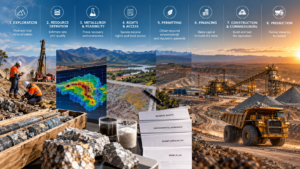
A potential cathode circuit would generally involve crushing and stacking ore on a heap, applying a leaching solution to dissolve copper, recovering the copper-bearing solution through solvent extraction and producing copper cathodes through electrowinning. That route can differ materially from a conventional sulphide concentrator, which would produce copper concentrate for shipment and downstream smelting.
The Copper Giant East result is therefore significant as a metallurgical and development signal, but it is not proof of commercial recoveries. Faraday would still need representative metallurgical testing, resource classification, mine planning, water and permitting studies, capital estimates and an economic assessment before determining whether an oxide cathode operation is viable.

Copper-bearing drill core provides geological information for resource and metallurgical studies.
Resource provides a large base, but confidence levels differ
Copper Creek’s current resource includes:
- 421.9 million tonnes measured and indicated at 0.45% copper, containing about 4.2 billion pounds of copper
- 83.6 million tonnes inferred at 0.34% copper, containing about 628 million pounds
The measured and indicated categories represent the higher-confidence portion of the estimate and are generally the categories used to support mine planning and economic studies, subject to the applicable technical and economic assumptions.
The inferred resource has a lower level of geological confidence. It may indicate exploration potential, but it cannot be treated as having the same economic or mine-planning certainty as measured and indicated material. Faraday’s ongoing drilling could upgrade portions of the inferred resource, expand known zones or identify new mineralization, but those outcomes are not guaranteed.
The current resource is based on a 2023 mineral resource estimate, and the company has deferred an updated resource and technical study while it completes the latest drilling program and evaluates the broader district.
Faraday’s own project information says Copper Creek’s resource area is approximately three kilometres long and remains open in multiple directions. The company also reports more than 320 mapped breccias across the wider property, with fewer than 15% drill-tested and 17 included in the existing mineral resource estimate.
That gap between mapped geology and tested mineralization is one source of exploration upside. It is also a reminder that geological potential is not equivalent to a mineable reserve.
San Manuel could change the district map
Faraday has entered into a non-binding letter of intent with a BHP subsidiary to acquire the adjacent San Manuel property, associated with the former San Manuel mine in Arizona. The company expects the transaction to close by the end of September, subject to the completion of definitive agreements and other conditions.
The acquisition is important because it would add roughly 109 square kilometres of land and legacy infrastructure to Faraday’s district position. The company has said an updated Copper Creek resource is expected next year, a combined Copper Creek-San Manuel resource is targeted around mid-2027, and roughly 23,000 metres of drilling is planned at San Manuel after closing.
Faraday paused drilling on June 20 while the proposed transaction is advanced. The company has said it expects to resume work in the fall after closing, allowing future drilling to be planned with the expanded district footprint in mind.
The potential benefit is strategic rather than immediate. A larger contiguous or operationally connected land position can improve the ability to test mineralized trends, evaluate infrastructure corridors and consider sequencing options. It does not, by itself, establish that the two properties can be developed as one mine or that historic San Manuel infrastructure remains available for reuse.

Copper Creek’s exploration footprint spans a broad, arid porphyry district in Arizona.
What investors and operators will watch next
The next set of milestones will determine whether the latest drilling translates into a stronger development case.
First, Faraday will need to complete assays from the remaining holes and incorporate the results into an updated geological model. That work should clarify whether the shallow American Eagle mineralization forms a continuous zone or remains a series of separate breccia and porphyry bodies.
Second, oxide material will require metallurgical confirmation. Acid-soluble copper can help identify leachable mineralization, but recoveries depend on mineralogy, permeability, clay content, crush size, leach kinetics, water balance and operating conditions.
Third, the company will need to close the San Manuel transaction and define how the acquired property affects exploration priorities. The expected end-September timing is a company target, not a completed transaction.
Finally, any future economic study will need to separate the higher-confidence measured and indicated resource from the inferred material. The inferred tonnes may support exploration planning, but they should not be assumed to contribute to a mine plan or cash-flow forecast until they are upgraded and evaluated through technical studies.
For now, the drilling has improved the geological case for shallow copper and identified oxide intervals that could support a domestic cathode concept. The larger question is whether those exploration results can be converted into a sufficiently continuous, recoverable and permitted resource to complement the deeper sulphide and breccia mineralization at Copper Creek.
That question will become clearer after the San Manuel transaction, the next resource update and additional metallurgical work.
Related reading
- Copper price forecast: deficit math, consolidation and scenarios
- Copper hits $6.727 a pound as tariff fears trigger a global stockpile rush
- Critical minerals supply chain: drivers, risks and scenarios
- Faraday Copper: Copper Creek project overview
- Faraday Copper’s Phase IV drilling release
- Original source: The Northern Miner report
SEO metadata
- Meta title: Faraday Copper drilling strengthens Arizona cathode case
- Meta description: Faraday Copper’s Copper Creek drilling outlines shallow oxide and near-surface copper zones in Arizona as the company advances the proposed San Manuel acquisition.
- Primary keyword: Faraday Copper
- Secondary keywords: Copper Creek drilling, Arizona copper, copper cathode, San Manuel mine, copper oxide, critical minerals
- Suggested slug:
faraday-copper-arizona-drilling-cathode-case - Category: Copper
- Tags: Faraday Copper, Copper Creek, Arizona mining, copper exploration, copper cathode, SX-EW, critical minerals