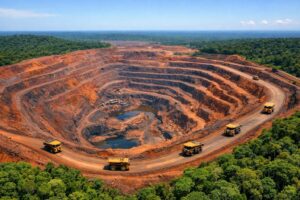
Fortuna Mining’s acquisition gives it control of the Bambadji gold exploration project, adjacent to its Diamba Sud project in southeastern Senegal.

By Charles Pitts
Fortuna Mining has acquired the Bambadji gold project in southeastern Senegal from Barrick Mining and IAMGOLD for US$200 million in cash, consolidating a large exploration land package next to its feasibility-stage Diamba Sud project.
The transaction, which closed under definitive agreements dated August 10, gives Fortuna control of the 190-square-kilometre Bambadji project and its Bambadji Sud exploration permits in the Kédougou region near the Mali border.
Fortuna paid US$130.35 million to a Barrick subsidiary and US$69.65 million to an IAMGOLD subsidiary. The company funded the purchase entirely from its treasury.
More Read
The deal also includes a 0.5% net smelter return royalty on the first 1.75 million ounces of gold produced from the Bambadji permit. Barrick will receive a 0.325% share of the royalty, while IAMGOLD retains a 0.175% share.

The acquisition expands Fortuna’s operating and exploration footprint in one of West Africa’s established gold corridors. It also brings together approximately 60 kilometres of prospective strike along the Senegal-Mali Shear Zone, a geological trend associated with several major gold deposits and mines.
Fortuna expands around Diamba Sud
Bambadji is contiguous with the eastern margin of Fortuna’s Diamba Sud Gold Project. That adjacency is central to the transaction because it gives Fortuna the opportunity to evaluate the two properties as a broader regional exploration and development district.
More Read

Diamba Sud has reported mineral reserves containing approximately 1.15 million ounces of gold. Fortuna has been advancing the project toward a final investment decision, while Bambadji remains an exploration-stage asset without a published mineral resource or reserve estimate.
The distinction is important for investors and operators assessing the value of the acquisition. Fortuna is not buying a producing mine or a project with a defined reserve base at Bambadji. It is acquiring prospective ground, an existing exploration database and the ability to test targets that could potentially expand the scale of a future Senegalese operation.
Fortuna President and Chief Executive Jorge A. Ganoza described the transaction as an opportunity to consolidate a large-scale exploration package beside Diamba Sud, where quality exploration ground is difficult to assemble.
The company said the combined position could support a longer-term gold district strategy, although any development case for Bambadji will depend on exploration results, resource definition, permitting, infrastructure studies and future feasibility work.
What Fortuna acquired
The Bambadji joint venture was previously controlled by Barrick and IAMGOLD, with ownership divided 65% and 35%, respectively. The joint venture was established under an agreement dated May 23, 2016.
The acquired package includes the Bambadji and Bambadji Sud permits, covering approximately 190 square kilometres. Previous work generated a substantial geological and drilling database, including geochemical, geophysical and lithological information and approximately 214,000 metres of auger, reverse-circulation and diamond drilling.
Fortuna said the historical work has identified at least eight significant drill-defined prospects. Several mineralised trends remain open along strike and at depth.
Previously disclosed drill results from the broader Bambadji project include:
| Prospect result | Reported interval |
|---|---|
| Shallow mineralisation | 45 metres at 2.34 grams per tonne gold |
| Shallow mineralisation | 47 metres at 3.76 grams per tonne gold |
| Shallow mineralisation | 46 metres at 3.57 grams per tonne gold |
| Higher-grade interval | 15 metres at 8.55 grams per tonne gold |
These results are historical exploration results and do not represent a mineral resource estimate. Their value will depend on continuity, geometry, metallurgy, mining conditions and the results of additional drilling.
The size of the historical dataset is nevertheless significant. For Fortuna, the transaction reduces the time and cost required to establish an initial exploration program compared with acquiring an entirely untested greenfield property.

Core logging and sample interpretation will be central to defining Bambadji’s next exploration targets.
$8 million exploration program planned
Fortuna has approved an initial US$8 million exploration budget for Bambadji for the remainder of 2026.
The program includes 51,000 metres of reverse-circulation and diamond drilling, with drilling expected to begin in the third quarter. The company plans to focus first on eight priority targets located within roughly 20 kilometres of the proposed Diamba Sud plant site.
That proximity could become strategically important if exploration identifies economic mineralisation. A deposit near planned processing infrastructure may offer different development economics from a standalone discovery, although trucking distances, ore characteristics, production sequencing and permitting requirements would still need to be assessed.
Fortuna also plans generative exploration across additional mineralised trends within the newly consolidated land position. The work is expected to test targets along the wider Senegal-Mali Shear Zone rather than focus only on previously drilled areas.
The near-term exploration schedule creates a clear set of milestones for the market:
- Mobilisation of drilling equipment and field teams.
- Initial assay results from priority targets.
- Confirmation of geological continuity and mineralisation thickness.
- Interpretation of the historical database alongside new drilling.
- Future decisions on resource definition and project integration.
No date has been provided for a maiden Bambadji resource estimate. The timing will depend on drilling progress, assay turnaround, geological interpretation and the quality of the results.
IAMGOLD monetises a non-core asset
For IAMGOLD, the sale converts its 35% interest in the Bambadji joint venture into approximately US$70 million in cash before taxes and transaction costs.
The company has described Bambadji as a non-core exploration asset and said the divestiture supports its focus on existing operating and development projects. IAMGOLD’s share of the royalty gives it continuing exposure to any future production from the permit, but removes its direct funding and operational responsibilities at the project.
Barrick also receives cash proceeds while retaining a portion of the royalty. For both sellers, the transaction provides immediate value from an exploration asset that had remained within a long-standing joint venture structure.
For Fortuna, the transaction represents the opposite strategy: deploying treasury capital to increase exposure to exploration upside around an existing development project.
The structure also gives Fortuna 100% control of the acquired permits rather than requiring the company to negotiate future exploration decisions with the former joint-venture partners. That may simplify target prioritisation and project-level planning, provided the company can secure the required approvals and maintain constructive relationships with local stakeholders and Senegalese authorities.
Senegal gold strategy and execution risks
Senegal has developed a significant gold industry, particularly in the Kédougou region. The country’s gold potential has attracted international producers and exploration companies, while established operations have helped build regional knowledge, contractor capacity and supporting infrastructure.
However, exploration success does not automatically translate into mine development. Fortuna will need to address several risks as it advances Bambadji.
The first is geological. Bambadji has promising drill results but no declared resource. A large exploration package can contain isolated high-grade zones that prove difficult to connect into a mineable deposit.
The second is capital allocation. The US$8 million 2026 exploration program is modest relative to the purchase price but could increase as Fortuna moves toward resource definition, metallurgical testing and economic studies.
The third is integration. If Fortuna identifies a potentially economic deposit, it will need to determine whether Bambadji should be developed as part of Diamba Sud, operated as a separate satellite deposit or retained as a longer-term exploration option.
The fourth is execution. Drill results, permitting, land access, logistics, water availability, power supply and community engagement will influence the pace at which the project can advance.
Fortuna’s wider portfolio also includes assets in Latin America and West Africa, making operational and financial discipline important as the company balances exploration spending with existing development commitments. Its gold market coverage provides additional context on the commodity backdrop supporting renewed interest in advanced exploration projects.
A district-scale bet rather than a near-term production deal
The Bambadji acquisition is best understood as a district-scale consolidation transaction rather than an immediate production expansion.
Fortuna is paying US$200 million for control of a large, data-rich exploration property next to a project with a defined reserve base. The company’s thesis is that Bambadji could add scale, extend the exploration runway around Diamba Sud and improve the long-term value of its Senegal platform.
That thesis remains unproven. The project has no published resource or reserve, and the disclosed exploration results require further drilling and technical validation.
The next test will come from Fortuna’s planned 51,000-metre program. If the drilling confirms continuity across multiple targets, the acquisition could develop into one of the more consequential regional gold consolidation moves in Senegal. If results are narrow or discontinuous, the company will have paid a substantial price for exploration optionality.
For now, the transaction places Fortuna in control of a 60-kilometre exploration corridor and gives it a new set of near-term drilling catalysts beside Diamba Sud.
Further coverage of critical minerals, commodities and mining project developments is available through the Skillings Mining Intelligence feed.

Fortuna plans to test eight priority targets with reverse-circulation and diamond drilling.
Key facts at a glance
| Item | Detail |
|---|---|
| Buyer | Fortuna Mining Corp. |
| Sellers | Barrick Mining and IAMGOLD |
| Asset | Bambadji and Bambadji Sud gold exploration permits |
| Location | Kédougou region, southeastern Senegal |
| Project area | Approximately 190 square kilometres |
| Consideration | US$200 million in cash |
| Barrick proceeds | US$130.35 million |
| IAMGOLD proceeds | US$69.65 million, or approximately US$70 million |
| Royalty | 0.5% NSR on the first 1.75 million ounces produced |
| Historical drilling | Approximately 214,000 metres |
| 2026 exploration budget | US$8 million |
| Planned drilling | 51,000 metres of RC and diamond drilling |
| Resource status | No published Bambadji resource or reserve estimate |
| Nearby Fortuna project | Diamba Sud, with approximately 1.15 million ounces of gold reserves |
Sources: Fortuna transaction coverage, IAMGOLD’s closing announcement, and independent transaction reporting.