Rio Tinto and Glencore confirmed Thursday they have resumed preliminary merger discussions that would create the world’s largest mining company through an all-share acquisition valued at more than $200 billion.

The Anglo-Australian miner Rio Tinto would acquire Switzerland-based commodities trader and miner Glencore under the proposed deal, the companies said in separate statements. The combined entity would surpass current industry leader BHP Group in market capitalization.
Rio Tinto faces a Feb. 5 deadline to announce whether it will make a formal offer for Glencore. The deadline can be extended with approval from the U.K.’s Takeover Panel.
Both companies emphasized that no terms have been finalized and no deal certainty exists. The talks remain in early stages with structure, conditions and valuation still under negotiation.

More Read

The renewed discussions follow the collapse of similar talks in 2024. Those negotiations broke down over valuation disagreements and concerns about Glencore’s coal mining operations, according to industry sources familiar with the matter.

Rio Tinto has been under pressure from investors to divest from fossil fuel assets as part of its climate commitments. Glencore’s thermal coal operations, which generated $3.2 billion in earnings before interest and taxes in 2024, remain a significant portion of its business portfolio.
The timing of the renewed talks reflects surging global demand for copper driven by electric vehicle production and data center expansion. Both companies control substantial copper assets that would position the merged entity as one of the world’s top five copper producers.
More Read

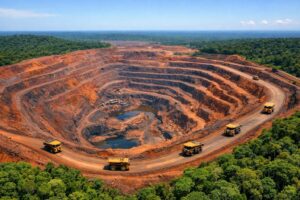
Glencore operates the Katanga and Mutanda copper mines in the Democratic Republic of Congo, while Rio Tinto controls the Kennecott mine in Utah and the Oyu Tolgoi project in Mongolia. Combined copper production would exceed 1.5 million tonnes annually.
Industry analysts say the merger would create significant synergies in copper, aluminum and iron ore markets. The combined company would control approximately 15% of global seaborne iron ore trade and 8% of worldwide copper production.
“This would fundamentally reshape the competitive landscape,” said mining sector analyst Sarah Chen at Goldman Sachs. “The scale advantages in procurement, logistics and marketing would be substantial.”

The proposed deal faces significant regulatory hurdles in multiple jurisdictions. Chinese authorities would likely scrutinize the merger given both companies’ substantial operations in iron ore, a critical steel-making ingredient for China’s construction and manufacturing sectors.
Australian competition regulators previously blocked BHP’s attempted acquisition of Rio Tinto’s iron ore assets in 2010, citing concerns about market concentration in the Pilbara region where both companies operate adjacent mines.
European Union antitrust officials would examine the deal’s impact on aluminum markets, where both companies maintain significant smelting operations. Glencore’s aluminum production capacity of 1.3 million tonnes annually combined with Rio Tinto’s 3.2 million tonnes would control roughly 7% of global primary aluminum output.
The merger discussions come as mining companies face increasing pressure to secure supplies of metals critical for the energy transition. Copper demand is expected to nearly double by 2035 as electric vehicle adoption accelerates and renewable energy infrastructure expands.
Rio Tinto shares closed 2.8% higher in London trading Thursday following the merger announcement. Glencore stock gained 4.1% on the news.
The companies’ combined market value of approximately $200 billion would exceed the gross domestic product of most countries. Rio Tinto’s current market capitalization stands at $114 billion, while Glencore is valued at $51 billion.

Previous attempts at mega-mergers in the mining sector have faced substantial obstacles. BHP abandoned its $200 billion pursuit of Rio Tinto in 2008 amid the global financial crisis and regulatory opposition.
Glencore CEO Gary Nagle has previously stated the company remains open to strategic transactions that create shareholder value. Rio Tinto CEO Jakob Stausholm has similarly indicated willingness to pursue acquisitions that align with the company’s portfolio optimization strategy.
The proposed merger would combine Rio Tinto’s established mining operations with Glencore’s extensive trading network. Glencore’s marketing division handled 185 million tonnes of commodities in 2024, providing global reach that could benefit Rio Tinto’s production.
Labor unions in both Australia and South Africa have expressed concerns about potential job losses from operational consolidation. The combined workforce would exceed 190,000 employees across six continents.
Environmental groups have criticized the potential merger, citing concerns about the enlarged company’s influence over global commodity markets and its ability to resist decarbonization pressures.
The Feb. 5 deadline gives Rio Tinto four weeks to complete due diligence and finalize terms. Investment banking sources familiar with the process estimate a formal offer announcement could come as early as late January if negotiations progress smoothly.
Both companies’ boards would need to approve any final agreement before it advances to shareholder votes. Regulatory approvals in major markets including Australia, China, the United States and European Union would likely take 12-18 months to complete.
By Penny Laneford