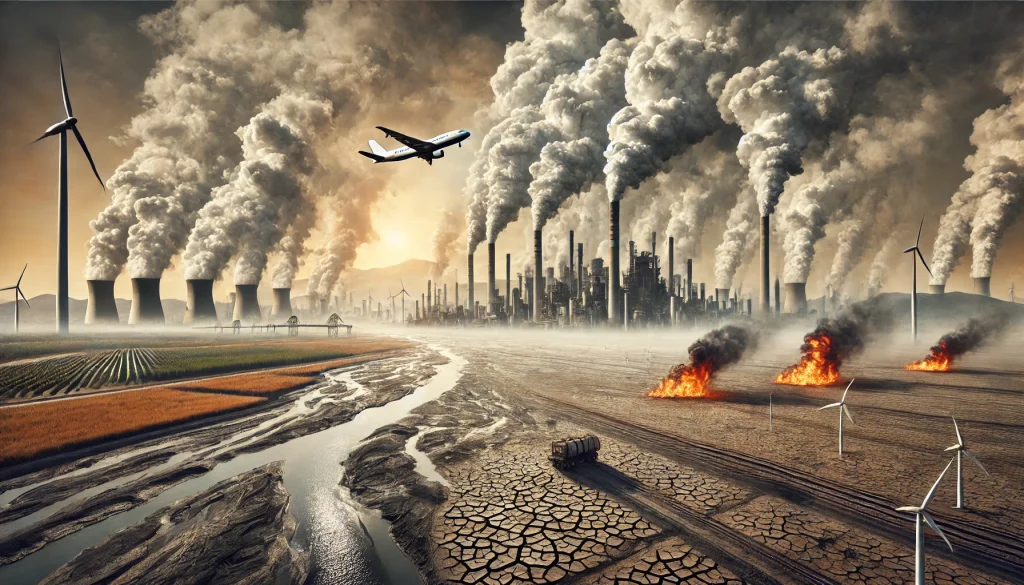
Global carbon emissions are projected to reach an unprecedented 41.6 billion metric tons this year, according to a report by the Global Carbon Budget presented at the UN’s COP29 climate summit in Baku. The increase, up from 40.6 billion metric tons in 2023, is primarily due to continued fossil fuel dependence and a surge in land-use emissions, including deforestation and forest fires. The findings highlight an alarming trend that distances the world from its climate goals, as emissions rise despite international pledges to reduce them.

The report, led by the University of Exeter with contributions from over 80 global institutions, warns that without immediate, substantial emission cuts, global temperatures are likely to breach the critical 1.5 °C threshold set by the 2015 Paris Agreement, increasing the risk of severe climate disruptions.
Fossil Fuels Drive Emissions Surge
Fossil fuel combustion remains the primary emissions source, contributing 37.4 billion metric tons in 2024—an increase of 0.8% from the previous year. Coal, oil, and gas provide about 80% of the world’s energy, underscoring the global economy’s entrenched reliance on these high-carbon fuels. The report finds no sign that fossil fuel emissions have peaked, a major challenge in meeting climate targets.
Pierre Friedlingstein, the report’s lead author and a climate scientist at the University of Exeter, emphasized that continued emissions growth could make the 1.5 °C target permanently unattainable. “We don’t see fossil fuel emissions peaking in 2024,” he said. “Without swift reductions, we will overshoot the target and continue warming.”
Divergent Global Emission Trends
The data reveals stark disparities in emission patterns across countries. While emissions in developed economies show signs of decline, emissions in rapidly industrializing nations continue to rise, driven by energy demands and economic growth.
- United States: The world’s largest oil and gas consumer, projected to reduce emissions by 0.6% this year.
- European Union: Emissions expected to fall by 3.8% in 2024.
- India: Emissions projected to increase by 4.6%, fueled by economic expansion and rising energy demands.
- China: The world’s largest emitter is expected to see a modest 0.2% increase, although signs suggest emissions from oil use may peak as electric vehicle adoption rises.
At COP29, tensions flared over responsibility for emission reductions. Host country Azerbaijan’s President Ilham Aliyev criticized Western nations for “lecturing” on climate commitments while maintaining high fossil fuel consumption. His remarks underscore a longstanding debate over which nations should lead the shift to low-carbon energy, with wealthier countries historically responsible for the highest emissions.

Rebound in Aviation and Shipping Emissions
The report also highlights a significant rebound in emissions from international aviation and shipping, sectors that saw declines during the COVID-19 pandemic. Emissions from these industries are projected to rise by 7.8% this year as air travel resumes, adding pressure on governments and corporations to develop cleaner alternatives in these challenging areas for decarbonization.
Wildfires and Deforestation Accelerate Land-Use Emissions
In addition to fossil fuel emissions, land-use emissions—which include deforestation and forest fires—are expected to increase by 13.5% to 4.2 billion metric tons. Severe droughts in the Amazon have intensified forest fires, reversing recent declines in land-use emissions.
Renewable Energy Expansion Falls Short of Offsetting Emissions
While the report acknowledges the progress some countries have made in expanding renewable energy and adopting electric vehicles, these advances remain insufficient to counterbalance the global rise in emissions. Industrialized nations generally lead the renewable transition, but emerging economies face significant challenges in moving away from fossil fuels.
The Path Forward: Challenges and Recommendations
As global leaders confront intensifying climate impacts, the message from COP29 is clear: without sweeping, coordinated action, current emission trajectories will likely result in greater climate extremes. To stay within the 1.5 °C limit, global emissions must decline rapidly each year through 2030—a goal scientists say is becoming increasingly difficult to achieve.
The report underscores the urgent need for governments and industries to double down on low-carbon investments, accelerate the phase-out of coal, oil, and gas, and adopt resilient policies in response to rising temperatures. With global leaders under pressure to set new, more ambitious targets at COP29, the world waits to see if these commitments will lead to meaningful action.