The relentless cycle of violence and exploitation in Eastern DRC is not just a regional issue but a glaring example of how global demands and local governance failures collide. By allowing continuous conflict and exploitation, particularly in the mining of critical minerals like tantalum, the international community and local leaders are complicit in perpetuating a crisis that they periodically attempt to placate with ineffective ‘peace talks.’” — Melissa ‘Mel’ Sanderson, Government Relations Expert & Co-Chair, Critical Minerals Institute (CMI)

Today’s headlines about violence in the Eastern DRC could have been written decades ago—because they essentially have been, for over 20 years. Once again, the terrorist group M23, backed by Rwandan President Paul Kagame, is advancing with the aim of capturing Goma, a key city in Eastern Congo. Why Goma? While it serves as a major commercial port with Rwanda, Kigali already has unfettered access to the region’s mineral wealth. M23’s goal is not logistical but political: to replicate its previous success when it seized Goma and was rewarded with concessions legitimized by hastily convened “peace talks.” Predictably, the UN and Western nations are once again calling for a ceasefire and peace talks.
Related News
- GoviEx Uranium Advances Muntanga Project with Strong Feasibility Study Results
- China’s dominance over critical minerals isn’t just an economic edge—it’s a global power move!
- Zulu Lithium and Tantalum Project: Premier African Minerals Secures $4.35 Million to Revive Operations
- Rio Tinto and Glencore’s Merger Talks Signal a Potential Shift in Mining Industry Dynamics
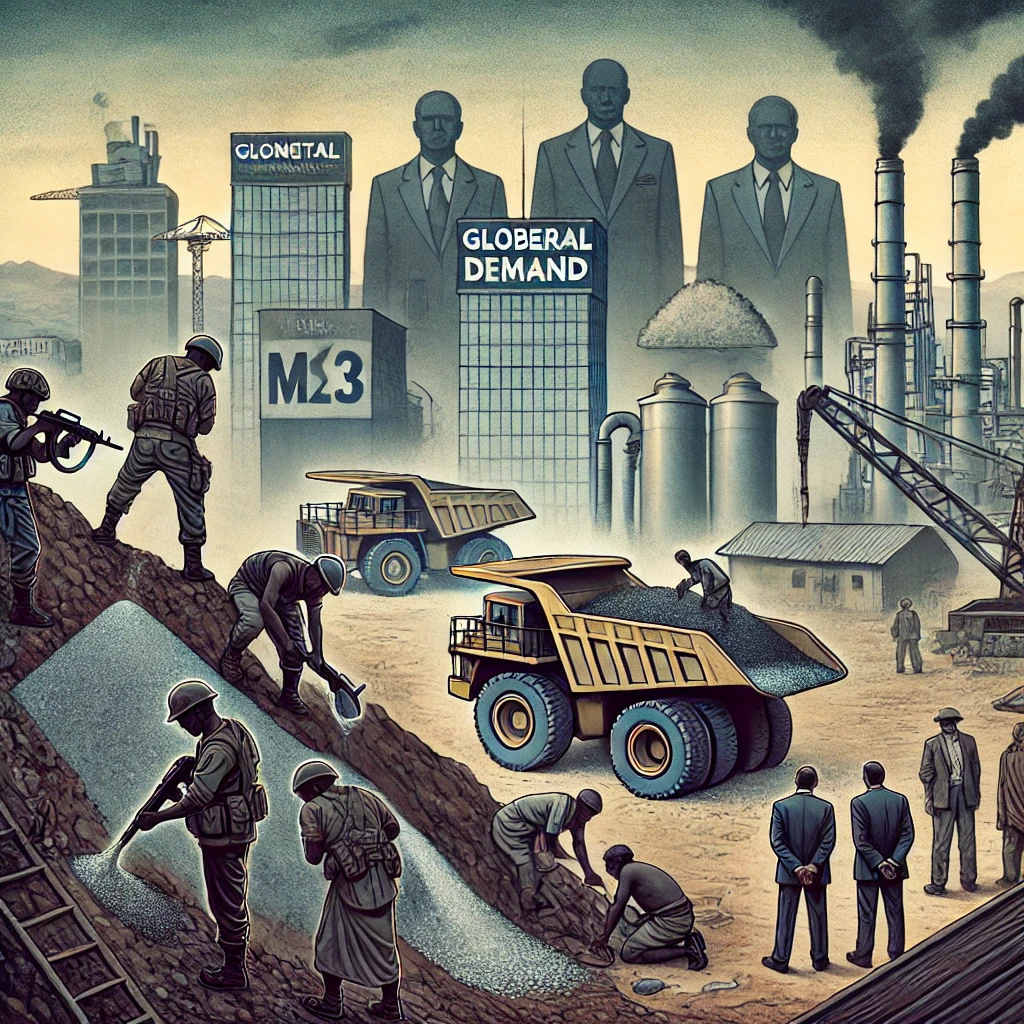
President Kagame faces increasing scrutiny as traceability measures for critical minerals such as coltan and tantalum tighten, threatening the lucrative illicit trade of minerals mined in Eastern Congo under abhorrent conditions. Kagame’s solution is to secure his supply chain by deploying M23 as a proxy force to terrorize the region. The connection between Kagame, the Rwandan military, and M23—whose leadership includes former Rwandan military officers—has been thoroughly documented over the past two decades. During this time, M23 has repeatedly committed atrocities, from using rape as a weapon of war to abducting children—girls forced into sexual slavery and boys turned into drug-addicted soldiers. Civilians are enslaved to extract and transport the minerals that M23 and Rwanda profit from.
‘Peace talks’ are not the solution. Talks presuppose multiple parties negotiating in good faith, which is not the case here. Kagame has consistently dismissed peace efforts without facing meaningful consequences. As long as Kagame faces no real penalties, he has no incentive to withdraw his proxy forces or cease his de facto annexation of Eastern Congo.
If the international community truly seeks peace in Eastern Congo, Kagame must be held accountable. He should be named as a sponsor of terrorism, and both he and the Kigali-based traders profiting from stolen minerals should face sanctions. Further, Kagame’s actions in DRC warrant investigation and potential prosecution for war crimes at the International Court of Justice. Kagame, often portrayed as Rwanda’s “elected” leader, is in fact a dictator who suppresses dissent, manipulates elections, and silences political opponents through imprisonment or forced disappearances—all while the world turns a blind eye.
For companies considering doing business in DRC, the situation poses a dilemma. Eastern Congo remains fraught with risks, from violence to extortion, with employees attacked, mine sites raided, and shipments stolen. Yet, the DRC is vast—roughly the size of the United States east of the Mississippi River. Mineral wealth is spread across the country, and the violence in the East does not affect regions far removed from M23 activity.

The Congolese government has made efforts to attract businesses by offering incentives, and the nation boasts a well-educated, eager workforce, especially in mining. Surprisingly, violence is not the primary challenge to doing business in DRC. The greater issue is the lack of infrastructure, which makes transportation and exporting products difficult, particularly in remote regions. For instance, a mining company in northwestern DRC may find inaccessibility a far greater obstacle than conflict.
Despite Africa’s challenges, DRC fares better than some of its neighbors. Corruption is less pervasive than in other African nations, societal violence is comparatively lower, and the country has so far avoided military coups. Foreigners face less prejudice, and the capital city is relatively stable.
Congo is not a “no-go zone”—except for the mineral-rich areas in the East from Bukavu to the Ugandan border, where Kagame exerts influence. If international businesses wish to operate securely in these regions, they must urge their governments to impose meaningful consequences on Kagame. Only by removing Rwanda’s control over Eastern Congo can peace be achieved, paving the way for economic development throughout the DRC.