By Charles Pitts | Deep-Dive Analysis

Newmont Corporation is advancing one of the most technically ambitious marine engineering and resource expansion initiatives in the global gold sector. The mining major is constructing an engineered nearshore soil barrier at its world-class Lihir gold mine in Papua New Guinea (PNG). Designed to control marine water seepage and stabilize ground conditions, the multi-million-dollar project unlocks more than 5 million ounces of high-grade gold reserves previously trapped beneath sea level in the rich Kapit ore body.
With full funds approval secured in February 2026 and physical mobilization scheduled for the second half of 2026, the project represents a capital commitment of US$500 million to US$550 million. The development is engineered to transform Lihir’s long-term production profile, paving the way for commercial production gains beginning in 2028 and extending the asset’s operating horizon well beyond 2040.
For institutional investors, project developers, and mining operators tracking tier-1 gold assets, the Lihir barrier expansion offers a compelling case study in overcoming complex hydrogeological boundaries to extract high-margin ounces from mature mining districts.
Engineering the Kapit Ore Body Below Sea Level
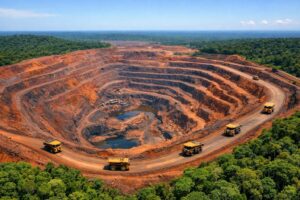
The Lihir operation, situated on Anietam Island within the-fabled Tabar group of PNG, has been a cornerstone of global gold supply for decades. However, mining the deeper extensions of the Kapit deposit has consistently presented severe geotechnical and hydrological challenges. Because a substantial portion of the high-grade ore body sits directly beneath sea level, uncontrolled seawater ingress and weak nearshore soils have historically limited deep-bench extraction.
More Read


To solve this, Newmont’s engineering teams designed an in-ground reinforced concrete seepage barrier: commonly referred to as the nearshore soil barrier. This subterranean wall acts as a hydrological cut-off, sealing off marine water migration into the open pit. By effectively stabilizing the shoreline and isolating the excavation zone from tidal influences, the barrier allows heavy equipment to safely access deeper benches that were previously unreachable under standard dewatering protocols.
Geotechnical assessments indicate that this boundary reinforcement will dramatically improve slope stability, reducing wall-movement risks and ensuring consistent material movement across the pit benches. The project requires precision marine construction techniques, coffer-dam staging, and continuous real-time geotechnical monitoring to execute the barrier installation without disrupting ongoing processing plant feed.
More Read

Capital Architecture and Financial Backing
Financing a major engineering undertaking of this scale requires robust balance-sheet strength. Newmont is funding the US$500 million to US$550 million total development capital through internal cash generation, supported by a stellar operational performance period. The mining titan recently reported a record Q2 free cash flow of US$2.2 billion, providing ample liquidity to absorb the initial capital outlays without straining dividend commitments or broader corporate exploration budgets.
| Project Metric | Specification | Operational Implication |
|---|---|---|
| Total Development Capital | US$500M – US$550M | Fully funded via internal free cash flow |
| 2026 Capital Allocation | ~US$140M | Covers engineering mobilization and early site works |
| Target Incremental Reserves | >5 Million Ounces | High-margin gold unlocked from Kapit ore body |
| Capital Intensity | ~US$100 – US$110 per oz | Highly competitive unit development cost |
| Target Completion | Second Half 2028 | Phased ramp-up toward full production gains |
As detailed in the capital allocation schedule above, Newmont has earmarked approximately US$140 million for expenditure during fiscal year 2026. Dividing the total projected capital expenditure by the targeted reserve addition yields an estimated capital intensity of US$100 to US$110 per incremental ounce. In the context of contemporary gold development: where grassroots discoveries in remote jurisdictions frequently face severe inflation and permitting bottlenecks: unlocking brownfield reserves through targeted engineering infrastructure offers superior capital efficiency.
Timeline to 2028: Mobilization and Construction Phases
The execution timeline for the Lihir nearshore barrier is structured across distinct operational milestones to mitigate execution risk. Following detailed front-end engineering design (FEED) and environmental permitting sign-offs, site mobilization is slated to accelerate through the second half of 2026.

Heavy marine civil works will dominate the 2027 construction calendar. Specialized marine piling rigs, slurry trenching equipment, and batching plants will be deployed to construct the contiguous pile wall along the coastline. Because Lihir operates on a remote island environment, logistical management of cement, reinforcing steel, and specialized marine vessels represents a critical operational path. Newmont’s supply chain management teams have established dedicated staging hubs to maintain uninterrupted inventory flow through the construction phase.
Production gains from the newly accessible Kapit reserves are projected to come on stream in 2028. As the barrier wall seals the marine interface and internal dewatering stabilizes the lower benches, mill feed grades are expected to experience a meaningful upward shift. This grade uplift directly supports Newmont’s objective of maintaining steady-state, low-cost gold production across its tier-1 asset portfolio.
Extending Lihir Beyond 2040: Strategic Horizon
For PNG’s mining sector and Newmont’s global stakeholders, the successful execution of the nearshore barrier secures Lihir’s operational future for another generation. Prior to this investment, Lihir’s mine life faced declining reserve grades and geological constraints that threatened a production tapering toward the late 2030s.

By unlocking more than 5 million ounces of high-confidence reserves, the project effectively extends the mine’s productive lifespan beyond 2040. This longevity provides long-term revenue visibility, sustains local employment for over 4,000 direct and contractor personnel, and underpins ongoing community development programs in New Ireland Province.
Furthermore, the project reinforces broader industry trends highlighted in recent market analysis across Skillings Mining Intelligence, where major producers increasingly favor brownfield expansions over high-risk greenfield exploration to secure tier-1 production profiles. For a deeper look at how capital discipline and asset optimization are driving the current mining landscape, industry professionals can review our ongoing reporting on global mining investments.
Control Room Integration and Fleet Optimization
Executing complex brownfield expansions requires seamless coordination between on-site marine civil teams and central operational telemetry. Lihir’s central control room serves as the nerve center for the mine, integrating real-time geotechnical radar data, slope stability monitors, and ultra-class haulage fleet tracking systems.

As excavation deepens within the Kapit pit behind the barrier wall, automated monitoring arrays will continuously measure pore-water pressure, wall displacement, and seismic activity. This data-driven approach ensures that mining operations adjacent to marine structures adhere to rigorous safety thresholds without sacrificing productivity. Fleet management systems will dynamically reroute haul trucks across the terraced benches, optimizing cycle times as high-grade ore from the newly unlocked zones begins flowing toward the primary crushers and processing plant.