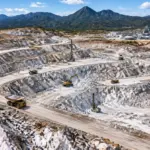
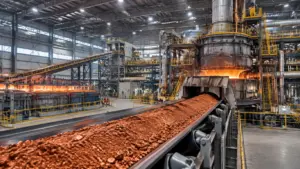
Representative cobalt processing facility with drying equipment and bagged concentrate in Central Africa.

By Salini Krishnan
A peer-reviewed study estimates that between 2,000 and 5,000 tonnes of natural uranium may have left the Democratic Republic of the Congo embedded in cobalt-hydroxide shipments between 2000 and 2024, exposing gaps in nuclear accountancy, worker protection and mineral-supply-chain oversight.
The finding, reported by NewsGram and detailed in a study published by Nature Communications, comes as refiners, battery manufacturers and governments intensify scrutiny of the cobalt supply chain.
The study’s authors, Ryan A. Manzuk of Princeton University and Sébastien Philippe of the University of Wisconsin-Madison, concluded that uranium and cobalt are naturally co-located in the southern DRC Copperbelt and can follow similar paths through hydrometallurgical processing.
The DRC supplies more than 70% of the world’s mined cobalt, according to the study and related reporting. The metal is used in some lithium-ion batteries for electric vehicles, smartphones, laptops and energy-storage systems, making the finding relevant well beyond the mining sector.

Study identifies uranium carryover in cobalt exports
The research, titled “Uranium in cobalt-hydroxide exports from the Democratic Republic of the Congo,” combines geological mapping, geochemical data, mine-level trade records and a model of uranium behavior during cobalt processing.
The researchers did not allege that uranium was deliberately smuggled out of the DRC. Instead, they described a byproduct pathway created by the region’s geology and the chemistry used to prepare cobalt for export.

Uranium occurs throughout parts of the Copperbelt, including near cobalt-bearing deposits. The principal cobalt mineral in oxidized ores, heterogenite, can absorb oxidized uranium compounds. During processing, the two elements can remain together as ore is leached and cobalt is concentrated.
The result is crude cobalt hydroxide, the main export form for DRC cobalt. The paper says more than 95% of DRC cobalt production has been exported in this form, rather than as refined cobalt metal or high-purity chemical products.
The study estimates that less than 10% of the uranium associated with those exports has been publicly declared and placed under international safeguards.
| Study finding | Estimate or implication |
|---|---|
| Natural uranium in cobalt-hydroxide exports, 2000–2024 | 2,000–5,000 tonnes |
| Uranium likely discarded in tailings | 1,000–4,000 tonnes |
| DRC share of global mined cobalt | More than 70% |
| Operations examined for uranium-removal indicators | 31 |
| Operations consistently showing evidence of phosphoric-acid treatment | Three |
| International shipping reference cited in the study | 75 parts per million uranium |
The estimates are modeled rather than based on a complete shipment-by-shipment assay program. The authors emphasized that limited public data on uranium grades and refinery flowsheets required them to work with scenarios covering low, intermediate and high uranium mobility.
Why cobalt processing can retain uranium
Cobalt processing in the Copperbelt commonly involves crushing and upgrading ore, leaching it with sulfuric acid, removing impurities and precipitating cobalt hydroxide.
At the acidic conditions used during leaching, uranium compounds can remain soluble alongside cobalt. Later impurity-removal steps may remove some uranium, but the study found that standard processing is not necessarily sufficient to separate the elements.

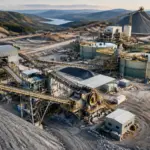
Hydrometallurgical equipment used to process cobalt-bearing material.
The researchers modeled two potential removal technologies: phosphoric-acid precipitation and ion-exchange systems. Both can be designed to remove uranium before cobalt hydroxide is shipped, but they require additional equipment, reagents and operating controls.
Analysis of import records suggested limited adoption. The study found no evidence of large-scale ion-exchange deployment for cobalt-stream uranium removal. Only three of the 31 operations examined appeared to be consistently importing enough phosphoric acid to meet the researchers’ treatment benchmark.
The authors estimated that about 20% of cumulative cobalt exports showed evidence of targeted uranium removal into stable tailings by the end of the study period. They cautioned, however, that phosphoric acid can also be used for other processing purposes, meaning import records are an indicator rather than definitive proof of plant performance.
Nuclear safeguards concern extends beyond the mine
The uranium identified in the study is natural uranium. It cannot be used directly in a nuclear weapon without further conversion and enrichment, and the research does not establish that any uranium was diverted for military use.
The concern is one of visibility and control. Uranium carried in a cobalt shipment may not enter nuclear accountancy until it is recovered downstream. That creates a potential gap between mining and processing records, particularly when the material is classified commercially as a cobalt product rather than a uranium shipment.
The study cites a documented case involving Finland’s Kokkola Chemicals facility, where uranium recovered during purification of DRC-origin cobalt products was declared and sold between 2010 and 2017. The authors said this was one of the few publicly documented examples of uranium entering the international supply chain through DRC cobalt production and subsequently being placed under safeguards.
About 65% of the uranium-bearing cobalt exports estimated by the researchers were sent to Chinese-owned companies, according to the paper. China dominates global cobalt refining, which means the issue could affect national material balances and downstream reporting obligations under international safeguards arrangements.
The authors also compared the modeled quantities with the International Atomic Energy Agency’s reporting framework. They said that even shipments meeting the cited 75 parts-per-million shipping threshold could contain enough uranium to raise accountancy and reporting questions when handled at the scale of the DRC’s cobalt industry.
Implications for refiners and battery supply chains
For refiners, the immediate issue is feedstock characterization. A cobalt hydroxide shipment that meets commercial specifications for cobalt content may still require additional testing for uranium and other regulated impurities.
Independent sampling at mine sites, processing plants, ports and receiving refineries could establish how much uranium is actually present. The study authors recommended representative assays rather than relying only on radiation checks at borders or ports.
Radiation screening remains important, but a negative or low reading from a basic instrument may not provide a full material balance. The level of detection, sampling method and consistency of testing all influence whether uranium-bearing shipments are identified.
For battery manufacturers and other end users, the finding does not mean that electric vehicles or finished battery cells necessarily contain hazardous uranium. Downstream refining can remove uranium from cobalt intermediates. However, the study raises questions about whether companies can demonstrate where and how that removal occurred.
That could add pressure to existing due-diligence systems covering labor conditions, environmental performance, sanctions exposure and origin tracing. Companies may need to expand supplier audits to include radiological assays, refinery treatment records and tailings-management controls.
The issue is consistent with broader scrutiny of critical-mineral supply chains, where ESG compliance and tailings rules increasingly overlap with trade, national-security and industrial-policy concerns.
Environmental and worker-safety risks
The study also estimates that between 1,000 and 4,000 tonnes of uranium may have been diverted to tailings in mobile forms during mining and processing.
That does not automatically mean every tailings facility presents the same level of risk. Uranium behavior depends on mineralogy, water movement, containment design and local operating conditions. But the authors said some uranium-bearing residues could be remobilized or re-leached, creating risks for nearby water systems and communities.

Bagged cobalt hydroxide concentrate awaiting shipment or further refining.
Worker exposure is another concern. Earlier research cited by the authors has reported uranium exposure among some artisanal miners and residents in the Copperbelt through blood and urine sampling. Artisanal workers may face higher risks because they can handle mineralized material directly, often without radiation monitoring or suitable protective equipment.
The researchers recommended biomonitoring for workers, improved ventilation in underground workings, independent testing of cobalt products and stronger controls on tailings storage. They also called for uranium to be removed from cobalt streams and disposed of in stable, isolated forms rather than left in easily mobilized residues.
DRC probe will face a data challenge
NewsGram reported that the DRC launched a probe after the study’s publication to test outgoing cobalt shipments for uranium and consult with the IAEA.
The investigation will need to distinguish between modeled estimates and measured material flows. A national sampling program covering different mines, ore types, refineries and export routes could help determine whether uranium concentrations are broadly distributed across the Copperbelt or concentrated in specific operations.
The findings may also prompt refiners and importers to revisit contracts. Commercial agreements could include uranium specifications, independent assay requirements, notification obligations and procedures for handling material that exceeds regulatory thresholds.
For the wider cobalt industry, the study illustrates how a critical-mineral supply chain can carry risks that are not visible in conventional production, quality or ESG reporting. The central question is no longer only how much cobalt is being produced, but also what other materials move with it: and whether those materials are being measured, reported and managed.
Further research and data are available through the study’s open-access article, including supplementary production, geological and processing information. Skillings continues to track developments across critical minerals and mining markets, including the regulatory and operational issues shaping the energy transition.

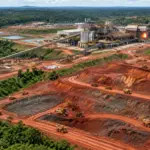
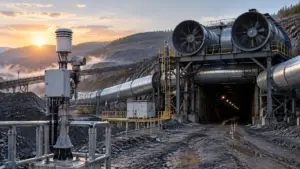
Mining and processing infrastructure in the DRC’s southern Copperbelt region.