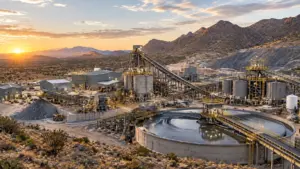
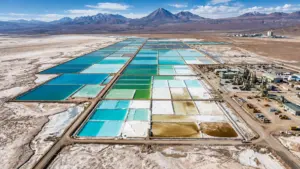
Representative view of the Northwestern Ontario mining region.

By Penny Langford
Generation Mining has secured $340 million in final funding for its 100%-owned Marathon copper-palladium project in Northwestern Ontario, completing what the company describes as an approximately C$1.3 billion construction financing package.
The financing brings the project closer to a construction decision after a year of negotiations with senior lenders, government-backed Canadian investment institutions, equity investors and metals partners. Generation Mining said early works construction is expected to begin in the fourth quarter of 2026, subject to the completion of the financing documents, regulatory approvals and other conditions.
The company’s Sept. 14 announcement did not specify a currency for the $340 million headline figure. Its related project disclosures use Canadian dollars for the overall capital package and most financing facilities. This article therefore refers to the final package as approximately C$340 million where currency clarification is required.
Financing package combines equity and subordinated debt
The final funding consists of three components:

| Component | Amount | Main participants |
|---|---|---|
| Bought-deal equity financing | C$200 million | Canada Growth Fund, Wheaton Precious Metals and Glencore Canada among the committed investors |
| Private placement | C$40 million | Canada Growth Fund |
| Subordinated unsecured convertible note | C$100 million | C$50 million from Canada Growth Fund and C$50 million from Canada Infrastructure Bank |
| Total final funding | C$340 million | : |
Under the bought deal, Generation Mining will issue 312.5 million common shares at C$0.64 per share. BMO Capital Markets is acting as sole bookrunner for the underwriting syndicate. The company said the offering is expected to close around Sept. 21, subject to regulatory approvals, including approval from the Toronto Stock Exchange.
The private placement will involve the issuance of 62.5 million common shares at the same price. Canada Growth Fund, an arm’s-length Canadian investment vehicle, has also committed to subscribe for the private placement.
The C$100 million convertible note will carry an annual interest rate of 9%, payable semi-annually, and was priced at a 40% conversion premium to the equity financing. The notes will be unsecured and subordinated, with an initial term ending no later than 11 years from issuance under the terms outlined by the company.
Completion of the note financing remains subject to shareholder approvals and other regulatory conditions. Generation Mining said it expects to hold a special shareholder meeting in the fourth quarter.
Capital stack reaches approximately C$1.3 billion
The final funding is being added to a financing structure that already includes senior project debt, subordinated debt, a metals stream and equipment leasing.
In June, Generation Mining said Export Development Canada, ING Capital and Société Générale had received internal credit approval for a US$310 million senior secured project finance facility, equivalent to approximately C$424 million at the exchange rate used in the company’s disclosure.
The senior facility is intended to fund construction and development of the Marathon project. It remains subject to final documentation, intercreditor arrangements and customary conditions precedent.
The Canada Infrastructure Bank separately received internal credit approval for a C$200 million subordinated facility. That facility includes C$110 million of subordinated debt for development and construction, as well as a C$90 million standby facility to help cover potential construction cost overruns.
The project also has an existing metals streaming agreement with Wheaton Precious Metals. Generation Mining has identified approximately C$200 million of undrawn stream funding, in addition to C$145 million of equipment leasing facilities. Together with the senior facility, those arrangements represented approximately C$769 million of funding identified in the company’s June financing update.
The company later reported approximately C$969 million of funding when the C$200 million CIB facility was included. The final C$340 million package is intended to close the remaining financing requirement and bring the total construction funding envelope to approximately C$1.3 billion.
The package includes a C$185 million cost overrun facility for the benefit of senior lenders. Generation Mining said C$95 million of that facility will be funded through the final funding arrangements, while C$90 million will come from the previously announced CIB subordinated facility. The company also cited a C$119 million contingency within the mine’s capital costs, as well as surety bonds and letters of credit totaling C$78 million.
Marathon project remains subject to final investment decision
The Marathon project is located near the town of Marathon on the north shore of Lake Superior. Generation Mining describes it as one of the few fully permitted critical-minerals projects in North America.
The company’s latest announcement said its board is expected to convene and make a final investment decision after the financing components are completed. The timing is important because financing close, rather than credit approval alone, is the point at which the project can move from capital arrangement into full construction execution.
Generation Mining previously said construction could begin in the second half of 2026. Its latest guidance points to early works construction in the fourth quarter.
The company has also awarded the engineering, procurement and construction management contract for the project to Ausenco. That work is intended to advance alongside financing and other pre-construction activities.

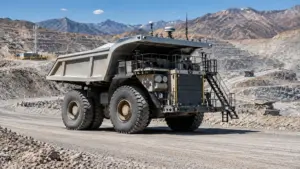
Representative mine construction activity in a Canadian setting.
Copper and palladium strengthen the project’s critical-minerals relevance
Marathon’s proposed production profile gives the project exposure to both copper and palladium, two metals with different but strategically important market roles.
Copper is used extensively in power infrastructure, electrification, industrial equipment and renewable-energy systems. Palladium is primarily associated with emissions-control technologies and has historically been important to the automotive sector. The combination gives Marathon a polymetallic profile rather than a single-commodity revenue base, although it also exposes the project to movements in several commodity markets.
Generation Mining’s feasibility study, with an effective date of Nov. 1, 2024, estimated a net present value of C$1.07 billion using a 6% discount rate. The study also reported a 28% internal rate of return and a 1.9-year payback based on three-year trailing average metal prices at the effective date.
Over an anticipated 13-year mine life, the company estimates payable production of:
- 532 million pounds of copper;
- 2.161 million ounces of palladium;
- 488,000 ounces of platinum;
- 160,000 ounces of gold; and
- 3.051 million ounces of silver.
Those figures are projections rather than operating results and remain subject to construction performance, commodity prices, operating costs, permitting compliance and other project risks. The full feasibility study is available through Generation Mining’s project feasibility study page.
For broader context on the role of copper in the energy transition, Skillings has also examined the interaction between inventories, tariffs and supply risks in its copper price outlook.
Glencore agreement links concentrate to Canadian processing
Generation Mining also announced terms for a copper and metals supply contract with Glencore AG. Under the agreement, Glencore will purchase polymetallic copper concentrate containing copper, palladium, platinum, gold and silver produced at Marathon.
The concentrate is expected to support domestic processing at Glencore Canada’s Horne smelter in Rouyn-Noranda, Quebec, described by Generation Mining as Canada’s only copper smelter. Further processing is expected to take place through Glencore Canada’s CCR refinery and other domestic facilities.
Under the proposed offtake structure, Glencore AG would purchase 100% of concentrate production during the first two calendar years after commercial production and from the 13th year onward. During the intervening years, Glencore would be entitled to approximately 50% of annual mine production, subject to an agreed scheduling mechanism and other offtake commitments.
The agreement is designed to give Marathon a defined outlet for its concentrate while connecting the project to existing Canadian processing infrastructure. It also supports the policy objective of developing more domestic critical-minerals supply chains, although the project must still complete construction and achieve commercial production before those benefits are realized.

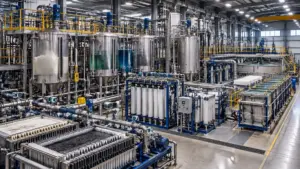
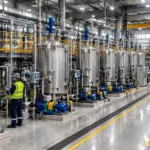
Representative mineral processing infrastructure.
Financing reduces one risk but leaves execution milestones
The final funding announcement removes a major financing uncertainty for Generation Mining, but it does not eliminate the remaining risks associated with building a large-scale mine.
The company must complete the bought deal, private placement and convertible note transactions, obtain required shareholder and stock exchange approvals, finalize project finance documentation and satisfy intercreditor and other conditions. It must then manage construction costs, contractor performance, equipment delivery, commissioning and operational ramp-up.
The financing structure also includes a substantial equity component. The bought deal and private placement will increase the number of shares outstanding, while the convertible note could create additional dilution if converted into common shares. At the same time, the subordinated debt and streaming arrangements add obligations that will affect the project’s future cash flows.
The next material milestones are therefore expected to be the closing of the equity financing, approval of the convertible note, completion of senior and subordinated debt documentation, the board’s final investment decision and the start of early works.
For Canada’s mining sector, the project’s significance extends beyond Generation Mining. If construction proceeds as planned, Marathon would add a new domestic source of copper and palladium and connect mine production with Canadian smelting and refining infrastructure. For investors and project financiers, the focus now shifts from whether the capital can be assembled to whether the financing can be closed and converted into a controlled construction program.

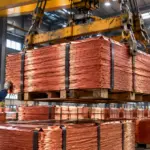
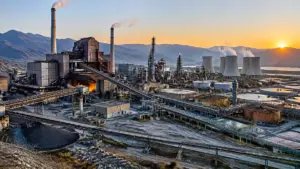
Representative concentrate transport infrastructure.
Sources: Generation Mining financing announcement, senior lender credit approval, Canada Infrastructure Bank subordinated debt commitment, and Generation Mining corporate project information.