For decades, Rio Tinto’s investment thesis has been synonymous with the Pilbara. The Australian iron ore engine has fueled record dividends and established Rio as one of the most efficient “bulk” movers in industrial history. However, as of July 2026, the narrative is shifting. With iron ore price pressure mounting and China’s steel demand reaching a structural plateau, Rio Tinto is aggressively pivoting its capital toward two distinct pillars: the Simandou project in Guinea and a massive expansion into the lithium sector.

The central question for investors and operators heading into 2027 is whether these high-growth assets can generate enough EBITDA to offset a softening iron ore market. This analysis explores the operational ramp-up of Simandou, the integration of lithium assets, and the financial trajectory of a major in transition.
The Iron Ore Challenge: Price Pressure and Surplus
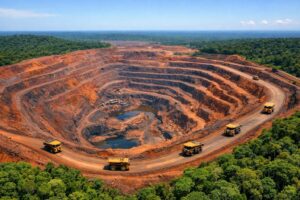
The “cash cow” of the Pilbara is facing a supply-demand squeeze. As we move through the second half of 2026, the seaborne iron ore market is tilting toward a surplus. The arrival of massive new tonnage: ironically much of it from Rio’s own Simandou project: is expected to push benchmark 62% Fe prices toward the $85–$90/dmt range by 2027.
While Rio Tinto remains a low-cost producer, the compression of margins in its legacy business necessitates a high-grade, high-margin alternative. This is where Simandou enters the frame.
Simandou: The “Pilbara of Africa” Enters Ramp-Up
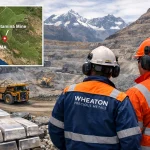
Simandou is no longer a “future project”; it is a live operational reality. Following the first cargo shipment in late 2025, the SimFer mine is currently in its primary 30-month ramp-up phase.
More Read


Operational Milestones and 2027 Outlook
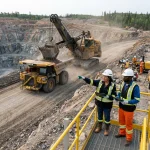
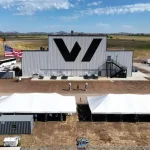
As of July 2026, construction at the SimFer mine site is approximately 75% complete, with the permanent crushing facilities expected to come online in H2 2026. The common rail-to-port infrastructure, a joint effort between Rio Tinto, the Guinean government, and the Winning Consortium Simandou (WCS), is now operational, facilitating the flow of what is arguably the highest-grade iron ore in the world.
- Capacity: At steady state, SimFer is designed for 60 million dry tonnes per year (Mtpa), with Rio Tinto’s share being ~27 Mtpa.
- Grade Advantage: With an average grade of ~65.3% Fe, Simandou ore commands a significant “green steel” premium. As steelmakers globally transition to Electric Arc Furnaces (EAFs) and Direct Reduced Iron (DRI) to meet ESG targets, the demand for low-impurity, high-grade feedstock like Simandou’s is expected to decouple from the standard 62% benchmark.
- Cost Structure: By 2027, as the project nears full run-rate, All-In Sustaining Costs (AISC) are targeted in the $55–$60/dmt range. This ensures that even in a depressed price environment, Simandou remains a Tier-1 EBITDA contributor.
The Lithium Gambit: Beyond the Arcadium Integration
Rio Tinto’s move into lithium is perhaps the most significant strategic shift in the company’s 114-year history. Following the 2024 acquisition of Arcadium Lithium, Rio has spent the last 18 months integrating a sprawling portfolio of brine and hard-rock assets across Argentina, Australia, and Canada.
More Read


The focus for 2027 is on the “Argentina Hubs.” Rio Tinto is developing a blueprint for two major lithium carbonate production centers in the Salta province. These projects are targeting a capital intensity of ~$30/kg of capacity and C1 operating costs below $5/kg.
By diversifying into lithium, Rio is betting that the lithium structural floor will provide a counter-cyclical hedge against iron ore. While iron ore is tied to traditional infrastructure and property, lithium is the bedrock of the energy transition and Battery Energy Storage Systems (BESS).
Financial Pivot: Shifting the EBITDA Focus toward FY27
The transition from a bulk-iron-ore-heavy earnings profile to a diversified energy-transition major is reflected in the company’s capital allocation. While the Pilbara still generates the bulk of the group’s current cash flow, the growth in EBITDA from 2027 onwards is heavily weighted toward Simandou and the Lithium division.
Comparison of Key Growth Pillars (Targeting FY27)
| Metric | Simandou (Iron Ore) | Argentina Lithium Hubs |
|---|---|---|
| Asset Type | High-grade hematite | Lithium Carbonate (Brine) |
| Annual Capacity (Target) | 60 Mtpa (Total) | 50kt – 100kt LCE (Consolidated) |
| Operating Cost (Target) | $55–$60/dmt AISC | <$5/kg C1 |
| Strategic Moat | High-grade (65%+ Fe) premium | Integration with global battery OEMs |
| Primary Risk | Guinean geopolitical stability | Price volatility in battery chemicals |
The integration of advanced mining operations control rooms has been a key factor in keeping these remote projects on schedule. By centralizing data from the SimFer rail line and the Argentine brine fields, Rio Tinto is attempting to replicate the autonomous efficiency of its Pilbara operations in far more complex jurisdictions.

Key Risks and Execution Hurdles
The pivot is not without significant risk. Simandou is located in a complex geopolitical environment. While the Guinean government has remained a supportive partner through the infrastructure phase, any shift in local policy or regional stability could disrupt the final 25% of construction.
In the lithium space, Rio faces a competitive landscape dominated by incumbents like Albemarle and SQM, as well as aggressive Chinese producers. The success of the Arcadium integration will depend on Rio’s ability to scale the DLE (Direct Lithium Extraction) technology at Rincon while managing a global supply chain that is increasingly fragmented by trade protectionism.
Conclusion: A New Era for Rio Tinto
Rio Tinto is no longer just an iron ore company with a side of aluminum and copper. As we look toward 2027, the company is emerging as a critical minerals powerhouse. Simandou provides the high-grade volume needed to sustain iron ore margins in a softening market, while the lithium portfolio offers a direct play on the decarbonization of the global economy.
For decision-makers and investors, the next 18 months are critical. The ramp-up at Simandou and the commissioning of the first Argentine lithium hubs will determine if Rio can successfully replace its aging “cash cow” with a new, more resilient herd of energy-transition assets.