By Charles Pitts

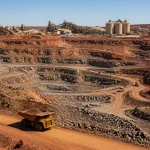
The global iron ore market is on the verge of its most significant structural shift in decades. Deep in the heart of Guinea’s Simandou mountains, an engineering feat of unprecedented scale is nearing completion. Often referred to as the “Mount Everest of mining,” the Simandou project represents a $27 billion investment in high-grade iron ore and the critical infrastructure required to bring it to market.
At the center of this ambition is the Compagnie du Transguinéen (CTG) rail link: a 650-kilometer “steel artery” designed to transport up to 120 million tonnes of ore annually from the inland highlands to the Atlantic coast. As of mid-2026, the project has reached a critical tipping point, with the main rail corridor reported to be approximately 85% complete. This infrastructure is not merely a logistics solution; it is a geopolitical and economic lever intended to break the long-standing iron ore duopoly held by Australia and Brazil.
The CTG Rail Link: 85% Completion and Technical Milestones
Building a heavy-haul railway through the rugged terrain of Guinea is an immense technical challenge. The 650km CTG line involves the construction of 235 bridges and the boring of 12 tunnels, traversing some of the most difficult geography in West Africa.
Construction progress accelerated significantly in late 2025 and early 2026. According to the latest project updates, the “common rail” infrastructure: the shared backbone of the system: saw technical commissioning of its primary segments in Q1 2026. This common-user model is a landmark achievement for the region, involving a tripartite partnership between the Government of Guinea, Winning Consortium Simandou (WCS), and Rio Tinto SimFer.
More Read



While the main 650km line enters its final 15% of physical construction, the SimFer spur: a 70km secondary line connecting Rio Tinto’s southern blocks to the mainline: is already fully operational. Trains began moving along this spur in early 2026, securing the ramp-up of ore transportation into the main corridor. The current schedule targets first commercial ore shipments by late 2026, a timeline that remains firm despite the logistical complexities of operating in a tropical environment.
Breaking the Duopoly: Challenging Australia and Brazil
For years, the seaborne iron ore market has been dominated by a handful of players: Rio Tinto, BHP, and Fortescue in Australia, and Vale in Brazil. This “Big Four” oligopoly has largely dictated global supply and pricing benchmarks. Simandou’s entry as a “Fifth Major” changes the math for global steelmakers.
More Read

When Simandou reaches its full design capacity of 120 million tonnes per annum (Mtpa), it will represent nearly 7% of the global seaborne iron ore market. More importantly, the ore from Simandou is of exceptional quality, consistently grading above 65% iron (Fe). This high-grade material is superior to the standard 62% Fe benchmark predominantly exported from the Pilbara region of Western Australia.
By introducing a massive new source of supply in the Atlantic basin, Simandou provides a critical alternative for buyers. It dilutes the geographical concentration of supply, offering a hedge against supply chain disruptions in Oceania or South America. For the first time in a generation, the pricing power of the Australian and Brazilian majors faces a genuine, large-scale competitive threat.
Geopolitical Necessity: China’s Play for Ore Independence
The urgency behind the $27 billion investment is largely driven by China’s strategic goals. As the world’s largest steel producer, China consumes over 1 billion tonnes of iron ore annually, with more than 70% of that supply currently originating from Australia. Amidst shifting trade relations and geopolitical tensions, the Chinese government has identified ore diversification as a top national security priority.
China’s involvement in Simandou is multi-layered. Winning Consortium Simandou (WCS) includes shareholders like the Weiqiao Aluminium (China Hongqiao Group) and the Winning International Group, while Rio Tinto’s SimFer venture includes a partnership with Chalco Iron Ore Holdings (CIOH), a consortium of Chinese state-owned enterprises.

For Beijing, Simandou is a “strategic ore” play. By co-owning the infrastructure and a significant portion of the production, China gains a stable, high-grade supply that is less susceptible to the geopolitical fluctuations of the Australia-China relationship. This vertical integration: from the mine face to the newly built Morebaya port: ensures that Chinese steel mills have a direct pipeline to the world’s richest undeveloped iron ore deposit.
The Green Steel Catalyst: High-Grade Ore and the EAF Shift
The impact of Simandou extends beyond volume; it is central to the decarbonization of the global steel industry. As steelmakers face increasing pressure to reduce carbon emissions, many are pivoting toward Electric Arc Furnace (EAF) technology and Direct Reduced Iron (DRI) processes.
These “green steel” technologies require ultra-high-grade iron ore with low impurities: exactly what Simandou provides. Most Australian ores (averaging 60-62% Fe) require significant beneficiation to meet DRI standards. Simandou’s 65%+ Fe ore can be fed into these processes with minimal treatment, resulting in significantly lower CO2 emissions per tonne of steel produced compared to traditional blast furnace routes.
Market Comparison: Simandou vs. Global Benchmarks
| Project/Region | Average Fe Grade | Estimated Annual Capacity | Primary Market |
|---|---|---|---|
| Simandou (Guinea) | 65% – 67% | 120 Mtpa | Global / Green Steel |
| Pilbara (Australia) | 58% – 62% | 850+ Mtpa | China / Asia |
| Carajás (Brazil) | 64% – 67% | 200+ Mtpa | Global / Europe |
| Mesabi Range (USA) | 62% – 65% | 40 Mtpa | Domestic US |
Source: Skillings Market Intelligence
This grade advantage is expected to put downward pressure on the “high-grade premium”: the extra cost buyers pay for 65% Fe ore over the 62% Fe benchmark. As Simandou floods the market with high-quality material, the premium that companies like Vale have historically enjoyed may begin to compress, benefiting steelmakers who are scaling up their green transitions.
Infrastructure as a Sovereign Asset: The CTG Model
The $27 billion spent on Simandou isn’t just about mining; it’s about transforming Guinea’s national infrastructure. Under the CTG agreement, the 650km railway and the deep-water port at Morebaya are designed as multi-user assets. This means that while iron ore is the primary cargo, the rail line can eventually be used to transport other commodities and passengers, stimulating economic growth along the corridor.

At the end of the concession period, all infrastructure and rolling stock will be transferred to the Guinean state. This model ensures that the project leaves a lasting legacy beyond the life of the mine. However, the path to 2026 has not been without risk. The project has navigated complex ESG challenges, including community displacement and environmental preservation in the sensitive Simandou ecosystem. Maintaining a social license to operate remains as critical as the engineering itself.
Conclusion: 2026 Outlook
As the calendar moves toward late 2026, the global mining community is watching Guinea with intense focus. The physical completion of the 650km rail link marks the end of the “sprint” and the beginning of a new era for iron ore.
For investors and operators, the message is clear: the iron ore duopoly is being challenged by a project of unmatched grade and scale. Simandou is no longer a “future project”: it is a looming reality. With the rail link 85% complete and commissioning underway, the first shipments of Guinean high-grade ore are set to rebalance global markets, provide a catalyst for green steel, and secure China’s long-term supply chain independence.
Relevant Internal Links from Skillings:
- Copper Deficit Forecast 2026: Drivers and Risks
- Lithium Price Forecast 2026: The Supply Wall
- Rare Earths: How the REAlloys Deal Redefines Domestic Processing