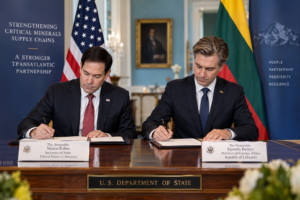
U.S. and Lithuanian flags outside a government building in Washington.

By Charles Pitts
The United States and Lithuania have signed a critical minerals framework that sets a six-month timetable for identifying priority projects and mobilizing government and private-sector financing, placing supply-chain resilience at the center of a broader economic and defense partnership.
U.S. Secretary of State Marco Rubio and Lithuanian Foreign Minister Kestutis Budrys signed the memorandum of understanding at the State Department in Washington. The agreement does not name specific projects, companies, minerals or investment amounts, but establishes a process for selecting initiatives across the critical minerals value chain.
Rubio said the United States and Lithuania would “jointly identify” priority projects and mobilize public and private financing within six months. His remarks, reported in coverage of the signing and released through State Department channels, linked the framework to both economic security and defense requirements.
More Read

The six-month target applies to project identification and financing mobilization. It is not a deadline for completing mines, processing plants or other facilities.

A framework aimed at the supply chain, not only mining
The agreement arrives as governments seek to reduce exposure to concentrated sources of minerals used in batteries, electronics, defense systems, industrial equipment and energy infrastructure.
For policymakers, the central issue is increasingly the full chain from geological resource to usable material. Mining capacity alone does not guarantee supply security if concentrates must be processed, separated or converted in a limited number of jurisdictions.

Lithuania does not rank among the world’s largest mining countries. Its potential role is more closely connected to advanced manufacturing, technology, logistics, investment screening and European policy coordination. Rubio specifically pointed to Lithuania’s strength in photonics and described secure investment screening as part of the broader economic-security relationship.
Budrys said economic security was the Lithuanian government’s second foreign-policy priority after hard security. He described the agreement as a practical step toward building more resilient supply chains with the United States.
The framework therefore appears designed to connect U.S. strategic financing and defense demand with Lithuanian and European industrial capabilities, rather than create a standalone bilateral mining program.
What the six-month test requires
The timetable creates an early test for both governments. Before capital can be mobilized, officials and companies will need to determine which projects qualify as priorities and whether they can meet commercial, regulatory and strategic requirements.
The framework’s immediate work is expected to involve several questions:
| Priority question | Why it matters |
|---|---|
| Which minerals and materials qualify? | Determines whether the effort focuses on rare earths, battery materials, specialty metals or defense inputs. |
| Which projects are sufficiently advanced? | Financing is more likely to move first toward permitted, technically defined or construction-ready assets. |
| Where is processing capacity required? | A mine without refining, separation or conversion capacity may not improve supply resilience. |
| What public support is available? | Grants, loans, guarantees, offtake agreements and defense procurement can change project economics. |
| Which private investors will participate? | Commercial financing will test whether projects can operate beyond government support. |
No project list was announced at the signing. That leaves the six-month process open to a wide range of possible initiatives, including mineral processing, recycling, materials manufacturing, logistics infrastructure and technology projects.
It also means that the practical value of the agreement will depend on how quickly officials convert a political understanding into a defined project pipeline.
Defense supply chains raise the stakes
The defense dimension gives the framework significance beyond conventional trade policy.
Critical minerals are used in aerospace systems, guidance and sensing equipment, communications hardware, specialized alloys, munitions and other defense applications. Some materials may be required in relatively small volumes, but shortages can have an outsized impact when substitutes are difficult to qualify or supply is controlled by a narrow group of producers.
The United States has increasingly treated mineral processing and materials manufacturing as national-security concerns. Recent policy efforts have focused on stockpiles, domestic production, allied supply agreements and financing for processing capacity.
Lithuania’s position on NATO’s eastern flank adds a further strategic layer. Cooperation with Washington on economic security can support broader efforts to protect infrastructure, technology supply chains and industrial capacity across Europe.
The pact does not itself guarantee defense procurement or establish a stockpile. Its importance lies in creating a channel through which government priorities, industrial projects and private capital can be coordinated.
European coordination will be an important variable
Rubio also highlighted Lithuania’s expected role in European Union leadership, describing the country’s forthcoming Council of the European Union presidency as an opportunity for closer coordination on economic security.
The EU has its own critical raw materials policies, including targets for domestic extraction, processing and recycling and efforts to reduce dependence on single external suppliers. A U.S.-Lithuania framework could provide a bilateral mechanism that complements those policies, although the agreement’s implementation will need to fit within European rules on state aid, procurement, environmental approvals and investment screening.
That coordination will matter particularly if projects involve cross-border infrastructure or financing. A processing facility in one European country, feedstock from another and U.S. defense or industrial offtake could require several layers of regulatory and commercial alignment.
Lithuania’s participation may also give Washington a useful point of contact with European institutions and companies at a time when critical minerals policy is becoming more closely linked to trade, technology and security policy.

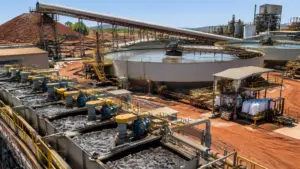
Critical minerals processing and advanced-materials work will be central to turning policy commitments into supply-chain capacity.
The missing details are commercially important
The agreement’s broad language leaves several issues unresolved for mining and investment decision-makers.
First, neither side identified the minerals that will receive priority. The United States has focused on materials such as rare earths, graphite, gallium, germanium, tungsten, cobalt, nickel and lithium, but the pact may ultimately cover a narrower or different group.
Second, the governments did not disclose a financing mechanism. Public support could take the form of direct grants, loans, loan guarantees, equity participation, tax incentives or defense offtake agreements. Each approach carries different implications for project risk and private-sector participation.
Third, there is no announced schedule for permitting, construction or first production. Even projects identified within six months could require years of engineering, environmental review, financing and commissioning.
That distinction is important for operators and investors. A project appearing on a priority list would represent policy support, but not necessarily a final investment decision or a binding procurement commitment.
A test of execution
The U.S.-Lithuania framework reflects a wider shift in critical minerals policy: governments are moving from general statements about diversification toward country-to-country mechanisms intended to produce investable projects.
The first measure of success will be whether the six-month process produces a public or clearly defined pipeline with named commodities, project stages, financing structures and responsible agencies.
A second measure will be whether private investors participate on commercial terms. Government backing can reduce risk, but it cannot replace engineering validation, reliable feedstock, competitive operating costs and credible customers.
A third will be whether the initiative connects with wider European and allied supply-chain programs rather than creating another isolated framework.
For now, the pact is a political and administrative starting point. Its strategic importance comes from the areas it brings together: critical minerals, defense readiness, advanced technology and European coordination.
The next six months will show whether that combination can move from diplomatic commitment to projects capable of producing, processing or recycling materials outside concentrated supply chains.

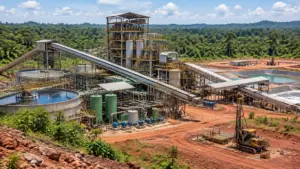
Ports, rail links and processing infrastructure will determine whether new mineral supply can reach industrial customers.
What to watch next
Industry participants should track five developments as the framework moves forward:
- The priority-minerals list: The first formal selection will indicate whether the initiative emphasizes battery materials, rare earths, defense metals or advanced-materials inputs.
- Project maturity: Early-stage exploration assets may receive attention, but financing is more likely to favor projects with defined resources, permits or processing plans.
- Public financing terms: Guarantees and offtake agreements could be more important than headline funding amounts.
- Lithuanian and EU coordination: The relationship between the bilateral pact and European critical raw materials programs will shape its reach.
- Private-sector participation: Companies, banks and industrial buyers will determine whether the framework supports commercially durable supply chains.
The United States and Lithuania have established a deadline for organizing the effort. The more difficult task will be demonstrating that priority projects can withstand permitting, technical, financial and market scrutiny.

Supply-chain monitoring and project coordination will be essential as governments move from agreements to execution.
Sources: U.S. Department of State; Mirage News report carrying remarks from the signing; SocialNews.XYZ report on the framework.
Related coverage: Critical minerals supply-chain risks and refining constraints | Defense demand and tungsten supply chains | Rare earths coverage