A high-stakes mining boardroom environment where executives analyze global project locations and M&A targets on digital maps.

By Charles Pitts
The mining industry is witnessing a structural shift in how scale is built. While the early 2020s were characterized by cautious balance sheet repair and dividend discipline, 2026 has emerged as the year of the mid-tier “roll-up.” Companies that previously sat comfortably in the mid-cap space are now aggressively pursuing peer-to-peer mergers and strategic royalty consolidations to insulate themselves against rising capital costs and jurisdictional volatility.
Two recent transactions: Elemental Royalty’s C$327 million acquisition of Vizsla Royalties and Critical Metals Corp’s ~US$835 million deal for European Lithium: serve as the blueprint for this new era. These aren’t cash-draining takeovers. Instead, they are calculated, all-scrip (share-based) maneuvers designed to capture Net Asset Value (NAV) accretion and simplify complex corporate structures.
The Elemental-Vizsla Strategy: Securing the Silver Cornerstone
The C$327 million deal between Elemental Royalty and Vizsla Royalties highlights a key trend: the pursuit of uncapped, high-grade exposure. By acquiring Vizsla Royalties, Elemental secured a 2.0% to 3.5% Net Smelter Return (NSR) royalty on the Panuco silver-gold project in Mexico.
More Read
For Elemental, the deal is transformative. Panuco is one of the highest-grade primary silver projects globally, with a feasibility study suggesting an average of 17.4 million silver-equivalent ounces per year. The royalty is “clean”: it has no buybacks or step-downs. This means Elemental captures every ounce of upside as Vizsla Silver (the operator) expands the resource.

The deal structure is the real story. With a cash cap of roughly C$82 million, the vast majority of the consideration is in Elemental shares. This protects Elemental’s liquidity while allowing Vizsla Royalties’ shareholders to retain exposure to the Panuco project through a larger, more diversified royalty vehicle.

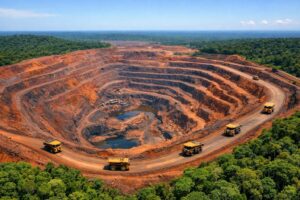
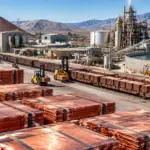
Large-scale extraction at a high-grade project site, representative of the long-life assets targeted by mid-tier royalty firms.
More Read
Critical Metals and the European Lithium Consolidation
In the critical minerals sector, consolidation is being driven by the need for vertical integration and simplified ownership. Critical Metals Corp’s (Nasdaq: CRML) acquisition of European Lithium Ltd is an exercise in corporate streamlining.
Critical Metals already held the flagship Wolfsberg Lithium Project in Austria following a 2024 business combination. However, the ownership structure remained fragmented. By moving to acquire 100% of European Lithium in an all-share deal at a fixed ratio of 0.035 CRML per EUR share, Critical Metals is consolidating its grip on:
- The Wolfsberg Project: Europe’s first fully permitted lithium mine.
- The Tanbreez Project: A 7.5% stake (with a path to 100%) in the massive Greenland rare earth asset.
- Offtake Security: Strengthening its position with partners like BMW Group and the Obeikan JV in Saudi Arabia.
This US$835 million transaction demonstrates how mid-tiers are using Nasdaq listings to swallow ASX or TSX-listed partners, creating a single, more liquid entry point for institutional investors.
Why All-Scrip Deals Dominate the 2026 Landscape
The pivot away from cash-heavy acquisitions is a defensive necessity. In the current environment, cash is reserved for autonomous haulage upgrades and the high CAPEX of mine construction.
All-scrip deals offer three distinct advantages:
- Risk Sharing: When a buyer uses stock, the target’s shareholders share the risk of project development. If the mine hits a permitting snag, the “currency” used for the purchase devalues alongside the asset.
- Valuation Arbitrage: A mid-tier company trading at 1.1x P/NAV (Price to Net Asset Value) can use its “expensive” stock to buy a developer trading at 0.5x P/NAV. Even after paying a 30% premium, the deal remains highly accretive to the buyer’s shareholders.
- Capital Preservation: Debt remains expensive. Issuing shares allows companies to scale without impacting credit ratings or increasing interest expenses.
Market Snapshot: Notable Mid-Tier M&A (H1 2026)
| Buyer | Target | Deal Value | Primary Asset | Structure |
|---|---|---|---|---|
| Elemental Royalty | Vizsla Royalties | C$327M | Panuco (Mexico) | Scrip-heavy (75%+) |
| Critical Metals Corp | European Lithium | ~US$835M | Wolfsberg (Austria) | 100% Scrip |
| Northern Star* | De Grey Mining | ~A$6.1B | Hemi Gold (Australia) | Mixed Scrip/Cash |
| G Mining Ventures | Reunion Gold | C$875M | Oko West (Guyana) | 100% Scrip |
*Note: Northern Star represents the upper-mid-tier/major transition.
The P/NAV Accretion Engine
In the mid-tier space, the goal is “Multiple Expansion.” Small producers often trade at a discount because they lack liquidity and asset diversity. By merging, two 0.7x NAV companies can become a single 1.0x NAV company. This re-rating is the primary driver of value for 2026 investors.
The “Heat Map” for this activity is currently glowing hottest in Tier-1 jurisdictions like Canada and Australia, where geopolitical safety warrants a higher multiple. However, strategic critical mineral assets in Europe and Mexico: as seen in the Critical Metals and Elemental deals: are catching up as supply chain security becomes a national priority.

Operational control centers are becoming the central hubs for merged entities, where data integration drives the post-M&A synergy phase.
Outlook for H2 2026
We expect the mid-tier consolidation wave to intensify through the end of the year. The gap between “the haves” (companies with cash flow and a Nasdaq/NYSE listing) and “the have-nots” (developers with high-quality assets but no path to funding) remains wide.
Investors should watch for:
- Regional Roll-ups: Especially in the West Australian gold belts and Canadian copper corridors.
- Royalty Simplification: More operators buying back royalties or royalty companies merging to gain index weight.
- The “Tanbreez” Effect: Further consolidation of rare earth and lithium juniors as majors look for “ready-to-build” projects.
The message for 2026 is clear: Scale is no longer optional. But in this cycle, scale is being bought with paper, not cash.