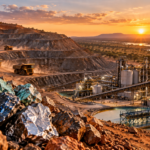
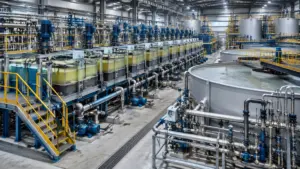
APT powder and antimony ingots in an industrial refining facility.

By Mo Shine
The tungsten market has moved from a long-term supply diversification story to an immediate industrial constraint. Ammonium paratungstate (APT) CIF prices rose from US$83 per kilogram of WO₃ in January to US$340/kg in July, according to S&P Global.
The increase has changed the financial conversation around new mines. At US$340/kg WO₃, the question is no longer whether high-cost projects can respond to price. It is whether they can secure permits, financing, processing capacity and qualified feedstock quickly enough to benefit from the market.
Antimony presents a similar strategic problem at a lower price level. European CIF prices rose from about US$23/kg in August 2024 to US$63/kg in mid-2025, before retreating toward US$27/kg in 2026 after the temporary lifting of export restrictions. The price retreat has not removed the underlying vulnerability: the United States remained 91% reliant on net imports for apparent antimony consumption in 2025, according to the U.S. Geological Survey.
The price spike is exposing a supply-chain bottleneck
China supplies about 80% of mined tungsten and controls roughly 85% of APT refining capacity, according to S&P Global. This gives the country influence over both the first stage of production and the intermediate product most commonly traded between miners, refiners and manufacturers.

APT is not the same as a mine-gate concentrate price. It is a processed tungsten intermediate, and the value received by a producer depends on concentrate grade, recovery, payable terms, treatment charges, impurities, freight and the cost of converting concentrate into APT or another saleable product.
Even so, the benchmark provides a clear signal. S&P Global estimates that an APT structural cost of US$36–48/kg WO₃ in 2028 would support more than 85% of the current and proposed ex-China project pipeline. A structural cost near US$90/kg WO₃ could support the full identified pipeline.
The difference between those cost levels and a US$340/kg benchmark illustrates the unusual nature of the current market. Prices are providing a strong incentive for supply, but mines and refineries still require years of technical work, permitting and construction.
S&P Global expects tungsten demand to grow by about 10% between 2026 and 2030. Even if 11 announced ex-China mining projects are completed, the market could still face a supply gap of approximately 16,000 tonnes of WO₃ in 2030.
That forecast excludes the normal attrition caused by financing delays, permitting problems, construction overruns and weaker-than-expected recoveries. In other words, the 16,000-tonne figure is an unrisked projection rather than a guaranteed supply outcome.

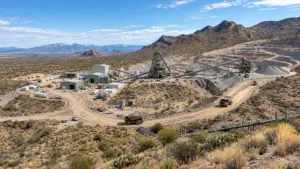
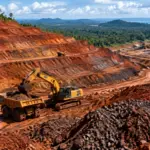
Tungsten mining and processing infrastructure in Queensland.
Antimony carries a different kind of risk
Antimony’s supply problem is less visible in the price chart but highly significant for manufacturers and governments.
The USGS reported that antimonial lead and ammunition represented 40% of U.S. antimony use in 2025. Metal products, including flame retardants, accounted for a further 49%. Recycling supplied about 12% of estimated apparent consumption, leaving the United States dependent on imports for most of its requirements.
S&P Global forecasts antimony demand growth of approximately 3% from 2026 to 2030. Declining demand from some lead-acid battery applications is expected to be offset by growth in solar glass, flame retardants and defense-related uses.
The processing constraint is more important than the demand rate. S&P Global projects that announced ex-China smelting projects could lift capacity to approximately 68,000 tonnes by 2030. That would still leave smelting capacity short of ex-China demand by about 27%, or roughly 25,000 tonnes.
The result is a market in which modest demand growth can produce a large strategic exposure. If export controls tighten again, buyers may find that alternative mine supply exists but cannot be processed into the required products at sufficient scale.
Project milestones show where economics are moving
New project activity is now focused on more than discovering ore. Companies are attempting to control the path from mine to refined product.
Tungsten Mining’s Watershed project in Queensland produced saleable concentrates grading 53.8% and 65.9% WO₃, with recoveries in the 60%–70% range. The company is targeting an October definitive feasibility study and a late-year final investment decision.
Those results matter because concentrate quality and recovery determine whether a high benchmark price translates into cash flow. A project with strong head grades but poor recovery, difficult impurities or limited refining options may not capture the headline APT price.
In the United States, American Tungsten & Antimony has restarted the Del Sol refinery in Nevada and produced an antimony ingot using material from the White Spar project in Arizona. The demonstration is intended to establish a domestic mine-to-metal pathway.
The company has also been selected for negotiations on a potential US$18 million U.S. Department of Energy award and commissioned Metso to complete a scoping study for a 2,500-tonne-per-year APT circuit, with a potential expansion to 5,000 tonnes per year.
The distinction between a mine and an integrated processing route is becoming increasingly important. Del Sol’s existing footprint could reduce the timeline and capital required compared with a greenfield refinery, although the project remains subject to technical, commercial and funding risks.
Exploration activity is also accelerating. Viking Mines reported 14 metres at 0.56% WO₃ at the Linka project in Nevada, with an estimated true width of about 9 metres. The company has also reported wide zones of visible scheelite in follow-up drilling, while laboratory assays remain necessary to confirm grades. Its ASX announcement cautions that visual estimates are not substitutes for assay results.
Stelar Metals reported rock-chip results of up to 15.69% WO₃ at Hill of Leaders. The result is a strong indicator of local high-grade mineralization, but surface samples cannot demonstrate the continuity, width or tonnage required for a mine plan. The comparison with Linka is useful: a moderate grade over a broad drilled interval may be more relevant to mine economics than an exceptional grade in a narrow surface sample.
Price, dependence and project milestones
| Metric or milestone | Tungsten | Antimony | Why it matters |
|---|---|---|---|
| Recent benchmark movement | APT CIF: US$83/kg WO₃ to US$340/kg WO₃ | European CIF: US$23/kg to US$63/kg, then toward US$27/kg | Shows the effect of export controls, inventory pressure and limited substitution |
| Supply concentration | China supplies about 80% of mined tungsten and about 85% of APT refining | China and Russia dominate mining and processing | Concentration creates geopolitical and logistics risk |
| Demand outlook | About 10% growth through 2030 | About 3% growth through 2030 | Tungsten has the stronger projected demand expansion |
| Projected supply gap | About 16,000 tonnes WO₃ outside China in 2030, even with planned projects | About 27% ex-China smelting shortfall in 2030 | Processing and project execution remain binding constraints |
| U.S. import exposure | No current domestic mine supply at meaningful scale | 91% net import reliance in 2025 | Domestic processing and mine-to-metal projects have strategic value |
| Watershed, Queensland | 53.8% and 65.9% WO₃ concentrates; 60%–70% recovery | – | Supports feasibility work and potential concentrate sales |
| Del Sol, Nevada | Planned 2,500 tpa APT circuit, with expansion pathway | Antimony ingot produced from White Spar material | Demonstrates integrated U.S. processing potential |
| Linka, Nevada | 14m at 0.56% WO₃ | – | Drill width provides more economic context than isolated surface grade |
| Hill of Leaders | Rock chips up to 15.69% WO₃ | – | High-grade exploration signal; continuity remains untested |
Sources: S&P Global, USGS, company disclosures and ASX announcements. Price references are market benchmarks, not guaranteed project revenue.
Base, bull and bear cases
The following framework is intended to help operators, policymakers and analysts test project assumptions. It is not a price forecast or an investment recommendation.
| Scenario | Market conditions | Likely impact on mine economics | Main indicators |
|---|---|---|---|
| Base case | Tungsten remains above long-term structural costs but below the extreme July benchmark; antimony trades near the upper end of its recent range | Existing permitted projects and brownfields refineries receive stronger financing interest, but execution remains decisive | Permits, offtake agreements, recovery rates, refinery commissioning |
| Bull case | Export controls persist or broaden, inventories remain low and defense demand accelerates | High-grade deposits and integrated processing routes command greater strategic value; project timelines become more valuable than marginal cost savings | Chinese licensing, defense procurement rules, APT availability and regional premiums |
| Bear case | Export restrictions ease, recycling increases and new projects ramp faster than expected | Prices retreat toward incentive levels; projects with high capital intensity, weak recoveries or no processing route face renewed pressure | Export volumes, secondary supply, substitution and actual commissioning rates |
The base case is not a return to normality. Even if prices retreat from US$340/kg WO₃, a market that remains above S&P Global’s structural cost range would continue to support project development. The risk is that high prices encourage a wave of announcements without producing enough commissioned capacity.
For antimony, the central issue is different. The market may remain adequately supplied in the short term while still lacking enough non-Chinese processing capacity for a sustained disruption. That makes refinery availability, feedstock contracts and product qualification as important as resource size.
What operators and investors should watch next
The most important signals are likely to come from execution rather than exploration headlines:
- Watershed’s feasibility study and FID, including capital cost, recovery assumptions and concentrate marketing terms.
- Del Sol’s restart performance, product quality and progress toward the proposed APT circuit.
- Assay results from Linka, which will determine whether visible scheelite translates into consistent grade and width.
- Antimony smelter development outside China, particularly whether proposed capacity secures reliable feedstock.
- Export-control policy, including licensing requirements and defense procurement rules.
- Recycling and substitution, which could moderate prices but are unlikely to close the short-term processing gap alone.
Tungsten and antimony are therefore moving closer together as policy metals. Their economics are being shaped not only by ore grade and operating cost, but also by refining geography, trade restrictions and the ability to deliver a qualified product to end users.
The US$340/kg APT benchmark has rewritten the incentive price for tungsten projects. It has not rewritten the permitting clock. For both metals, the winners of the next phase will be defined by recoveries, processing access and execution discipline, not by resource size alone.
Distribution snippets
LinkedIn:
Tungsten APT prices rose from US$83/kg WO₃ to US$340/kg in the first half of 2026, yet S&P Global still sees a potential 16,000-tonne ex-China supply gap by 2030. Antimony faces a parallel processing problem: announced ex-China smelters could still fall 27% short of demand. Our analysis examines what the price shock means for Watershed, Del Sol, Linka and the next generation of critical-minerals projects.
X:
APT at US$340/kg WO₃ has changed tungsten project economics, but not the permitting clock. S&P Global still sees a 16kt ex-China gap by 2030. Antimony faces a 27% ex-China smelting shortfall. The next test is execution: recoveries, refineries, feedstock and FID.