By Charles Pitts

China owns the global tungsten market. That isn’t a secret; it’s a strategic chokehold that has existed for decades. But the walls are starting to close in on the status quo.
In a move that signals a massive shift in American industrial policy, the US Export-Import Bank (EXIM) is closing in on a $240 million funding deal for QazMoly’s Drozhilov project in Kazakhstan. This isn’t just another mining loan. It is a calculated, high-stakes attempt to pivot the supply chain of one of the world’s most critical minerals away from Beijing.
The condition for the cash? Every single ounce of tungsten produced must be sold to US interests.
Welcome to the era of resource nationalism. If you aren’t paying attention to the “tungsten crunch,” you’re already behind the curve.
More Read

The 5x Surge: Anatomy of a Shortage
Tungsten prices have surged fivefold over the past twelve months. That isn’t a rounding error. It’s a crisis.

For years, tungsten was the “forgotten” critical metal, overshadowed by the lithium and cobalt hype of the EV revolution. While everyone was chasing battery metals, the world’s supply of the hardest metal: essential for everything from armor-piercing rounds to the semiconductors in your pocket: was quietly being consolidated.
BMO Capital Markets recently issued a grim warning: the world is facing a severe, structural shortage. Global demand is projected to grow at an 8% annual clip, potentially turning tungsten into a $10 billion industry by the mid-2030s.
More Read


The problem is the math. China currently controls roughly 75% of global production. When China decides to tighten exports or prioritize its own domestic manufacturing, the rest of the world is left fighting for scraps. We are seeing the same patterns play out here as we did in the copper forecast for 2026, where supply risks are now the primary driver of price action.
The Kazakh Connection: Why Drozhilov Matters
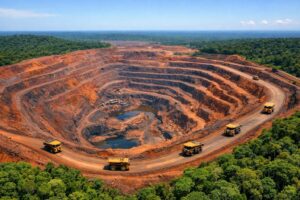
Kazakhstan is the new frontier for Western resource security. The US EXIM Bank’s $240 million interest in QazMoly’s Drozhilov field is part of a larger $1.6 billion “letter of interest” portfolio targeting the region.
The Drozhilov project isn’t just a tungsten play; it’s a polymetallic powerhouse containing molybdenum and beryllium. But tungsten is the crown jewel. By securing the offtake, the US is essentially building a strategic reserve that doesn’t have to transit through Chinese-controlled ports or processing facilities.
But let’s be real: building a mine in Kazakhstan isn’t like breaking ground in Nevada. There are geopolitical nuances and infrastructure hurdles that would make most junior miners lose sleep. Yet, the strategic calculus is simple: the risk of doing nothing is higher than the risk of the project itself.
This push into Kazakhstan follows a broader trend of Western firms looking for “Tier 1” assets in non-traditional jurisdictions. We’ve seen similar movements with Core Critical Metals acquiring stakes in tungsten-silver properties to diversify their portfolios.
Why the Pentagon is Panicking
Tungsten is the “heavy lifter” of the defense industry. It has the highest melting point of all elements and is nearly as dense as gold. If you want to build a missile that can punch through steel or a drill bit that can penetrate granite, you need tungsten.
There is no substitute.
The US military’s reliance on a supply chain dominated by its primary geopolitical rival is a vulnerability that the Department of Defense is finally addressing. The EXIM Bank deal is essentially a defense contract masquerading as a commercial loan.

The strategic importance extends beyond the battlefield. In high-tech manufacturing, tungsten is used in specialized alloys for aerospace and the tooling required for precision engineering. As M&A mania heats up in 2026, companies are realizing that owning the raw material is the only way to guarantee they can keep their factories running.
The Broader US Investment Landscape
The $240 million for QazMoly is just one piece of the puzzle. The US International Development Finance Corporation (DFC) has also issued a letter of interest for up to $700 million to support the Severniy Katpar tungsten project.
This is a joint venture between Cove Kaz Capital and Kazakhstan’s national mining company, Tau-Ken Samruk. When you add up the EXIM and DFC commitments, you’re looking at over $1.5 billion in potential US government-backed financing focused on a single commodity in a single country.
That’s a lot of eggs in one basket. But it shows how desperate the West has become to find a counterweight to China’s dominance.
Price Forecast 2026: Drivers and Risks
Where do we go from here? The market is currently in a state of “forced discovery,” where buyers are realizing that the old prices are never coming back.
The Bull Case:
- Defense Spending: With global tensions rising, demand for tungsten-heavy munitions is at a post-Cold War high.
- Supply Scarcity: New mines like Drozhilov won’t hit full production for years. The gap between demand and supply is widening.
- Resource Nationalism: China may further restrict exports to protect its own high-tech industries.
The Bear Case:
- Substitution: While difficult, extreme prices could force engineers to find inferior but cheaper alternatives in non-critical applications.
- Economic Slowdown: A global recession could dampen industrial demand for tooling and manufacturing.
- Regulatory Hurdles: If the Kazakh projects face delays or ESG-related financing issues, the expected supply won’t materialize.
The “Luxury of Discipline” that companies like BHP are showing in the copper sector doesn’t apply to tungsten. This is a scramble, not a stroll.

The ESG Reality Check
It’s easy to talk about “breaking the grip” of a monopoly, but doing it sustainably is another story. The US government and EXIM Bank are under increasing pressure to ensure that their “strategic” investments meet Western ESG standards.
Kazakhstan has made strides in mining transparency, but it’s still a complex environment. Investors are watching closely to see if these projects can maintain social licenses while operating at the breakneck speed required to meet US demand. As we’ve noted before, mining ESG reporting is changing the way capital is accessed, and even “strategic” projects won’t be exempt from the rules.
Conclusion: A New Map for Critical Minerals
The tungsten tsunami is just the beginning. What we are seeing with EXIM and QazMoly is the blueprint for the next decade of mining.
Governments are no longer passive observers of the commodity markets. They are active participants, using their balance sheets to “pick winners” and secure supply lines. The $240 million bet on Drozhilov is a clear signal: the US is tired of being at the mercy of the Chinese market.
But geology doesn’t care about politics. Building these mines takes time, capital, and a lot of luck. Whether the Kazakh projects can scale fast enough to prevent a total “tungsten crunch” remains to be seen.
For now, the market is on edge. The price is up, the stakes are higher, and the game has completely changed. If you’re looking for stability, you’re in the wrong industry.
Key Data Points for Decision Makers:
- China Production Share: ~75%
- US EXIM Interest (Drozhilov): $240 million
- US DFC Interest (Severniy Katpar): $700 million
- Projected Global Demand Growth: 8% CAGR
- Price Increase (LTM): 5x
For more deep dives into the shifting landscape of global mining, check out our full sitemap of industry analysis.