By Charles Pitts

LOS ANGELES : The U.S. Department of Justice (DOJ) has submitted formal filings in the U.S. District Court for the Central District of California, providing a significant legal victory for Dateline Resources (ASX: DTR). The filings support the validity of the existing Plan of Operations for the Colosseum Gold and Rare Earths Project, situated within the Mojave National Preserve.
Following the news of the federal government’s support, shares in Dateline Resources jumped 24% on the Australian Securities Exchange (ASX), reflecting investor confidence in the project’s regulatory pathway. The DOJ’s position directly opposes claims made by the National Parks Conservation Association (NPCA), which had sought to halt development at the site.
The Colosseum Project, located in San Bernardino County, California, has become a focal point in the domestic push for critical mineral independence. The DOJ’s intervention confirms the “Valid Existing Rights” (VER) held by Dateline, a legal status that allows for mining operations to proceed under previously approved frameworks, even within land now designated as a national preserve.
The Federal Stance: Valid Existing Rights Confirmed
The DOJ filings, submitted as part of the ongoing litigation National Parks Conservation Association v. U.S. Department of the Interior, et al. (Case No. 2:26-cv-04002), argue that federal agencies acted within their authority when they confirmed Dateline’s ability to operate under its 1980s-era Plan of Operations.
More Read

The core of the dispute centers on the 1994 California Desert Protection Act, which established the Mojave National Preserve. While the act expanded environmental protections, it specifically included provisions to respect “valid existing rights” for mining claims that predated the preserve’s creation.

The DOJ’s brief clarifies that the Department of the Interior (DOI) and the National Park Service (NPS) performed a rigorous review of Dateline’s rights. The government concluded that because the Colosseum Mine had a functional and approved plan before the land was transferred to the NPS, the company is not required to undergo a de novo permitting process, which often takes years or decades to complete.
“The federal government’s defense of the Plan of Operations provides the regulatory certainty required for large-scale capital investment,” noted a legal analyst following the case. “By affirming these rights, the DOJ is signaling that historical mineral discoveries in California can still play a role in the modern economy.”
More Read

Strategic Importance of the Colosseum Project

The Colosseum Mine was originally a gold-producing asset, yielding approximately 344,000 ounces of gold between 1988 and 1993 under the management of Bond Gold and later Lac Minerals. It was decommissioned in 1993, just before the creation of the Mojave National Preserve.
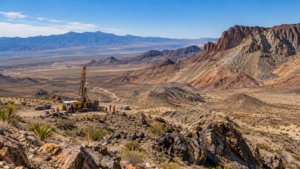
When Dateline Resources acquired the project in 2021, the focus shifted from gold to its significant potential for Rare Earth Elements (REE). The project is located in the Clark Mountain Range, less than 10 miles from the Mountain Pass Mine: the only operational rare earth mine and processing facility in the United States.
Geological similarities between Colosseum and Mountain Pass have drawn intense interest from the Department of Defense and domestic manufacturers. Initial drilling and surface sampling at Colosseum have identified carbonatite-hosted rare earth mineralization, the same type of deposit found at Mountain Pass.
As the U.S. seeks to decouple its critical mineral supply chains from foreign adversaries, projects like Colosseum are viewed as vital national security assets. Recent industry developments, such as the redefinition of domestic rare earth processing, underscore the urgency of bringing new REE supply online.
Legal Challenges from Environmental Groups
The National Parks Conservation Association, represented by Earthjustice, filed its complaint in April 2026, alleging that the reopening of the mine would cause “irreparable harm” to the Mojave’s fragile ecosystem. The NPCA argues that the 1980s Plan of Operations is outdated and does not account for modern environmental standards or the current state of the desert habitat, which includes protected species like the desert tortoise.
The NPCA’s lawsuit sought to vacate the April 2025 decision by the DOI that recognized Dateline’s rights. However, the DOJ’s recent filing argues that the NPCA has failed to show that the federal agencies’ decision was “arbitrary or capricious.” The government maintains that the agencies conducted a sufficient “validity examination” to ensure the claims were legally sound before allowing Dateline to resume activity.
| Project Milestone | Date | Status |
|---|---|---|
| Initial Gold Production | 1988 | Completed |
| Mine Decommissioned | 1993 | Completed |
| Dateline Acquisition | 2021 | Completed |
| REE Discovery Announced | 2022 | Completed |
| DOI Confirms Valid Rights | April 2025 | Confirmed |
| NPCA Files Lawsuit | April 2026 | Ongoing |
| DOJ Files Support Brief | July 2026 | Active |
Market Reaction and ASX Performance
The market response to the DOJ filing was immediate. Dateline Resources (ASX: DTR) saw its shares climb 24% in the following trading session, reaching a multi-month high. The surge reflects the removal of a significant “legal overhang” that had clouded the project’s future since the NPCA first announced its intent to sue.
Analysts suggest that the DOJ’s backing provides a “protective shield” for the company. While the litigation is not entirely resolved, the federal government’s active defense of the project makes it much more difficult for the plaintiffs to secure a preliminary injunction that would stop work at the site.
Dateline has stated that it will continue with its current exploration and development plans, which include deeper drilling to delineate the rare earth resource and technical studies for potential processing routes. The company’s subsidiary, Colosseum Rare Metals Inc., has also moved to formally intervene in the lawsuit as a defendant, allowing it to present its own evidence directly to the court.
Operational Outlook for 2026

With the legal wind in its sails, Dateline is expected to accelerate its 2026 work program. The focus remains on two fronts: the legacy gold resource and the high-growth rare earths opportunity.
The gold resource at Colosseum is currently estimated at approximately 1.1 million ounces. However, the rare earths potential is the primary driver of the company’s valuation. By utilizing the existing open pit and infrastructure, Dateline could potentially bring the project into production faster and at a lower capital cost than a greenfield project.
The proximity to Mountain Pass also offers potential logistical advantages. While no formal agreements are in place, the regional concentration of rare earth expertise and infrastructure in the Clark Mountain district creates a “critical minerals hub” that benefits all participants. For more on the regional mining landscape, readers can explore our comprehensive mining news archives.
Environmental Stewardship and Compliance
Despite the ongoing legal friction, Dateline has reiterated its commitment to high environmental standards. The company noted that its current activities are confined to previously disturbed areas of the mine site, minimizing the impact on native vegetation and wildlife.
“Operating within a National Preserve carries a high level of responsibility,” a company spokesperson said in a recent statement. “We are working closely with the National Park Service to ensure that all activities: ranging from drilling to site maintenance: are conducted in a way that respects the desert environment while fulfilling our rights as claim holders.”
The DOJ’s filing also touched upon this, noting that the NPS retains the authority to monitor and regulate ongoing activities to prevent “unnecessary or undue degradation” of the land, even under an existing Plan of Operations.
The Road Ahead for the Mojave Project
The U.S. District Court is expected to set a schedule for summary judgment motions in the coming months. If the court rules in favor of the federal government and Dateline, it would set a powerful precedent for other mining projects facing similar challenges in federally protected areas.
For the mining industry, the Colosseum case is a litmus test for how “Valid Existing Rights” are balanced against modern conservation efforts. For now, the DOJ’s decision to stand by the Department of the Interior’s 2025 ruling suggests that the federal government is prioritizing the domestic supply of critical minerals as a matter of national policy.
Investors and operators will be watching the Central District of California closely. As the legal battle unfolds, the physical work at Colosseum continues, marking a new chapter for one of California’s most historic and strategically positioned mining assets.