The United States government isn’t just interested in the “green transition” anymore. That narrative: the one about saving the polar bears with electric SUVs: has been quietly archived in the basement of the Pentagon. In its place is a much grittier, much more urgent reality: Energy Security.

Since January 2025, Uncle Sam has poured over $1 billion into Latin American critical mineral projects. That’s not a projection. That’s capital deployed.
We’re seeing a fundamental shift in how Washington views the ground beneath our feet in the Western Hemisphere. For decades, Latin America was treated as a secondary priority, a region to be “managed” rather than invested in. But the math has changed. China has spent the last twenty years building a stranglehold on processing and supply chains, and the U.S. is finally realizing that you can’t build a 21st-century economy on 20th-century neglect.
The stakes are simple: control the minerals, or lose the decade.
The Death of “Energy Transition”
Let’s get one thing straight: the term “Energy Transition” is effectively dead in the halls of D.C. power. It’s been replaced by “Energy Security” and “Supply Chain Resilience.” It’s a subtle shift in vocabulary, but a massive shift in funding.
More Read

When you talk about a “transition,” you’re talking about a choice: a preference for cleaner air. When you talk about “security,” you’re talking about survival. The Pentagon is now a major player in mining discussions. Why? Because you can’t build a F-35 or a missile guidance system without the same rare earth elements that go into a Tesla.

The U.S. Development Finance Corporation (DFC) and the Department of Defense are no longer just observing from the sidelines; they are acting as the ultimate de-risking agents for junior and mid-tier miners. By providing low-interest loans and direct grants, they are signaling to private equity that these projects aren’t just viable: they’re essential.
Breaking Down the $1 Billion Spend
Since the start of 2025, the pace of investment has been relentless. The headline figure is $1 billion, but the “mobilized” capital: the money that follows the government’s lead: is significantly higher.
More Read
The Inter-American Development Bank (IDB) is expected to mobilize more than $30 billion in 2026. Compare that to $23 billion in 2025. We are watching a vertical climb in capital allocation. This isn’t a rounding error. It’s a strategic pivot.
The strategy focuses on three pillars: Lithium, Copper, and Rare Earth Elements (REEs). Latin America holds roughly 60% of the world’s identified lithium reserves and nearly half of the global copper production. If the U.S. wants to decouple from Chinese supply chains, there is no other path forward. You either play in Latin America, or you don’t play at all.
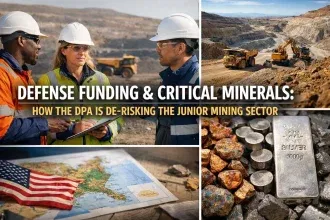
Defense funding’s role in de-risking mining.
Brazil: The Rare Earth Frontier
Brazil has become the primary beneficiary of this new U.S. aggression. The standout deal is the $465 million investment into the Serra Verde rare earth project.
Serra Verde achieved commercial production in 2024, but the 2025-2026 funding surge is about scaling and downstream processing. The U.S. doesn’t just want the raw ore; they want the capacity to process it outside of China’s influence. Serra Verde is one of the few places outside of China that produces all four of the “heavy” rare earths essential for permanent magnets.
Then there’s Aclara Resources. Scheduled for production in 2028, Aclara is another recipient of U.S. attention. The goal here is to create a Rare Earth hub in Brazil that serves the entire Western Hemisphere. The U.S. Trade and Development Agency (USTDA) is already laying the groundwork for feasibility studies to link these Brazilian mines directly to U.S.-based magnet manufacturers.
It’s about closing the loop. Extraction, processing, and manufacturing: all within a “friendly” logistical corridor.
Argentina’s Lithium Surge
If Brazil is the rare earth play, Argentina is the lithium powerhouse. Despite the country’s perennial economic volatility, the U.S. is betting big on the “Lithium Triangle.”
Rio Tinto’s $2.5 billion lithium production plan in Salta province is a cornerstone of this strategy. The DFC stepped in with a $100 million loan to kickstart specific infrastructure components. That might seem like a small piece of a $2.5 billion pie, but it’s the “Uncle Sam Stamp of Approval.” When the DFC puts $100 million into a project in Argentina, it tells the rest of the world that the geopolitical risk is being managed by Washington.
The framework Rio Tinto is building isn’t just about digging holes. It’s about high-tech extraction. We are seeing a move toward Direct Lithium Extraction (DLE), which promises to be faster and more environmentally sustainable than traditional evaporation ponds. This is critical for the “S” and “G” in ESG: factors that still matter when you’re trying to keep institutional investors from fleeing.

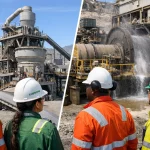
Professionals reviewing South American operations.
Chile and the Copper Problem
Then we have Chile. It’s the world’s largest copper producer, but its relationship with the U.S. is more nuanced. Because Chile has an existing Free Trade Agreement (FTA) with the U.S., its minerals are eligible for the juicy tax incentives provided by the Inflation Reduction Act (IRA).
This makes Chilean lithium and copper incredibly attractive to U.S. automakers. But there’s a catch: Chile is also trying to nationalize parts of its lithium industry and increase royalties on copper.
Despite these headwinds, the U.S. is doubling down. The focus has shifted to the Vicuña District, a massive mineralized belt straddling the Chile-Argentina border. Projects like Filo del Sol and Josemaria are seeing massive interest from U.S.-backed entities. Copper is the “nervous system” of the modern world. Without it, you don’t have a grid, you don’t have EVs, and you certainly don’t have AI data centers.
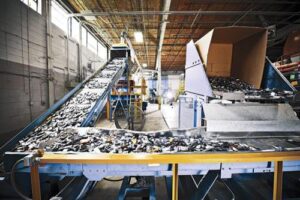
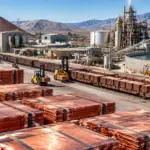
Understanding how that copper moves from crushing to cathode is becoming a prerequisite for any serious investor in 2026. The technical complexity is rising, and so is the cost of failure.
The 2026 Inflection Point: Security Over Price
Here is the uncomfortable truth for many investors: the U.S. government doesn’t care if lithium prices are currently in a slump. They are playing a 20-year game, not a 20-day game.
In early 2026, the U.S. announced a critical mineral stockpile worth nearly $12 billion, backed by a $10 billion loan program. This is a strategic reserve designed to insulate the U.S. economy from price spikes or: more likely: deliberate supply disruptions from adversaries.
This stockpile acts as a guaranteed buyer for Latin American miners. It provides a “floor” for the market. If you are a miner in Brazil or Argentina, you aren’t just looking at the spot price on the LME; you’re looking at the long-term procurement contracts from the U.S. government.
The strategic calculus isn’t subtle:
- Divert supply from China.
- De-risk the projects for private capital.
- Defend the supply chain with a massive domestic stockpile.

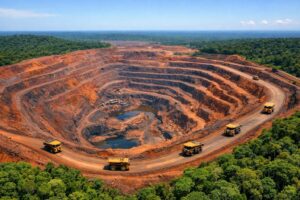
Major copper expansion in the Vicuña District.
The China Shadow
We can’t talk about U.S. funding without talking about what it’s fighting. China produces roughly 46% of the world’s copper and dominates the processing of almost every critical mineral on the list.
In late 2025 and into early 2026, Beijing tightened export controls on several key minerals. They aren’t just flexing; they are reminding the world who holds the keys. The U.S. $1 billion bet in Latin America is a direct response to this. It’s a “Near-Shoring” and “Friend-Shoring” strategy intended to blunt the impact of future trade wars.
But there’s a problem. China is also investing in Latin America. They are building the ports, the roads, and the refineries. They are often willing to move faster and with fewer environmental strings attached. The U.S. is trying to compete by offering better financing terms and “transparent” partnerships. Whether that’s enough to win over local governments in the long run remains to be seen.
What Investors Need to Watch
The tide of capital is moving, but the rocks beneath the surface are still sharp. As we move through 2026, there are three things that will determine the success of Uncle Sam’s $1B bet:
- Permitting Speed: The U.S. can throw all the money it wants at Argentina, but if it takes ten years to get a permit, China wins by default. Watch for “Fast-Track” agreements being negotiated alongside the funding.
- Downstream Capacity: Investing in a mine is step one. Building a refinery in Brazil or Chile is step two. Without step two, the ore still has to go to China for processing. That’s the “Achilles’ heel” of the current strategy.
- Local Politics: Latin America is in the midst of a populist wave. Governments in the region are demanding a bigger slice of the pie. The U.S. needs to ensure its “investments” look like “partnerships” to avoid being seen as the next imperialist power.
The Bottom Line
2026 marks the inflection point where “Energy Transition” officially became a matter of national security. The $1 billion surge in Latin American funding is just the beginning. We are moving toward a world where the U.S. government is a primary financier, a primary buyer, and a primary protector of mining interests in the Western Hemisphere.
The “shiny AI revolution” that everyone is talking about? It runs on copper and lithium. The “defense of democracy”? It runs on rare earths.
Uncle Sam has realized that you can’t disrupt geology. You can only secure it. And right now, the most important ground in the world is located south of the border.
The clock is already ticking. The investments are being hammered out. 2026 isn’t just another year in the mining cycle; it’s the year the map was redrawn.