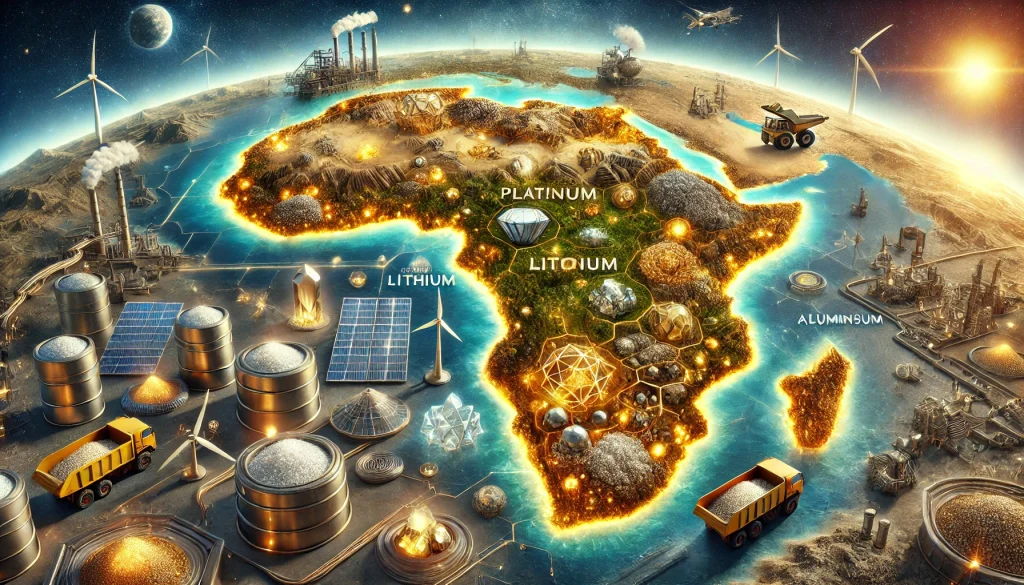
Critical minerals are considered crucial for the strategic well-being of every nation and the global community. They have value due to their use in various industries, such as electronics manufacturing, renewable energy technologies (like solar, wind, and geothermal power), electric vehicles, military equipment, and other applications.

Africa is home to approximately 30% of the world’s known critical mineral resources, encompassing various essential minerals such as platinum, lithium, cobalt, aluminum, and rare earth elements among others. African countries fortunate enough to have these mineral deposits in economically exploitable quantities for concentrations can significantly benefit from their constantly rising demand by effectively mining these resources, enhancing processing capabilities, and exporting finished products.
Related News
- Geologists Uncover World’s Largest Iron Ore Deposit in Western Australia
- Trump’s Tariffs on Canada, Mexico, and China Disrupt Mining and Mineral Trade, Sparking Global Concerns
- How One Cyclone Could Send Shockwaves Through the Global Iron Ore Market
- Ukraine, Russia and Lithium The Battle Shaping Europe’s Energy Security
Currently, critical minerals are being mined iRen many African nations. However, metallurgical processing, refining and manufacturing are mostly absent. To give some examples, Botswana currently focuses on developing its lithium processing sector. Ghana is actively working towards establishing a value chain for aluminum production by establishing the Ghana Integrated Aluminum Development Corporation (GIADEC). South Africa is at the forefront of Platinum Group Minerals (PGM) production. It possesses robust downstream processing capabilities that encompass refining and the creation of value-added goods, such as automotive catalysts and jewellery. South Africa has also made significant advancements in refining techniques for vanadium. Namibia, recognized as a prominent global producer of uranium, has successfully established processing facilities, such as the Husab and Rössing uranium mines.
On the other hand, the Democratic Republic of Congo (DRC) is responsible for producing more than 60% of the global cobalt supply. Nevertheless, a significant portion of this production is exported in its unprocessed state or the form of hydroxide, essentially a lower value than the cobalt metal that ends up in alloys and semi-products for batteries and other high-tech devices. Countries such as Burundi, Malawi and Namibia have deposits of Rare Earth Elements (REE), but their processing capacities for these elements are limited to none. Most of the raw material is shipped to nations with advanced refining capacity, such as China. Furthermore, noteworthy advancements in graphite mining have taken place in Mozambique. However, a significant portion of the graphite is exported as a concentrate, with minimal value-added processing occurring inside the country or the African continent.

(Source: Mo Inrahim Foundation, 2022)
A common secret in the world of minerals and metals, especially for critical minerals, is that more value is added in the downstream processing to the semi- and end-products using the properties of these commodities. This gives African nations a huge opportunity to benefit from domestic production, royalties, and taxes.

However, African nations must address challenges to fully maximize these opportunities. Key obstacles include inadequate infrastructure development, a lack of skilled labour, social and environmental issues, ensuring health and safety standards, financial limitations, creating an investment climate, and tackling governance issues like corruption and inadequate regulations, considering geopolitical factors. Analysing the complexities surrounding the establishment of downstream and value chains in Africa requires consideration of numerous challenges classified as economic, technical, environmental, political, and social.
However, challenges are being combined with corresponding opportunities using the global basic principles of sustainable mining practices. These include job creation, fostering industrialization and technological innovation, attracting foreign direct investment to diversify economies, and promoting regional integration.
Therefore, it is imperative to tackle these challenges and turn them into opportunities to meet the global demands and social and economic benefits of having critical minerals and manufacturing semi- and end-products of high value. These factors are vital for advancing the sector and ensuring the improvement of the well-being of the economics of African countries by having factories that can go into the downstream value chain of manufacturing gadgets and phones that will increase the revenue of those African countries rather than exporting the concentrates to other countries with lower revenue. Furthermore, the world will have other end-product manufacturing centres in Africa without depending on the few. As a result, the world needs more materials for net zero emissions and having a processing and downstream value chain in Africa will increase the capacity worldwide.
The field of downstream processing in Africa holds significant promise, encompassing activities such as mineral refining, smelting, and value-added manufacturing. The continent has demonstrated notable advancements in several domains; however, it exhibits a relative deficiency in others.
African nations need to work both domestically and internationally to realize the full potential of their critical mineral reserves. With proper infrastructure development, policy support, and reduced reliance on foreign monopolies, Africa can become a key player in the global critical minerals landscape.