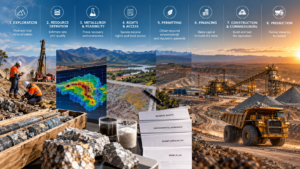
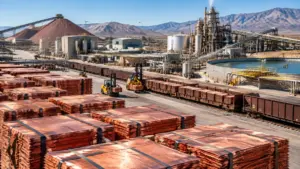
Rare earth processing infrastructure in an industrial mining environment.

By Charles Pitts
USA Rare Earth has finalized definitive agreements with the U.S. Department of Commerce for up to $1.6 billion in CHIPS Act support, converting an earlier funding proposal into a formal package for a domestic rare earth supply chain spanning mining, separation, metal and alloy production, and permanent magnets.
The agreements support the company’s planned mine-to-magnet strategy at the Round Top Mountain project in Hudspeth County, Texas, with downstream manufacturing in Stillwater, Oklahoma, and Blacksburg, South Carolina. The initiative is intended to reduce U.S. exposure to overseas rare earth processing and magnet supply chains used in semiconductors, defense systems, electric vehicles, wind turbines and other strategic industries.
The package includes up to $277 million in direct federal funding and up to $1.3 billion in senior secured loan capacity, according to details previously outlined by the National Institute of Standards and Technology and described in USA Rare Earth filings.
More Read

Agreement replaces proposed support with definitive terms
The finalized arrangements follow a non-binding letter of intent announced by the Commerce Department’s CHIPS Program Office in January. That earlier proposal was subject to further diligence, final agreements, closing conditions and regulatory approvals.

The definitive agreements now establish the funding framework, although disbursements remain linked to construction, production and other project milestones rather than being paid entirely upfront.
| Component | Amount or capacity | Purpose |
|---|---|---|
| Direct CHIPS funding | Up to $277 million | Construction and development support |
| Senior secured loan | Up to $1.3 billion | Project financing through a federal lending structure |
| Total CHIPS support | Up to $1.6 billion | Integrated mine-to-magnet supply chain |
| Planned NdFeB magnet capacity | Up to 10,000 tonnes per year | U.S. permanent magnet manufacturing |
| Planned commercial mine start | Targeted for 2028 | Round Top Mountain, Texas |
The government’s participation also includes an equity-linked component. Under the terms described by NIST and in company filings, the Commerce Department is to receive approximately 16.1 million common shares and warrants for an additional 17.6 million shares.
More Read

That structure gives the government exposure to the company’s future value while providing USA Rare Earth with a substantial source of project capital. It also means investors will need to assess the potential effects of the equity issuance and warrants alongside the benefits of federal financing.
The company previously announced a $1.5 billion private investment in public equity transaction, which it said would support its broader project and capital requirements. Taken together, the private and public financing arrangements are intended to fund a large-scale domestic supply chain rather than a stand-alone mine.
Round Top provides the upstream resource
The strategy begins at Round Top Mountain, a mineral deposit in West Texas that USA Rare Earth plans to develop as a source of heavy rare earth elements and other critical minerals.
According to the Commerce Department’s January announcement, the planned operation is designed to extract approximately 40,000 metric tonnes of feedstock per day. Commercial production is targeted for 2028, subject to construction, permitting, financing, commissioning and operating milestones.

The Round Top project is planned as the upstream foundation of USA Rare Earth’s domestic supply chain.
The Round Top resource is expected to supply material for a processing system handling a combined 8,000 tonnes per year of third-party mixed rare earth carbonate, heavy rare earth elements, and critical mineral oxides and concentrates.
The planned product portfolio includes yttrium, gallium, dysprosium, terbium, holmium, lutetium, erbium, thulium, ytterbium, gadolinium, hafnium and zirconium. Several of these materials are particularly important to high-performance electronics, semiconductor manufacturing and defense applications.
The breadth of the deposit is central to USA Rare Earth’s strategy. Rather than relying on a single light rare earth product, the company is seeking to recover a group of materials that are difficult to source and process at scale outside established Asian supply chains.
Processing and metal-making remain critical links
Mining the resource is only the first stage. The more strategically important part of the project is the planned conversion of ore and intermediate products into separated oxides, metals, alloys and magnet feedstock.
The company’s plan includes heavy rare earth separation as well as metal and alloy production. USA Rare Earth has also described the reshoring of approximately 10,000 tonnes per year of heavy rare earth metal and alloy-making and strip-casting capacity through its Less Common Metals subsidiary.

Separation, alloy production and strip casting are key stages between mined material and finished magnets.
Strip casting produces the alloy feedstock used in the manufacture of neodymium-iron-boron, or NdFeB, magnets. Establishing those capabilities in the United States would address a major gap in the domestic supply chain, where mining capacity alone does not provide manufacturers with finished magnet inputs.
The Department of Energy’s National Energy Technology Laboratory has separately signed a letter of intent with USA Rare Earth to collaborate on heavy rare earth separation technologies at the company’s Wheat Ridge laboratory and Round Top deposit. The work is expected to include digital twin technology and process-development support.
The involvement of both the Commerce and Energy departments illustrates the technical and policy challenges involved. Government funding can help accelerate construction, but commercial success will still depend on recovery rates, separation costs, product quality, water and energy management, and the ability to operate reliably at scale.
Oklahoma and South Carolina anchor magnet production
The downstream part of the strategy is intended to create U.S. production of NdFeB permanent magnets, which are used where high magnetic strength and compact size are required.
USA Rare Earth is expanding magnet manufacturing in Stillwater, Oklahoma, while also developing production capability in Blacksburg, South Carolina. The company has outlined a target of up to 10,000 tonnes per year of NdFeB magnet capacity across its manufacturing plans.

Automated equipment is intended to support domestic NdFeB magnet production.
The Oklahoma operation has been identified as the initial focus of the company’s advanced manufacturing buildout. The South Carolina facility would broaden the geographic footprint of the downstream network and provide additional capacity for customers seeking domestic or North American sourcing.
For the U.S. semiconductor sector, the supply chain could support materials used in chemical vapor deposition, high-k materials, compound semiconductors and dopants, according to the CHIPS Program Office. The same materials and magnets also have applications in defense equipment, industrial motors and energy-transition technologies.
That cross-sector demand is one reason the government has treated the project as part of semiconductor and national-security policy, rather than solely as a conventional mining development.
Strategic rationale is clear, but execution risk remains
The agreement comes as governments and manufacturers seek alternatives to highly concentrated rare earth supply chains. China remains dominant in the mining, separation, refining and magnet industries, particularly for several heavy rare earth elements and finished NdFeB products.
USA Rare Earth’s proposed system would not eliminate the need for global trade, but it would add domestic capacity across multiple processing stages. That distinction matters because bottlenecks often occur after mining, when material must be separated, refined, converted into metal and manufactured into usable components.
The project nevertheless faces a demanding execution path. Round Top must progress from development into commercial production, while the processing and manufacturing facilities must achieve the required throughput and product specifications. Federal support is milestone-based, so delays or cost increases could affect the timing and availability of capital.
Key issues for operators, policymakers and investors include:
- Permitting and construction: Whether the Texas mine and associated processing facilities advance on schedule.
- Metallurgical performance: Recovery rates and separation economics for the deposit’s broad mix of rare earths and critical minerals.
- Manufacturing ramp-up: The speed at which Oklahoma and South Carolina can reach commercial NdFeB output.
- Capital structure: The financial impact of the federal loan, government-held shares and warrants.
- Customer qualification: Whether semiconductor, defense, automotive and industrial buyers qualify and adopt the company’s products at the planned scale.
The definitive CHIPS agreements mark an important financing milestone, but they do not remove the technical and commercial hurdles typical of an integrated mining and advanced-manufacturing project.
For the U.S. rare earth sector, the significance lies in the scope of the plan. Round Top, domestic separation, heavy rare earth metal-making and magnet production are being developed as connected parts of one supply chain. If USA Rare Earth meets its construction and operating targets, the project could become one of the most substantial U.S. efforts to link critical-mineral extraction directly with finished component manufacturing.
The next milestones will show whether the federal backing can translate into physical capacity: from Texas feedstock to Oklahoma and South Carolina magnets.
Sources: NIST and the CHIPS Program Office, Reuters report on the definitive agreements, and USA Rare Earth SEC filings.
Related coverage: Rare earths news and analysis, U.S. critical minerals strategy, and the global supply-chain concentration risk facing critical minerals.