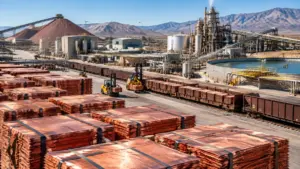
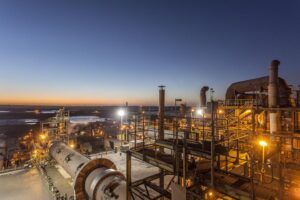
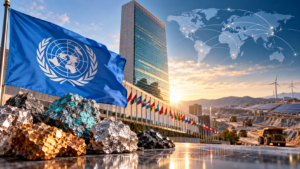
The global race for critical minerals is heating up, and Greenland just became ground zero. While China controls 60% of rare earth element production, a frozen island three times the size of Texas is positioning itself to rewrite the rules of resource sovereignty. Here's why Greenland mining matters more than most analysts realize: and why the next four years are critical.

1. Greenland Holds 36.1 Million Metric Tonnes of Rare Earth Elements
Let's start with the numbers that matter. Scientists estimate Greenland's geological deposits contain enough rare earth elements to meet roughly one quarter of global demand. We're talking about 36.1 million metric tonnes of the minerals that power everything from EV motors to wind turbines to guided missile systems.
This isn't speculative geology. These are surveyed, documented deposits that include heavy rare earth elements: the ones China has near-monopolistic control over and the ones the U.S. defense sector literally cannot function without.

The Tanbreez project alone is estimated to contain 27% of the world's heavy rare earth reserves. That single project could theoretically break China's stranglehold on the most strategically critical elements in the periodic table.
More Read

2. The EU Just Went All-In on Greenland Supply Agreements
The European Commission didn't just acknowledge Greenland's potential: they embedded it into policy. The EU's Critical Raw Materials Act explicitly aims to reduce dependence on single suppliers like China by 2030, and Greenland features prominently in that strategy.

Since 2021, the EU has signed 13 supply agreements to secure critical materials, with Greenland mining projects receiving significant attention. The European Commission's Joint Research Centre projects Greenland could supply nearly 10,000 tonnes of rare earth oxides annually by 2030.
That's not a massive percentage of global supply, but it's a critical beachhead. Supply chain diversification isn't about replacing China overnight: it's about creating viable alternatives that reduce leverage and price manipulation.
3. Active Projects Are Already Securing Export Financing
Here's where theory meets capital. Critical Metals' Tanbreez project has secured $120 million in export financing. Greenland Resources' Malmberg project has signed long-term supply agreements. These aren't PowerPoint presentations: they're funded operations with customer commitments.

The Aclara project is scheduled to begin production in the second half of 2028, with ramp-up throughout 2029. That timeline puts first deliveries right at the end of this decade, which means the groundwork being laid now directly impacts supply availability before 2030.
Will Greenland be producing at scale by January 1, 2030? Probably not. But will the first meaningful shipments from these projects be flowing by late 2029? Absolutely: and that's what reshaping a supply chain looks like in real time.
4. Greenland Contains 25 of 34 EU-Classified Critical Minerals
This isn't just a rare earth story. Greenland's geology contains 25 of the 34 minerals classified as critical by the European Commission. That includes:
- Rare earth elements (both light and heavy)
- Graphite (essential for battery anodes)
- Platinum group metals
- Niobium
- Copper
- Zinc

This mineral diversity matters because modern supply chains don't just need one critical mineral: they need all of them. A single EV battery requires lithium, cobalt, nickel, graphite, and rare earths. Having a single jurisdiction that can supply multiple critical inputs simultaneously is a strategic game-changer.
5. Global Demand for Critical Minerals Is Tripling by 2030
The International Energy Agency's projection is stark: global demand for critical minerals will nearly triple by 2030. That's not a typo. The clean energy transition, EV adoption, and defense modernization are creating unprecedented demand pressure on a supply chain that's already stretched thin.
Current production capacity simply cannot meet projected 2030 demand without massive new sources coming online. Greenland isn't optional in this equation: it's essential. Every tonne of rare earth oxides from Tanbreez is a tonne that doesn't need to come from China, and a tonne that reduces supply risk for Western manufacturers.
The timeline problem is real: establishing independent rare earth processing capacity requires 15-20 years at scale. But projects breaking ground now will be ramping production by decade's end, which means investment decisions made in 2024-2026 directly determine supply availability in 2029-2032.
6. Greenland's Regulatory Environment Just Got Serious About Extraction
Here's a nuance most coverage misses: Greenland banned uranium and fossil fuel extraction in 2021. That sounds like it would slow mining development, but it actually clarified the regulatory framework. Companies now know exactly what's permissible and what isn't.

Projects like Kvanefjeld, which contain uranium alongside rare earths, face complex regulatory hurdles. But projects focused purely on critical minerals without radioactive components have a clearer path forward. This regulatory clarity: even when it's restrictive: reduces investment risk and accelerates timelines.
Greenland's government is also actively courting responsible mining operations that meet strict environmental standards. They're not interested in becoming the next sacrifice zone: they want partnership-based development that respects indigenous communities and environmental limits. That takes longer upfront, but creates more durable, politically stable operations long-term.
7. The Infrastructure Investment Wave Is Just Beginning
The biggest bottleneck in Greenland mining isn't geology: it's infrastructure. Building ports, roads, power generation, and processing facilities in Arctic conditions requires massive capital and engineering expertise. But that investment wave is now underway.
Processing capacity is the real game-changer. Raw ore from Greenland still needs to be refined into usable oxides and metals. Building processing facilities in Greenland, Iceland, or Northern Europe creates an integrated supply chain that bypasses China entirely. Those facilities take years to construct, which is why projects announced in 2024-2026 determine supply chain structure in 2030 and beyond.
The honest timeline: Greenland's critical minerals won't meet the EU's 2030 targets in full. The ramp-up is too slow, and processing capacity takes too long to establish. But the groundwork being laid right now: the financing, the regulatory approvals, the infrastructure investment: determines whether Western nations have a viable alternative to China-dependent supply chains by 2032-2035.
The Real Question: Who Controls the Next Decade of Critical Minerals?
Greenland mining won't magically solve supply chain vulnerability by January 2030. But it represents the single largest concentration of critical minerals outside China's sphere of influence, and the projects moving forward now will be producing at scale within five years.
The reshaping isn't instant: it's incremental, capital-intensive, and politically complex. But it's also inevitable if Western nations want any leverage in the critical minerals supply chain. Greenland is where that leverage gets built, one tonne of rare earth oxide at a time.
Join the Mission
The future of resource sovereignty is being written right now in Greenland's fjords and America's policy corridors. Join the mission on Rumble for unfiltered analysis on critical minerals, mining projects, and the geopolitical chess match over rare earth elements.

Support MineWatch : Because someone needs to track who's actually securing the minerals that power modern civilization.