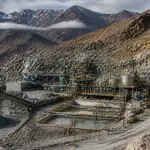
The Nevada Gold Mines district illustrates why asset concentration, infrastructure and governance can matter as much as ownership percentages.

By Penny Langford
A reported $1.95 billion settlement between Barrick Mining and Newmont has resolved a long-running dispute over Nevada Gold Mines while expanding the joint venture’s asset base and changing how the partners manage future development.
The agreement does not alter Nevada Gold Mines’ headline ownership split. Barrick remains the operator and holds 61.5%, while Newmont owns 38.5%. But the settlement changes the economic and governance framework around one of the world’s most important gold districts.
The transaction brings Barrick’s Fourmile project and Newmont’s Fiberline and Mike projects into Nevada Gold Mines. Newmont will pay Barrick $1.95 billion in cash, described by the companies as consideration or a top-up payment for the contributed properties, revised joint-venture terms and the resolution of outstanding disputes.

The deal provides a useful case study in the next phase of mining M&A: consolidation is increasingly focused not only on acquiring companies, but also on controlling contiguous districts, infrastructure corridors, development sequencing and decision-making rights.

What the settlement changes
The terms were implemented through a Second Amended and Restated Limited Liability Company Agreement for Nevada Gold Mines. Barrick said the agreement modernizes governance, updates property valuation and dilution mechanics, and resolves disputes between the partners.
According to disclosures summarized in market reports and Barrick’s public statements:

- Barrick contributes the Fourmile project.
- Newmont contributes the Fiberline and Mike projects.
- Nevada Gold Mines assumes the related project liabilities.
- Newmont pays Barrick $1.95 billion in cash.
- The existing 61.5%/38.5% ownership split remains in place.
- Newmont consents to Barrick’s planned North American gold IPO or spin-off structure.
The cash payment is expected within 30 days after Fourmile is contributed to the joint venture. The agreement also records deemed capital contributions of approximately $3.11 billion from Barrick and $1.95 billion from Newmont.
That accounting treatment is important. The $1.95 billion does not simply represent a conventional acquisition price for a percentage interest in Nevada Gold Mines. Instead, it functions as a balancing payment within a broader restructuring of property contributions, capital accounts, liabilities and governance.
Barrick’s announcement on the Nevada Gold Mines agreement described the payment as consideration related to the contribution of previously excluded properties into the joint venture.
Transaction mechanics at a glance
| Element | Reported term | Strategic significance |
|---|---|---|
| Nevada Gold Mines ownership | Barrick 61.5%; Newmont 38.5% | Economic ownership remains unchanged |
| Cash consideration | $1.95 billion from Newmont to Barrick | Rebalances property contributions and resolves disputes |
| Barrick contribution | Fourmile project | Adds a high-grade development adjacent to Goldrush |
| Newmont contribution | Fiberline and Mike projects | Expands the joint venture’s regional project inventory |
| Barrick deemed capital contribution | Approximately $3.11 billion | Reflects the assigned value of contributed assets |
| Newmont deemed capital contribution | $1.95 billion | Aligns with the cash top-up payment |
| Liability treatment | NGM assumes related project liabilities | Moves development obligations into the district-level vehicle |
| Governance | Amended approval and valuation provisions | Changes how partners manage future decisions |
| IPO consent | Newmont consents to Barrick’s North American plan | Removes a major transaction and governance obstacle |
The public disclosures do not provide a complete valuation formula for each project. That limits the ability of outside investors to independently reconstruct the $1.95 billion figure. The amount should therefore be viewed as a negotiated settlement payment rather than a transparent standalone valuation for Fourmile, Fiberline or Mike.
Why Fourmile matters
Fourmile is strategically important because it is adjacent to Barrick’s Goldrush development. Its inclusion in Nevada Gold Mines could allow the operator to evaluate geology, infrastructure and mine sequencing across a larger contiguous area.
District-scale ownership can create advantages that are difficult to capture in a project-by-project model. A larger land package may support:
- Shared shafts, roads, power and water systems.
- More efficient exploration and drilling programs.
- Flexible mine sequencing across deposits.
- Centralized processing and maintenance infrastructure.
- Better use of technical teams and autonomous equipment.
- Greater optionality when commodity prices or permitting conditions change.
The value of a district is not simply the sum of individual resources. It can also lie in the ability to combine deposits into a longer-life production system.

Processing, haulage and shared infrastructure are central to the economics of district-scale mining.
Control changes without an ownership change
The settlement illustrates an important distinction in mining M&A: ownership percentage and operational control are not the same thing.
Barrick remains the operator of Nevada Gold Mines, but the amended agreement changes the approval rights and governance arrangements that shape how the partners make decisions. Those provisions can influence:
- Capital allocation.
- Project development timelines.
- Exploration budgets.
- Property valuations.
- Future contributions and dilution.
- Strategic transactions involving the joint venture.
- Dispute resolution and default procedures.
For investors, this means that the practical control of an asset can change even when the ownership percentages do not. A partner with operational authority, project-management responsibility or stronger approval rights may have greater influence over the timing and shape of value creation.
The settlement also reduces uncertainty surrounding Barrick’s planned North American IPO or spin-off. Newmont’s formal consent removes a significant governance risk for a transaction that includes exposure to Nevada Gold Mines.
That does not eliminate execution risk. Barrick must still determine the structure, assets, financing and timing of the proposed transaction, while Newmont must evaluate how its retained Nevada exposure fits within its broader portfolio.
District consolidation is becoming more selective
The Nevada agreement comes as mining companies increasingly pursue consolidation around existing infrastructure rather than buying unrelated assets across multiple jurisdictions.
The logic is especially strong in gold, copper and critical minerals, where construction costs, permitting timelines and labor constraints make brownfield expansion more attractive than greenfield development.
However, district consolidation is not automatically value-accretive. It can also create risks:
- Capital competition: Multiple projects may compete for the same development budget.
- Complex governance: A larger asset base can increase disagreement over priorities.
- Valuation disputes: Partners may assign different values to early-stage properties.
- Liability transfer: Environmental, reclamation and development obligations move with the assets.
- Execution concentration: Operational problems at a major district can affect a larger share of production.
- Integration risk: Shared infrastructure may deliver less benefit than expected if ore schedules or metallurgical characteristics differ.
The settlement’s revised valuation and dilution provisions are therefore as important as the asset transfers. They establish the rules that could determine how future properties are valued and how ownership changes if one partner contributes additional capital.
A framework for assessing district-scale M&A
| Test | Questions for operators | Questions for investors |
|---|---|---|
| Resource continuity | Are deposits geologically and geographically connected? | Does consolidation improve reserve conversion or mine life? |
| Infrastructure | Can roads, power, processing or water systems be shared? | Are projected synergies supported by engineering studies? |
| Governance | Who controls budgets, schedules and technical decisions? | Could approval rights delay development or capital returns? |
| Capital intensity | What additional spending is needed to integrate projects? | Does the deal increase funding requirements or balance-sheet risk? |
| Liability profile | Which party assumes reclamation and development obligations? | Are liabilities fully disclosed and reflected in valuation? |
| Project sequencing | Can production be staged through a common plan? | Does the portfolio create flexibility across price scenarios? |
| Valuation mechanics | How are contributed properties valued? | Could future contributions cause dilution or disputes? |
| Strategic optionality | Does consolidation support processing, IPO or partnership plans? | Is the transaction creating durable value or simply reducing friction? |
This framework can also be applied to copper districts, lithium basins and rare earths processing hubs. The key question is whether control over adjacent assets creates measurable operating advantages.
The broader gold-market implications
Nevada Gold Mines is one of the sector’s most important operating platforms, with large-scale production, established infrastructure and a long project pipeline. Changes to its governance and property base can influence the strategic positioning of both companies.
For Barrick, the settlement secures control over a broader Nevada development platform while providing consent for a potential North American transaction. The cash payment also gives Barrick immediate liquidity, although the company has exchanged a portion of its economic settlement for the obligation to contribute Fourmile and continue developing the district.
For Newmont, the agreement resolves a governance conflict and adds Fourmile to the joint venture at the existing ownership split. The company receives access to additional district-scale growth potential but must fund the $1.95 billion payment and accept revised governance arrangements.
The strategic outcome is therefore balanced. Barrick gains cash and a clearer path for its corporate restructuring. Newmont gains a larger, more integrated Nevada portfolio. Nevada Gold Mines gains a broader property base and a new operating framework.

Governance and operational data systems increasingly determine how large mining districts allocate capital and manage risk.
What to watch next
The next milestones will determine whether the settlement produces operational value or simply closes a legal and governance chapter.
Decision-makers should monitor:
- Completion of the Fourmile, Fiberline and Mike contributions.
- Confirmation of the $1.95 billion payment.
- Updated technical studies and development schedules.
- Changes to Nevada Gold Mines’ capital-allocation priorities.
- Details of the amended valuation and dilution provisions.
- Progress on Barrick’s North American IPO or spin-off.
- Exploration results around Goldrush and Fourmile.
- The treatment of project liabilities in future disclosures.
The central lesson from the Nevada settlement is that mining M&A is moving beyond headline ownership. The most valuable transactions may be those that align geology, infrastructure, capital and governance inside a single district-scale platform.
But consolidation only creates value when the operating model is clearer after the transaction than before it. For Nevada Gold Mines, the next test is whether the amended agreement can convert a settlement payment and a larger asset base into faster development, more efficient infrastructure use and a lower-risk path to future gold production.
LinkedIn snippet
The reported $1.95 billion Barrick-Newmont Nevada Gold Mines settlement does more than resolve a joint-venture dispute.
It brings Fourmile, Fiberline and Mike into the district, updates governance and valuation mechanics, shifts related liabilities into the JV and removes a major obstacle to Barrick’s planned North American IPO.
The broader lesson for mining M&A: district-scale control can matter as much as ownership percentage. Infrastructure, project sequencing, approval rights and capital-account rules increasingly determine where value is created.
X snippet
The reported $1.95B Barrick-Newmont Nevada settlement reshapes control without changing the 61.5%/38.5% ownership split.
Fourmile, Fiberline and Mike join NGM, governance rules are revised and Newmont consents to Barrick’s North American IPO plan.
District-scale consolidation is about infrastructure and decision rights; not just acreage.
Related Skillings coverage
- Skillings Mining Intelligence: rate shock, royalty cash flow and the P/NAV discount
- Mining finance: project capital costs and funding conditions
- Lithium price forecast: supply, demand and project risk
- Autonomous mining technology and the 1,000-truck milestone
This article is for information and market analysis only. It does not constitute financial advice or a recommendation to buy or sell any security.