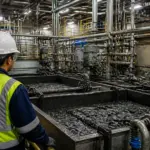
Mining operations control room with live production, equipment and performance data.

By Penny Langford
Mining projects are entering a more selective funding cycle. Capital remains available for copper, gold, critical minerals and strategic processing assets, but lenders and investors are demanding stronger evidence that projects can absorb construction inflation, permitting delays, geopolitical disruption and weaker commodity-price scenarios.
The shift is visible in Canada’s latest spending data. The country’s broader minerals sector recorded C$23.1 billion in capital expenditures in 2025, down 4% from the previous year, while spending intentions for 2026 point to a 5% recovery to C$24.2 billion, according to Natural Resources Canada. Upstream mining and quarrying spending is expected to rise 7% to C$18.5 billion.
That is a recovery, not a return to easy money. The data also show that capital is moving unevenly. Copper and gold are attracting greater interest, while lithium and nickel projects remain more exposed to price volatility, oversupply concerns and financing discipline.

The financing test has moved beyond geology
Mining finance has always depended on the quality of an orebody. Increasingly, however, geology is only the starting point.

A project must also demonstrate:
- A credible construction schedule.
- Permits that are sufficiently advanced for lenders.
- A realistic capital-cost estimate.
- Access to power, transport and processing infrastructure.
- A defensible operating-cost profile.
- Offtake or other protections against revenue volatility.
- A sponsor capable of funding cost overruns.
- Clear environmental, social and Indigenous engagement plans.
Legal and banking advisers at Cassels describe the current project-finance market as structurally more selective, with higher pricing, tighter covenants, stronger completion requirements and less tolerance for execution risk. In practice, projects without robust feasibility studies, permits and sponsor support are increasingly being delayed, restructured or sold.

This matters because mining capital is committed long before revenue begins. A construction delay can increase interest during construction, contractor costs, working-capital requirements and the size of the equity contribution. For a marginal project, the effect can be enough to push the final investment decision beyond the point where lenders are willing to participate.
A measurable recovery masks a capital-allocation divide
Natural Resources Canada’s figures provide a useful view of how capital is being allocated across the sector.
In 2025, mining and quarrying capital expenditures excluding oil and gas declined 2% to C$17.2 billion. Metal-mining capital expenditures fell 2% to C$11.9 billion, while spending intentions for 2026 imply a 14% increase to C$13.5 billion.
Copper and gold are central to that improvement. Copper benefits from long-term demand tied to electricity networks, data centers and industrial electrification. Gold projects continue to attract capital because the commodity trades in a deep and liquid market, with established debt, equity, royalty and streaming channels.
Battery metals face a more mixed picture. Lithium and nickel prices were under pressure through much of 2025 as supply growth outpaced demand in some market segments. This does not remove the strategic case for new supply, but it raises the financing threshold. Developers must show that their projects can survive a longer period of low prices before a recovery in demand.
For investors, the result is a sharper distinction between strategic importance and financeability. A mineral may be critical to an energy or defense supply chain while still being difficult to finance without government support, an offtake agreement or a strategic partner.
Capital intensity is rising in new supply regions
The International Energy Agency has highlighted a related challenge: projects in regions seeking to diversify supply away from incumbent producers can carry capital costs roughly 50% higher than comparable projects in established producing regions.
The reasons include weaker infrastructure, higher logistics costs, more limited supplier networks, unfamiliar permitting systems and a lack of local processing capacity. A project may therefore be strategically valuable but financially disadvantaged before construction begins.
That premium has direct implications for copper, lithium, nickel and rare earths. A developer operating in a new jurisdiction may need to raise more equity, accept lower leverage or secure public support to reach financial close. The same project may also require a larger contingency because the contractor market, labor pool and infrastructure base are less predictable.
Canada’s project pipeline illustrates the scale of the opportunity and the funding challenge. Natural Resources Canada lists 132 planned or proposed mining-related projects over the next decade, representing potential investment of C$122.6 billion. Turning that pipeline into operating mines will require more than commodity-price optimism. It will require bankable studies, efficient approvals, infrastructure coordination and financing structures that distribute risk among developers, governments, lenders and end users.

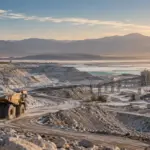
Lithium brine ponds and processing infrastructure illustrate the scale of capital required before production begins.
The funding stack is becoming more complex
Traditional senior debt remains important, particularly for permitted projects with proven reserves, established infrastructure and contracted production. But many development-stage projects now require a layered capital structure.
Common elements include:
- Sponsor equity: Provides the first-loss capital and demonstrates commitment, but can be expensive and dilutive.
- Senior project debt: Typically offers lower headline cost than equity but requires stronger security, covenants and repayment visibility.
- Streaming and royalty finance: Provides upfront capital in exchange for future metal deliveries or revenue participation.
- Offtake-backed finance: Uses long-term purchase agreements to improve revenue visibility.
- Joint ventures and earn-ins: Bring a larger producer’s balance sheet, technical capability or market access into the project.
- Government and development-finance support: Can include guarantees, concessional loans, first-loss capital or strategic procurement commitments.
The structure matters as much as the amount raised. Streaming may reduce near-term balance-sheet pressure but can transfer a portion of future project value. Senior debt may preserve ownership but impose strict completion tests. Government finance can lower the effective cost of capital but may include domestic-processing, reporting or supply obligations.
The IEA’s critical-minerals outlook and PwC’s Mine 2026 analysis point to the same conclusion: new supply will require more coordinated capital because private markets alone do not consistently absorb early-stage geological, permitting and processing risk.
An illustrative project-finance scenario
The table below provides a simple framework for testing how capital costs and financing conditions can change the funding requirement for a hypothetical greenfield copper or critical-minerals project.
The assumptions are illustrative and are not a forecast, valuation or investment recommendation. The purpose is to show how a change in construction cost, contingency, leverage and debt pricing can alter the financing package.
| Scenario | Construction capex | Contingency | Total funding need | Illustrative debt share | Debt amount | Equity and strategic capital | Illustrative debt cost |
|---|---|---|---|---|---|---|---|
| Bull case | US$900 million | 10% / US$90 million | US$990 million | 65% | US$644 million | US$346 million | 7% |
| Base case | US$1.0 billion | 15% / US$150 million | US$1.15 billion | 60% | US$690 million | US$460 million | 8% |
| Bear case | US$1.3 billion | 25% / US$325 million | US$1.625 billion | 45% | US$731 million | US$894 million | 11% |
The most important feature is the bear case. Debt does not rise in proportion to total project cost because lenders may reduce leverage when construction and market risks increase. The additional funding requirement therefore falls disproportionately on equity, strategic capital, government support or alternative financing.
That is why cost certainty has become a financing asset. A fixed-price engineering, procurement and construction contract, a detailed commissioning plan and independently reviewed cost estimates can protect not only the project schedule but also the capital structure.
The milestone lenders will watch
The clearest milestone is financial close followed by a fully funded final investment decision. A project that has a resource estimate or a positive feasibility study has not yet proven that it can be built.
Before committing capital, lenders will typically test whether the project has:
- Secured core permits and land access.
- Completed an independent technical review.
- Defined a credible construction contract and schedule.
- Funded a realistic contingency.
- Established power, transport and processing arrangements.
- Signed appropriate offtake or revenue-support agreements.
- Demonstrated resilience under lower prices and higher costs.
- Allocated cost-overrun risk to parties able to absorb it.
For operators, the practical lesson is to treat bankability as a staged operating milestone rather than a financing event at the end of development. Technical, legal, environmental and commercial work must advance together.
For policymakers, the focus is shifting from announcing strategic minerals priorities to reducing the risks that prevent projects from reaching construction. Permitting clarity, infrastructure investment, credit guarantees and demand commitments can have a greater effect on financing than headline subsidies alone.
What changes the outlook for mining capital
The funding environment is unlikely to become uniform across commodities. Copper and gold may continue to receive stronger interest because of their market depth, production economics and strategic relevance. Lithium, nickel and rare earths may attract capital selectively where projects offer low-cost production, integrated processing, strong sponsors or government-backed demand.
Technology will also influence financeability. The use of autonomous equipment, predictive maintenance and integrated control systems can improve operating reliability, but lenders will want evidence that these systems reduce costs or execution risk rather than simply increase upfront spending. Skillings’ analysis of autonomous mining technology explores how that relationship is developing.
The same principle applies to ESG. Environmental and social performance is increasingly treated as credit risk. Tailings management, water availability, emissions exposure and community agreements can affect insurance, permitting, debt covenants and the availability of strategic capital. Skillings’ overview of ESG compliance, disclosure and permitting risk provides further context.
Mining finance is therefore becoming a test of sequencing. Projects that resolve permits, costs, infrastructure, offtake and governance before seeking full construction funding will have a better chance of attracting competitive capital. Projects that approach the market with unresolved execution risks may still advance, but at a higher cost and with greater dilution or loss of control.
The central question for 2026 is not whether mining needs more capital. It does. The question is which projects can convert strategic importance into predictable cash flow, disciplined construction and a financing package that remains viable when conditions deteriorate.
LinkedIn snippet
Mining projects are not being screened on geology alone. Higher construction costs, tighter debt terms, permitting risk and commodity volatility are reshaping the path to financial close.
Our latest analysis examines:
- Why Canada’s minerals-sector capex is expected to recover to C$24.2 billion.
- How capital intensity affects copper, lithium and nickel projects.
- Why lenders may reduce leverage as construction risk rises.
- How royalties, offtake agreements, government guarantees and joint ventures are filling funding gaps.
- An illustrative bull/base/bear financing table for a US$1 billion project.
The projects most likely to secure capital will be those that turn strategic mineral demand into credible, contractable cash flow.
X snippet
Mining finance is becoming more selective.
Higher capex, tighter debt terms and permitting risk are changing how copper, lithium, nickel and critical-minerals projects reach financial close.
Our scenario table shows why cost overruns can shift the funding burden sharply from debt to equity.