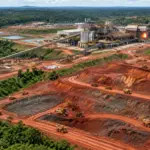
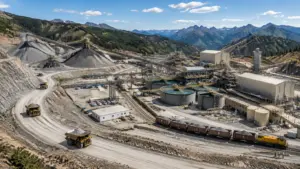
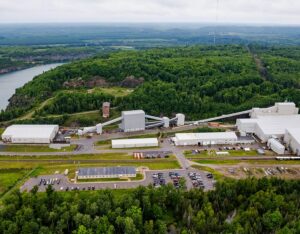
Gold processing infrastructure at a modern mine site.

Gold and silver prices fell sharply Thursday after a hotter U.S. producer-price report and a surge in oil prices pushed investors to raise expectations for another Federal Reserve rate hike at next week’s meeting.
Spot gold fell more than 1% to approximately $4,349 an ounce, while spot silver dropped more than 4% to roughly $64.47 an ounce after earlier holding above $66, according to market data cited by Reuters and Kitco. The move came as traders reassessed the inflation outlook ahead of the Federal Open Market Committee’s Sept. 15-16 meeting.
Market-based estimates for a rate increase rose to about 70%, up from roughly 60% to 65% before the data, although pricing shifted during the session. Higher Treasury yields added to the pressure on non-yielding metals. The U.S. dollar softened slightly, limiting part of the downside, but the broader rates signal dominated trading.
The latest move marks a sharp reversal from the supportive environment that had helped precious metals advance in recent sessions. Investors had been looking for signs that inflation was cooling enough to allow the Federal Reserve to ease policy. Instead, the August data suggested that production costs remain elevated, particularly in energy-intensive parts of the economy.

Market snapshot
| Indicator | Latest reported level or move | Why it matters |
|---|---|---|
| Spot gold | About $4,349/oz, down more than 1% | Higher yields raise the opportunity cost of holding bullion |
| Spot silver | About $64.47/oz, down more than 4% | Silver has greater industrial exposure and tends to amplify moves in gold |
| U.S. headline PPI | Up 0.4% in August | Signals renewed pressure in producer input costs |
| PPI annual rate | About 5.4% | Keeps inflation concerns elevated |
| Fed hike probability | About 70% in market pricing | Raises the prospect of tighter policy at the next meeting |
| Oil | Sharply higher | Increases inflation expectations and operating costs for miners |
| U.S. 10-year yield | Higher, near the 4.8% area in reports | Weighs on precious metals and mining-equity valuations |
Levels are intraday figures reported by Kitco, Reuters and related market-data sources and may change throughout the session.

Why the PPI report unsettled metals
The U.S. Producer Price Index rose 0.4% in August, while annual producer inflation accelerated to approximately 5.4%. The headline increase was particularly important because producer prices can signal future pressure on consumer prices as companies pass higher costs through to customers.
Energy was a major contributor. Kitco reported a 4.2% monthly increase in energy prices and a 24.1% jump in diesel fuel. Those increases matter beyond the inflation data itself. Diesel is a direct cost for open-pit mining fleets, underground equipment, power generation, contractors and mineral transport.

Core PPI, which excludes food and energy, rose more moderately. But the annual core measure remained elevated, reinforcing concerns that inflationary pressure is not limited to volatile fuel markets.
“China is no longer exporting deflation,” Jeffrey Roach, chief economist at LPL Financial, told Kitco. He said changing pricing conditions in China could add pressure to both producer and consumer prices in the United States.
That combination gave markets a difficult signal. Energy prices were rising because of geopolitical risk, while the underlying inflation picture remained firm enough to keep the Fed under pressure. The result was a renewed focus on whether policymakers may need to maintain restrictive rates for longer: or consider another increase.
Oil turns a geopolitical shock into a rates problem
Higher oil prices usually offer some support to gold through safe-haven demand, particularly when the increase is linked to geopolitical tension. This time, however, the inflation channel proved stronger.
Brent crude moved toward the $100-per-barrel area in reports, while West Texas Intermediate also advanced. Disruptions around the Strait of Hormuz and the broader U.S.-Iran conflict raised concern about supply routes and tanker flows.
That creates a difficult environment for precious metals. Geopolitical risk can increase demand for bullion, but an oil shock can also lift inflation expectations, bond yields and the probability of tighter monetary policy. On Thursday, investors appeared to prioritize the second effect.
Kitco reported that the 10-year Treasury yield was trading near 4.8%. The dollar softened slightly, but not enough to offset the impact of higher yields. Gold and silver therefore traded less like pure safe-haven assets and more like interest-rate-sensitive commodities.
The next major test is the U.S. consumer-price report. A cooler CPI reading could reduce some of the newly hawkish Fed pricing and give metals room to stabilize. A further upside surprise would likely keep yields elevated and increase pressure on gold and silver.

Refinery inspection of gold and silver output.
What the move means for mining companies
For mining companies, the session’s message is more complicated than the bullion chart.
A gold price near $4,349 an ounce remains supportive of revenue for producers, even after the decline. Companies with established operations and controlled costs may continue to generate strong operating margins if prices remain above their all-in sustaining costs.
But the cost side is becoming more challenging. Diesel, explosives, trucking, power and contractor expenses are all sensitive to higher oil prices. A prolonged energy rally could therefore offset part of the benefit from elevated gold prices.
Higher interest rates also affect project economics. Developers and junior companies must discount future cash flows at a higher rate, which can reduce net present values and make construction financing more expensive. That is particularly relevant for projects that require large upfront capital before producing revenue.
Skillings has previously examined how project valuation and P/NAV metrics are being used to distinguish higher-quality juniors from more speculative development stories. The latest market move reinforces that distinction: a high commodity price does not automatically remove permitting, financing, construction or execution risk.
Silver producers face an additional complication. Silver is both a precious metal and an industrial input used in electronics, solar equipment and other manufacturing applications. When markets become concerned about higher rates and slower growth, silver can underperform gold because it carries greater exposure to industrial demand.
That helps explain the size of Thursday’s move. Silver had earlier held above $66 an ounce, but fell toward $64.47 as traders reduced exposure to the more volatile metal.
Technical levels come back into focus
Kitco identified approximately $4,341 as an important near-term reference for gold, with further downside levels near $4,290 and $4,263 if selling intensifies. On the upside, the market would need to recover the $4,396 area before a move toward $4,500 becomes technically more credible.
For silver, the first important downside area was near $63.31, followed by approximately $62.57. A recovery above $65.72 would improve the short-term picture, while a sustained move beyond $67.25 would suggest that the market had absorbed the inflation shock.
These levels should be viewed as market references rather than forecasts. They are useful because they show where traders may reassess positions, but they do not resolve the larger question: whether the PPI report represents a temporary energy-driven shock or the beginning of a broader reacceleration in inflation.
Gold mining news and the 2026 outlook
For readers tracking gold mining news in 2026, the key issue is no longer simply whether bullion prices can rise. It is whether miners can protect margins as energy, labor, equipment and financing costs increase.
Large producers with operating mines may be better positioned than developers because they have current cash flow and greater access to funding. However, their equity valuations remain exposed to changes in real yields and investor risk appetite. A high gold price can support earnings, but it does not prevent share prices from falling when markets rotate away from commodities or favor cash-generating assets elsewhere.
The same distinction matters for a silver price prediction for 2026. Silver’s long-term demand story remains linked to industrial applications and electrification, but its short-term performance can be more volatile than gold. Investors will be watching manufacturing data, solar demand, mine supply, byproduct production and the path of U.S. interest rates.
Rate-path scenarios for precious metals
| Scenario | Macro trigger | Likely market response |
|---|---|---|
| Higher-for-longer | CPI remains firm, oil stays elevated and the Fed signals another hike | Gold and silver face pressure from yields; silver may underperform |
| Base case | Inflation cools gradually and the Fed holds after a restrictive move | Gold stabilizes; miners focus on margins and cost control |
| Relief scenario | CPI weakens, yields fall and the dollar remains soft | Gold could regain momentum; silver may rebound more sharply |
The immediate direction will likely depend on the CPI report and the language used by Federal Reserve officials before the meeting. Until then, Thursday’s selloff is a reminder that even historically high precious-metals prices remain vulnerable to changes in inflation expectations.
For mining executives, the priority is operational resilience. For investors and analysts, the focus is shifting from headline metal prices to the quality of cash flow, energy exposure, balance-sheet strength and project execution.
Sources: Kitco’s market report, Kitco’s PPI coverage, Reuters market report carried by Kitco, U.S. Bureau of Labor Statistics Producer Price Index, and Skillings’ gold mining coverage.

Underground mine development and drilling infrastructure.

Industrial processing equipment at a silver-bearing mine.