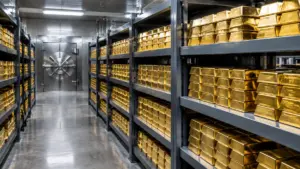
Gold bars in a refinery illustrate the market’s focus on inflation, rates and physical demand.

By Penny Langford
Gold and silver have been pulled sharply lower by a renewed inflation and interest-rate shock, putting the metals’ record-setting rally under pressure but not yet invalidating the broader bullish case.
Spot gold was trading near $4,349 an ounce, down more than 1%, while spot silver fell more than 4% to roughly $64.47 an ounce after a hotter-than-expected August Producer Price Index report strengthened expectations that the Federal Reserve could raise interest rates. Fed-funds markets were pricing close to a 70% probability of a hike, while the U.S. 10-year Treasury yield moved toward 4.8%.
The immediate problem for gold is straightforward: higher yields increase the opportunity cost of holding a non-yielding asset. But the underlying macro picture is more complicated. Brent crude was near $100 a barrel, diesel prices jumped 24.1% in August, and geopolitical risks continue to feed uncertainty around energy supply, inflation and global growth.

That combination creates a difficult short-term environment for bullion while preserving several of the structural forces that have supported gold through its record run.

Why the PPI report mattered
The August PPI showed headline producer prices rising 0.4% month over month and 5.4% from a year earlier, according to Kitco’s report on the data. Core PPI, excluding food and energy, increased 0.2% on the month and 4.6% annually.
The headline number was broadly in line with expectations, but the annual rate was slightly hotter than forecast. More importantly, the report arrived alongside a sharp rise in energy prices. The diesel increase matters because it feeds through to freight, mining, construction, agriculture and manufacturing costs.

For precious metals, the market’s interpretation mattered more than the headline surprise. Investors treated the data as evidence that inflation could remain persistent enough to keep the Fed restrictive, or even force another increase in official rates.
That repricing pushed Treasury yields higher and reduced demand for gold in the immediate aftermath. A later Kitco market report described gold trading near $4,317 during the late U.S. session and silver near $63.50, illustrating the volatility around the initial $4,349 and $64.47 levels.
The difference between those price points is a reminder that the metals market is moving quickly. For operators, investors and finance teams, the direction of yields and the dollar may be more important than any single intraday quote.

Energy costs are now central to the inflation and monetary-policy outlook.
Market snapshot: the variables driving gold
| Indicator | Latest market signal | Why it matters for gold |
|---|---|---|
| Spot gold | About $4,349/oz | Record levels remain vulnerable to profit-taking and higher yields |
| Spot silver | About $64.47/oz | Silver’s larger decline shows its higher sensitivity to growth and liquidity |
| August headline PPI | +0.4% month over month; +5.4% year over year | Reinforces concern about persistent inflation |
| August diesel prices | +24.1% | Raises transport, mining and industrial input costs |
| Brent crude | Near $100/bbl | Supports inflation expectations and complicates Fed policy |
| Fed hike odds | About 70% | Increases the opportunity cost of holding bullion |
| U.S. 10-year yield | Near 4.8% | A key headwind for non-yielding assets |
| 2026 gold forecast range | Mid-$4,000s to $6,000 in major outlooks | Shows a wide distribution of possible outcomes |
Sources: Kitco, World Gold Council, J.P. Morgan Global Research and FRED. Figures are indicative market levels and may change rapidly.
The near-term test is real rates, not inflation alone
Gold often benefits from inflation fears, but inflation by itself is not always bullish. The more important question is whether inflation causes nominal and real interest rates to rise.
If energy prices remain elevated and the Fed responds by keeping rates higher for longer, gold can face sustained pressure even as investors worry about purchasing-power erosion. In that environment, cash and short-duration government securities become more attractive relative to bullion.
The 10-year Treasury yield is already a critical reference point. The Federal Reserve Bank of St. Louis’ FRED data shows the 10-year Treasury yield spread over the federal funds rate widening, a sign that longer-term borrowing costs are moving independently of expectations for short-term policy.
That matters for the mining sector as well. Higher yields raise the discount rates used in project valuations, increase the cost of debt and can pressure the equity multiples of gold producers and developers. The effect is particularly significant for companies with long development timelines or large sustaining-capital requirements.
Skillings’ coverage of project valuation and P/NAV analysis provides useful context for how changing rates can affect mining assets even when commodity prices remain elevated.
Why the structural bull case has not disappeared
The PPI shock has weakened the tactical case for gold, but it has not removed the longer-term supports behind the rally.
The World Gold Council’s 2026 outlook identifies geopolitical risk, dollar movements, interest rates, investment demand and central-bank buying as the main forces shaping the market. Its scenario work suggests that a mild slowdown and lower rates could lift gold moderately, while a deeper global downturn could produce a much stronger move.
J.P. Morgan’s outlook is more bullish, with its research team expecting gold to approach $6,000 an ounce by the fourth quarter under its current path. The bank also highlights continued central-bank demand and Chinese gold imports as important structural factors.
Those forecasts are not guaranteed price targets. They are conditional views that depend on monetary policy, geopolitical developments and investor flows. The range itself is more informative than any single number: analysts broadly agree that gold can remain structurally supported, but disagree substantially over the timing and scale of the next move.
Central-bank demand is particularly important because it is less sensitive to short-term real yields than ETF or speculative demand. Official buyers may be responding to reserve diversification, sanctions risk and concerns about dependence on the U.S. dollar.

Physical bullion demand remains a key counterweight to higher bond yields.
Gold price forecast: base, bull and bear cases
The most useful way to approach the 2026 outlook is through scenarios rather than a single-point forecast.
| Scenario | Macro conditions | Gold implication | Indicative range |
|---|---|---|---|
| Base case | Inflation remains uneven, the Fed stays restrictive before eventually easing, and geopolitical risk remains elevated | Consolidation followed by a gradual recovery as yields stabilize | $4,500–$5,000/oz |
| Bull case | Growth slows materially, the Fed cuts rates, the dollar weakens and central-bank or ETF demand accelerates | Gold retests highs and attracts momentum-driven inflows | $5,000–$6,000+/oz |
| Bear case | U.S. growth remains firm, inflation stays high, the Fed hikes or holds longer, and the dollar strengthens | ETF outflows and higher real rates produce a deeper correction | $3,500–$4,200/oz |
The base case assumes the current yield shock eventually fades without a severe recession. Under this outcome, gold could trade in a broad range before returning toward the upper-$4,000s.
The bull case requires a stronger shift in financial conditions. A combination of falling yields, a weaker dollar, renewed geopolitical stress and stronger fund inflows could push gold toward or above $6,000. The World Gold Council’s framework describes a similar environment as a severe slowdown or “doom loop” scenario.
The bear case is the most direct consequence of the current PPI reaction. If energy prices remain high but economic activity and employment stay resilient, the Fed could maintain a restrictive stance for longer than markets expect. The World Gold Council’s scenario analysis notes that a successful reflationary outcome, accompanied by higher rates and a stronger dollar, could produce a material correction.
Silver faces a more complicated outlook
Silver’s decline of more than 4% compared with gold’s loss of just over 1% reflects its hybrid character. Silver is both a monetary metal and an industrial commodity.
Higher yields and a stronger dollar weigh on its investment demand, while higher energy costs and concerns about global growth can pressure industrial expectations. At the same time, silver remains tied to solar manufacturing, electronics, electrical equipment and other energy-transition applications.
That gives silver more upside torque if global growth stabilizes, but it also makes the metal more vulnerable during a liquidity shock. A recovery in gold without a recovery in industrial demand could leave the gold-silver ratio elevated. Conversely, falling yields combined with stronger manufacturing activity could allow silver to outperform.

Silver’s industrial exposure makes it more sensitive to growth and manufacturing demand.
What to watch next
The next phase of the gold market will likely be determined by the interaction of four indicators:
- Consumer inflation: A cooler CPI reading could reverse some of the rate-hike repricing.
- Treasury yields: A sustained move above the recent range would keep pressure on gold.
- Energy prices: Brent near or above $100 would maintain inflation risk but could also weaken growth.
- Investment flows: ETF inflows would signal that institutional demand is returning to the rally.
The current sell-off is therefore a test of the bull market’s breadth. If gold stabilizes while yields remain elevated, it would suggest that central-bank and physical demand are absorbing profit-taking. If prices continue lower alongside persistent ETF outflows and a stronger dollar, the market may need to reassess the assumption that record prices can be sustained without easier monetary policy.
For the mining industry, the message is similarly mixed. High gold prices continue to support margins and exploration budgets, but higher capital costs, diesel expenses and valuation discount rates are eroding part of that benefit. Companies with reliable production, disciplined capital allocation and manageable debt may remain better positioned than projects that depend on aggressive financing assumptions.
The PPI shock has not ended the gold bull run. It has exposed its central dependency: gold needs either falling opportunity costs, persistent official-sector demand or a fresh increase in geopolitical risk to overcome a sustained rise in real yields. Until one of those forces becomes clearer, a wide and volatile trading range remains the most defensible forecast.
This article is for information purposes only and does not constitute investment advice or a recommendation to buy or sell any security, commodity or financial instrument.