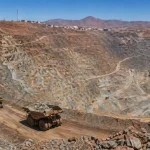
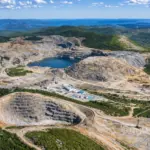
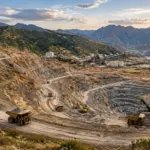
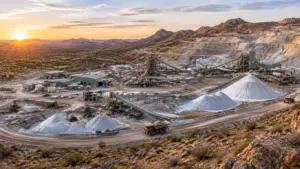
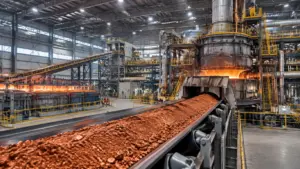
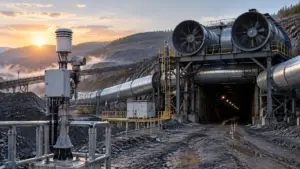
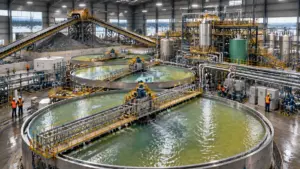
The Araxá-Barreiro district in Minas Gerais combines established niobium and phosphate operations with a growing rare earths development pipeline.

By Penny Langford
St George Mining’s latest resource upgrade at the Araxá Project in Minas Gerais, Brazil, has changed the scale of the emerging rare earths–niobium district. The company now reports a total Mineral Resource Estimate of 111.2 million tonnes, containing 3.98 million tonnes of total rare earth oxides (TREO) and approximately 630,000 tonnes of niobium pentoxide (Nb₂O₅).
The upgrade also places about 68% of the resource in the Measured and Indicated categories. St George describes Araxá as hosting the world’s largest undeveloped measured niobium resource, a claim that elevates the project from an exploration story to a potential long-life critical minerals development.
The distinction matters. Araxá is not yet a producing mine, and the resource is not an ore reserve. Mine design, recovery assumptions, project economics, permitting and financing remain to be established. But the combination of scale, confidence, location and commodity mix gives the project unusual strategic weight.

Araxá’s new resource in numbers
The latest estimate, reported by St George on its Araxá Project page, is based on a resource model prepared in accordance with the JORC Code. It uses a primary TREO cut-off, with niobium reported within the same mineralised blocks.

| Metric | Latest Araxá resource | Why it matters |
|---|---|---|
| Total Mineral Resource | 111.2 Mt | Establishes district-scale development potential |
| Average TREO grade | 3.57% | High-grade rare earths profile for a hard-rock project |
| Contained TREO | 3.98 Mt | Large inventory of total rare earth oxides |
| Contained NdPr oxides | 760,000 t | Exposure to magnet-material supply chains |
| Average Nb₂O₅ grade | 0.57% | Provides a second critical minerals revenue stream |
| Contained Nb₂O₅ | 630,000 t | Significant undeveloped niobium inventory |
| Measured and Indicated tonnage | 75.2 Mt | Approximately 68% of the total resource |
| Nb₂O₅ in Measured and Indicated material | About 440,000 t | Higher-confidence foundation for technical studies |
The increase is particularly important because it follows a sharp improvement in resource confidence. Earlier in 2026, St George reported a 70.91 Mt resource grading 4.06% TREO and 0.62% Nb₂O₅. That estimate included 29.49 Mt in the Measured and Indicated categories.
The subsequent upgrade expanded the total tonnage while retaining a large higher-confidence component. For project developers, that is more consequential than a headline tonnage increase alone. Measured and Indicated material can provide a stronger basis for metallurgical campaigns, mine scheduling and preliminary economic assessment, although it still does not have the certainty of a proven and probable ore reserve.
Why the geology matters
Araxá sits within the Barreiro Carbonatite Intrusive Complex, a geological feature approximately 5 kilometres in diameter that was emplaced about 90 million years ago. The project is adjacent to CBMM’s long-established niobium operations and near Mosaic’s phosphate mine.
The district’s mineralisation is associated with weathered carbonatite. Pyrochlore is the principal niobium-bearing mineral, while monazite hosts much of the rare earth mineralisation. Weathering has concentrated these minerals in near-surface saprolite and clay-rich zones.
That geological setting creates both an opportunity and a technical challenge.
St George says the mineralisation begins at surface and that the upper 120 metres are within the weathered profile. The company has indicated that this material could support conventional, free-digging open-pit mining. Near-surface mineralisation can reduce the need for drilling and blasting, but it does not automatically translate into low-cost production. Mining dilution, water management, geotechnical conditions, haulage distances and waste movement will determine the eventual operating profile.
The same weathering process can also make processing more complex. Fine-grained clay and monazite may require carefully designed beneficiation and hydrometallurgical circuits. Historical work on Araxá included flotation, acid digestion and pilot-scale testing, but St George is now conducting further testwork on more representative material from its recent drilling.

Weathered carbonatite and saprolite are central to the Araxá mineralisation model.
Niobium changes the project’s strategic profile
Rare earths have drawn most of the attention in Western supply-chain policy because neodymium and praseodymium are essential to high-performance permanent magnets. Araxá’s resource includes approximately 760,000 tonnes of NdPr oxides, giving it direct relevance to electric vehicles, wind turbines, robotics and other applications that depend on magnet materials.
Niobium adds a different form of strategic value.
Most niobium is used in steelmaking, where small additions can improve strength, toughness and weight efficiency. The market is smaller than the markets for copper or lithium, but supply is concentrated and the material has applications in pipelines, transport infrastructure, high-strength automotive steels and advanced alloys.
The presence of niobium could allow Araxá to develop a broader processing and product strategy rather than relying exclusively on a rare earths basket. It also gives the project potential relevance to industrial customers outside the magnet supply chain.
That does not mean the two commodities will automatically be recovered economically in parallel. The central question is whether St George can produce saleable niobium and rare earth products through a flowsheet that is technically reliable, commercially competitive and manageable from an environmental perspective.
From resource size to project value
The resource upgrade improves the starting point for economic studies, but four tests will determine whether Araxá can move toward development.
1. Metallurgical recovery
The project’s value will depend on the proportion of TREO, NdPr and Nb₂O₅ that can be recovered into products that customers will buy. Historical testwork provides a basis for further study, but recent drilling has expanded the resource into new geological domains.
St George has said it is evaluating grinding, magnetic separation, flotation and downstream hydrometallurgical options. The preferred circuit will need to balance recovery against reagent consumption, energy use, water demand, residue management and product quality.
2. Product definition
A mixed rare earth concentrate is not equivalent to separated NdPr oxides. The former may require a discount or a downstream partner; the latter can command greater strategic value but typically requires more processing complexity and capital.
The same issue applies to niobium. A project may produce a niobium concentrate, ferroniobium feedstock or another intermediate product. Each route has different specifications, customers and logistics.
3. Permitting and land access
Araxá is in a mining district with established infrastructure, workforce capability and an operating industrial base. That is a major advantage over remote greenfield projects.
However, the project still faces permitting requirements, environmental constraints and land-access considerations. St George’s technical disclosures note that some areas require regulatory approvals for exploration or future mining activity. A nearby operating mine can provide regional knowledge, but it does not remove project-specific obligations.
4. Capital and construction risk
The project’s resource is large, but development will require decisions on mine scale, beneficiation, chemical processing, residue storage and product transport. A smaller staged operation could reduce initial capital requirements but may sacrifice economies of scale. A larger integrated plant could improve unit costs but increase financing and execution risk.
The next resource update, pilot-scale results and preliminary economic studies should provide the first meaningful evidence of which path is realistic.

Pilot-scale processing will determine whether Araxá’s rare earths and niobium can be recovered through a commercially viable flowsheet.
Base, bull and bear framework
The following framework is designed to separate the resource opportunity from the development risks.
| Scenario | Operating and market assumptions | Potential outcome | Key risks |
|---|---|---|---|
| Base case | Testwork confirms recoveries that support a staged operation; permitting progresses; NdPr and niobium remain strategically attractive | Araxá advances through economic studies and partnership discussions as a multi-commodity project | Capital intensity, product specifications, permitting pace and commodity-price volatility |
| Bull case | Additional drilling converts Inferred material; East Araxá adds scale; pilot testing supports separate or higher-value products | Araxá becomes a major non-Asian source of rare earths and niobium with regional infrastructure advantages | Execution complexity and the need to finance an integrated processing chain |
| Bear case | Metallurgy varies across the deposit; clay handling or impurity removal raises costs; approvals or funding take longer | The resource remains strategically important but development is delayed, redesigned or reduced in scale | Recovery losses, residue management, financing conditions and weak NdPr or niobium pricing |
This framework also highlights why the resource headline should not be treated as a production forecast. The current estimate contains a substantial Inferred component, and St George has not published an ore reserve or a completed mine plan. Further drilling may add tonnes, but it can also change the distribution of grades and confidence categories.
What Araxá means for the rare earths map
Araxá does not replace the established niobium industry in Minas Gerais. It sits beside it.
That distinction is central to the project’s strategic appeal. The region already has roads, mining expertise, industrial services and a long history of processing carbonatite-hosted minerals. St George’s project is therefore being evaluated within an operating mining ecosystem rather than an isolated frontier district.
For rare earths, the project could add another Brazilian source of magnet-related material at a time when manufacturers and governments are seeking supply outside China. For niobium, it could introduce new undeveloped supply into a market traditionally associated with a small number of major producers.
The project’s significance will ultimately be measured not by the size of the resource alone, but by whether the company can convert geological scale into reliable products, acceptable costs and permitted production.
For mining professionals tracking rare earths and critical minerals, Araxá is now a project to follow across three linked indicators: resource conversion, metallurgical performance and permitting progress. Those milestones will determine whether the latest upgrade merely reshapes the exploration map: or establishes a new long-term supply hub in Brazil.

Near-surface weathering gives Araxá an open-pit development rationale, but mine design and recovery studies remain outstanding.
Social snippets
LinkedIn:
St George Mining’s Araxá Project now reports 111.2 Mt at 3.57% TREO and 0.57% Nb₂O₅, including about 760,000 tonnes of NdPr oxides and 630,000 tonnes of niobium pentoxide. The upgrade strengthens Brazil’s position in the rare earths–niobium supply-chain conversation: but metallurgy, permitting and project economics will decide what happens next.
X:
Araxá’s resource upgrade puts Brazil’s rare earths–niobium potential under a brighter spotlight: 111.2 Mt, 3.98 Mt TREO, 760 kt NdPr and 630 kt Nb₂O₅. The next test is not geology: it is whether St George can turn scale into saleable products and permitted production.