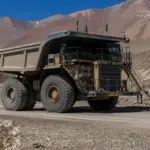
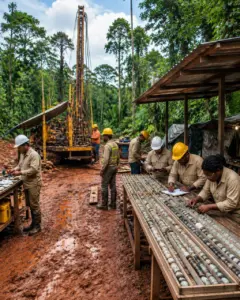
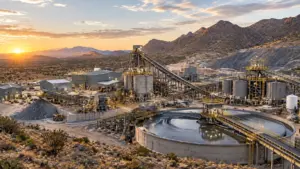
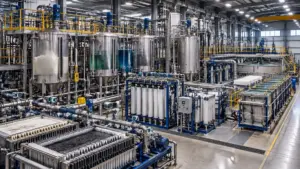
Brazilian mining tailings and waste-rock facilities with visible containment, drainage and monitoring infrastructure.

For mining companies, ESG compliance in 2026 is becoming less about broad commitments and more about whether operational claims can be supported by a complete, controlled evidence trail.
Tailings storage facilities (TSFs), waste-rock piles and emergency systems now sit at the centre of that shift. A company may disclose that it manages geotechnical risk, protects communities or aligns with global standards. Auditors, regulators, lenders and customers increasingly want to see the underlying records: facility inventories, permits, monitoring data, risk assessments, inspection reports, consultation records and evidence that corrective actions were completed.
Brazil offers a useful case study. The country already has detailed legal requirements for mining dams and closure planning. The Brazilian National Mining Agency (ANM) is also developing a regulatory framework for the safety of mining piles, including structures containing waste rock, tailings, ore, products or byproducts.
At the same time, voluntary standards such as the Global Industry Standard on Tailings Management (GISTM) and mandatory or jurisdiction-dependent reporting frameworks such as IFRS S1, IFRS S2 and the European Union’s CSRD are converging around a common expectation: material risks must be governed, measured and traceable.
Brazil’s mining-pile proposal raises the evidence threshold
The ANM’s Public Hearing No. 2/2026 concerns proposed safety criteria for mining piles. The agency opened written contributions from Aug. 31 through Oct. 14, 2026, following a public session on Sept. 11.

The proposal is not yet a final rule. That distinction matters for compliance teams. Companies should not describe the draft requirements as binding obligations until the regulatory process is complete. They should, however, treat the proposal as a credible indicator of the direction of travel.
The draft framework would apply to mining piles meeting one or more criteria, including:
- A current height of at least 25 metres or a projected height of at least 50 metres.
- Storage of hazardous material or radioactive tailings.
- A potentially affected area containing homes, state or federal roads, essential infrastructure or certain dams.
The proposed approach would create obligations for safety management and emergency preparedness. For operators, that means the relevant evidence will likely extend beyond design drawings. It may include inspections, deformation monitoring, drainage performance, slope stability assessments, emergency response procedures and records showing that identified risks were addressed.
This is particularly significant for operations that have historically managed waste-rock piles as production infrastructure rather than as major risk-bearing facilities. A facility register that excludes piles because they are not conventional dams may become difficult to defend if the structure meets the proposed thresholds.
Rules, proposals and voluntary standards are not the same
Mining ESG programs often fail at the point where different frameworks are treated as interchangeable. They are not.
| Framework or instrument | Status in 2026 | Primary focus | Evidence operators should retain |
|---|---|---|---|
| Brazilian mining-dam and closure requirements, including ANM resolutions | Binding rules, subject to scope and jurisdiction | Dam safety, risk classification, emergency planning and closure | Permits, classifications, safety plans, stability declarations, inspections and closure plans |
| ANM mining-pile safety framework | Proposal under public consultation | Safety management and emergency preparedness for qualifying piles | Facility dimensions, material classification, affected-area analysis, monitoring and emergency controls |
| GISTM | Voluntary global industry standard, but increasingly used by investors and counterparties | Governance, lifecycle risk management, stakeholder engagement and transparency | Accountabilities, risk studies, independent reviews, engagement records and facility disclosures |
| IFRS S1 | Sustainability disclosure standard adopted or applied through jurisdictional requirements | Sustainability-related risks and opportunities affecting enterprise prospects | Governance, strategy, risk management, metrics, targets and financial linkages |
| IFRS S2 | Climate disclosure standard adopted or applied through jurisdictional requirements | Climate-related physical and transition risks | Climate scenarios, rainfall and water-risk analysis, resilience measures and financial effects |
| CSRD/ESRS | Mandatory for companies within scope of EU rules | Double materiality: impacts plus financial risks and opportunities | Materiality assessments, value-chain data, policies, actions, metrics and assurance evidence |
The most important operational distinction is between legal compliance, proposed regulation and voluntary alignment.
A company can comply with Brazilian law without fully meeting GISTM. It can align with GISTM without being subject to CSRD. It can also be outside the scope of CSRD while still facing similar information demands from European customers, lenders or shareholders.
The practical response is not to maintain separate evidence systems for every framework. It is to build one controlled evidence stack and map each record to the relevant obligation or disclosure.
What an audit-ready tailings evidence stack looks like
A credible evidence stack begins with a complete inventory. Every TSF, dam and qualifying mining pile should have a unique identifier, location, status, material type, dimensions, volume, construction method, consequence classification and lifecycle stage.
That inventory should connect directly to permits and operating controls. For each facility, the company should be able to trace:
- Design and change history: engineering drawings, construction records, raises, drainage upgrades and change approvals.
- Regulatory status: ANM registration, environmental licences, water permits, conditions, deadlines and regulator correspondence.
- Monitoring: piezometers, inclinometers, survey prisms, drones, satellite data, rainfall measurements and visual inspections.
- Risk analysis: failure-mode assessments, bow-tie analysis, slope stability studies, acid rock drainage evaluations and climate stress tests.
- Emergency preparedness: emergency action plans, warning systems, evacuation routes, training exercises and contact protocols.
- Independent oversight: Engineer of Record responsibilities, external reviews, audit reports and management responses.
- Stakeholder engagement: meeting records, information requests, complaints, community feedback and evidence of design or operating changes.
- Disclosure and financial linkage: public facility information, closure provisions, remediation assumptions, insurance exposure and production interruption scenarios.
The key test is traceability. If an annual report says a facility is monitored in real time, the company should be able to show the system owner, data source, alarm thresholds, exception reports and documented response to alerts.

Mining personnel review monitoring data and operational risk indicators in a control room.
GISTM turns disclosure into a continuing obligation
GISTM is not Brazilian law, but it has become an important benchmark for large operators and their stakeholders. The standard contains six topic areas, 15 principles and 77 auditable requirements.
Its Principle 15 addresses public disclosure and access to information. Requirements 15.1 through 15.3 cover regular facility disclosures, responses to stakeholder information requests and participation in credible transparency initiatives.
That creates a practical difference between publishing a sustainability report and maintaining a disclosure-ready operating system. A static narrative may describe governance, but GISTM-style disclosure requires facility-level information, risk summaries, impact assessments and updates.
For operators, this means disclosure should be generated from controlled operational records rather than assembled manually at year-end. The facility register, monitoring systems, risk assessments and consultation database should be capable of producing consistent information for internal management, regulators, auditors and the public.
IFRS S1, IFRS S2 and CSRD connect tailings to enterprise risk
The reporting frameworks add a financial and strategic dimension.
IFRS S1 requires disclosures about sustainability-related risks and opportunities that could reasonably affect cash flows, access to finance or cost of capital. Its core content areas are governance, strategy, risk management, and metrics and targets.
IFRS S2 focuses on climate-related physical and transition risks. For tailings and mining piles, that may include extreme rainfall, flooding, water scarcity, changing closure conditions and the resilience of drainage or containment systems.
Under the EU’s CSRD framework, in-scope companies use European Sustainability Reporting Standards and apply double materiality. Tailings can be material from both perspectives:
- Impact materiality: potential effects on communities, workers, water, ecosystems and downstream environments.
- Financial materiality: potential remediation costs, production interruptions, litigation, insurance changes, permitting delays and financing consequences.
The same operational record can support both. A failure-mode assessment can inform safety management, an IFRS S1 risk disclosure and a CSRD financial-materiality analysis. A rainfall stress test can support both emergency planning and IFRS S2 climate resilience reporting.
Three scenarios for mining ESG compliance in 2026
The following framework is not an investment forecast. It is a planning tool for operators, lenders and policymakers.
| Scenario | Regulatory and market conditions | Operational outcome | Priority response |
|---|---|---|---|
| Base case | ANM advances mining-pile rules; GISTM remains a major benchmark; IFRS and CSRD implementation continues unevenly across jurisdictions | Large operators improve facility inventories and disclosure controls, while smaller companies face data and assurance gaps | Build a unified evidence register and close high-risk documentation gaps |
| Bull case for compliance maturity | Regulators, lenders and customers accept interoperable evidence aligned across ANM, GISTM, IFRS and ESRS | Strong operators reduce duplicated reporting, improve early-warning response and gain greater confidence from stakeholders | Integrate monitoring, enterprise risk, finance and ESG reporting systems |
| Bear case for compliance maturity | Final rules expand scope faster than data systems can adapt; incidents or audit findings increase scrutiny | Companies face remediation costs, permit delays, disclosure corrections and higher financing friction | Prioritize qualifying piles, independent reviews, emergency exercises and evidence retention |
The central variable is not whether every framework becomes legally mandatory. It is whether a company can demonstrate control over the risks that matter.
The 2026 action list for operators
Mining companies should begin with five practical steps:
- Reconcile the physical inventory. Confirm that all dams, TSFs, waste-rock piles and temporary storage structures are recorded.
- Map the regulatory perimeter. Separate binding ANM obligations from the mining-pile proposal and identify facilities that would fall within the draft thresholds.
- Assign evidence owners. Every material data point should have a named operational, technical or reporting owner.
- Test the audit trail. Select high-consequence facilities and trace one disclosure from the published statement back to raw monitoring data, approvals and management action.
- Connect risk to finance. Quantify potential effects from closure, remediation, production interruption, extreme weather and permitting constraints.
The direction of mining ESG compliance in 2026 is clear: evidence is becoming part of the asset itself. Tailings governance is no longer confined to the geotechnical department or the sustainability report. It now links engineering, emergency response, regulatory affairs, finance, investor disclosure and community accountability.
Companies that build this connection early will be better positioned for Brazil’s evolving rules, global tailings expectations and the expanding demand for decision-useful ESG information.
For related context, see Skillings’ analysis of mining ESG compliance, tailings permits and disclosure and its reporting on critical-minerals supply-chain risk.