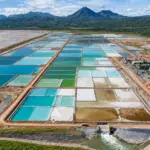
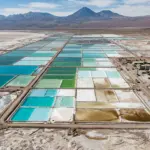
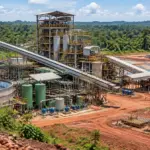
Zambian copper processing infrastructure under bright African light.

By Charles Pitts
Jubilee Metals Group’s copper production in Zambia more than tripled in the year through June, as output from its Roan operations increased and the newly commissioned Molefe mine began contributing feed to the company’s processing network.
Combined pre-refining copper production reached 3,739 tonnes in FY2026, up 225% from 1,149 tonnes in FY2025, according to the company’s operational update. The increase marks a significant step in Jubilee’s effort to move from processing mainly third-party material toward an integrated mine-to-metals business.
The company is not yet providing group-wide copper guidance for the next financial year. Instead, its FY2027 production range covers only Roan, which management says has reached stable and predictable operating performance. Molefe remains in a ramp-up and operational proving phase.
Roan provides the formal production base
Roan produced 2,823 tonnes of copper in concentrate during FY2026, a 145.5% increase from the previous year. The operation processed oxide, sulphide and oxide fines material, demonstrating the flexibility of its concentrator while a new dewatering circuit was installed and commissioned.

Jubilee’s FY2027 guidance for Roan is 2,850–3,150 tonnes of contained copper. The range is based on expected processing rates of 25,000–30,000 tonnes per month and an anticipated copper feed grade of approximately 1.5%–1.6%.
The company said the Roan guidance does not depend on the potential installation of a dense-media separation circuit, which remains under review.

That narrow guidance is significant because it separates demonstrated operating performance from project targets. Jubilee said each production source will be added to formal guidance only after it has shown sustained stability and predictability.

Flotation equipment is central to the concentration stage before refining.
Molefe adds copper but remains outside guidance
Molefe began production in September 2025 and contributed 916 tonnes of contained copper in run-of-mine material during FY2026.
The material consisted of high-grade ore transported to Jubilee’s Sable Refinery and lower-grade material stockpiled at the mine site for future processing. Of the Molefe total, 345 tonnes of contained copper in high-grade run-of-mine material was dispatched to Sable, while an estimated 571 tonnes was contained in lower-grade material stockpiled at the operation.
Jubilee mined 456,511 tonnes of copper-bearing material at Molefe during the financial year. However, mining activity was temporarily curtailed in the final quarter as the company prioritised pre-stripping and pit expansion.
The updated mine plan calls for high-grade run-of-mine deliveries to increase first toward approximately 7,000–7,500 tonnes per month before progressing toward a project target of 10,000 tonnes per month. Jubilee has not classified that target as production guidance.
The company expects to test the sustainability of Molefe’s grade, recoveries, throughput and acid consumption at the intermediate operating level. It has also completed bulk ore-sorting trials intended to improve the separation of high-grade and lower-grade material.
The ramp-up leaves Molefe exposed to the normal risks associated with a developing mine, including feed-grade variability, pit development requirements and metallurgical performance through the Sable circuit.
Production and guidance at a glance
| Metric | Result |
|---|---|
| FY2025 copper production before refining | 1,149 tonnes |
| FY2026 copper production before refining | 3,739 tonnes |
| Year-on-year change | +225% |
| FY2027 guided Roan production | 2,850–3,150 tonnes |
| Molefe in FY2027 guidance | Excluded pending ramp-up |
The table compares copper units produced before refining at Roan and Molefe. It should not be read as a comparison of final cathode sales.
Jubilee reported that Sable produced 1,207 tonnes of copper cathode in FY2026, up 17.5% from the prior year. Combined final products for sale, including cathode and copper sulphide concentrate, totalled 2,120 tonnes, a more modest 1.3% increase.
The difference between pre-refining production and final products reflects the timing of feed deliveries, stockpiled oxide fines and the company’s processing configuration.
Shift toward a mine-to-metals model
Jubilee’s Zambian strategy is built around three connected parts: third-party feed processing through Roan, refining through Sable and the development of Jubilee-controlled mines such as Molefe.
That structure is beginning to change the company’s exposure to the supply chain. In FY2026, copper concentrate and run-of-mine material delivered to Sable contained 1,342 tonnes of copper, a sharp increase from the previous year.
The company said its longer-term objective is to secure a growing supply of controlled copper feed for its own concentrator and refinery rather than rely mainly on material purchased or processed from third parties.
Molefe is the first owned and operated mine in Jubilee’s Zambian portfolio. Project G is expected to become another potential source of controlled feed, although its development remains behind Molefe and is not included in current production guidance.

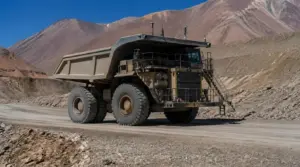
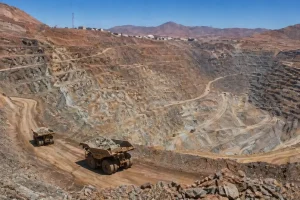
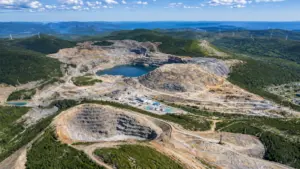
Molefe’s expansion depends on pit development, pre-stripping and consistent ore grades.
Zambia’s broader copper expansion
Jubilee’s production increase comes as Zambia seeks to expand its national copper industry. The government has set a target of raising annual copper production above 3 million tonnes by the early 2030s, from a current level of roughly 800,000 tonnes.
The goal would require substantial investment in mines, processing capacity, power infrastructure, transport links and skilled labour. It also places greater importance on projects that can demonstrate reliable production rather than only large in-ground resources.
Zambia is a key beneficiary of the global drive to secure copper units for electricity networks, renewable power infrastructure, electric vehicles and industrial equipment. Supply growth has been constrained by declining grades, ageing mines, project delays and operational disruptions.
Global copper mine output fell 1.1% in the first half of 2026, while Morgan Stanley expects the market to record its first annual decline in mine production since 2017. Copper prices have also moved sharply higher, with LME copper reaching a reported record of $5.45 per pound on Sept. 16.
For related market context, Skillings has examined the pressure on copper concentrates in its copper price and smelter-fee analysis.
Power and processing remain important risks
The increase in mined and concentrated copper does not remove the operating risks facing Jubilee’s Zambian platform.
Sable’s performance depends on dependable deliveries from Roan and Molefe, as well as the availability and cost of key inputs. Jubilee reported that domestic acid availability tightened during FY2026, with acid costs rising by more than 200%. Diesel costs also increased sharply during the period.
Power reliability remains a broader risk for Zambia’s mining industry. Concentrators and refineries require consistent electricity to maintain throughput, operate pumps and sustain metallurgical performance. Interruptions can reduce production even when ore is available.
The company’s integrated model may provide greater control over feedstock, but it also increases the number of operating links that must function together. Mine output, haulage, stockpiling, concentration, refining and power supply must all perform within planned parameters.
What to watch next
The key near-term test will be whether Molefe can sustain higher high-grade run-of-mine deliveries while the enlarged pit is developed.
Investors and operators will be watching several indicators:
- Molefe’s progress toward 7,000–7,500 tonnes per month of high-grade run-of-mine material.
- Achieved copper grades and recoveries through Sable.
- The timing and performance of the bulk ore-sorting installation.
- Roan’s ability to maintain production within its 2,850–3,150-tonne FY2027 range.
- The rate at which stockpiled oxide fines are dewatered and delivered for refining.
- Power, acid and diesel availability across the Zambian operations.
- The timing of a resource update for Molefe and development progress at Project G.
The immediate production headline belongs to both Roan and Molefe, but the formal outlook remains deliberately narrower. Roan has earned a place in guidance because it has reached stable operating performance. Molefe must still demonstrate that its mine plan, ore grades and processing results can be sustained at higher rates.
That distinction will determine whether Jubilee’s sharp FY2026 increase becomes a durable expansion of Zambian copper production or remains primarily a ramp-up milestone.