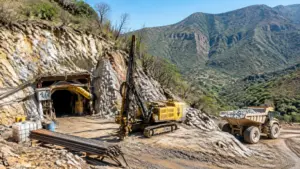
Underground drilling equipment operating at an active hard-rock gold mine.

Gold is trading near $4,290 an ounce, well below its early-year peak but still at a level that is reshaping the economics of mining, exploration and project finance. The more important change may be beneath the price chart: central banks bought 288.9 tonnes of gold in the second quarter, according to the World Gold Council, absorbing metal even during a period of price weakness.
That combination has raised the market’s perceived floor. Gold is no longer supported only by Federal Reserve expectations, exchange-traded fund flows or short-term geopolitical risk. Official-sector accumulation is becoming a structural source of demand, while supply remains constrained by long project timelines, rising development costs and declining grades at mature operations.
For producers, the result is stronger cash generation but also greater pressure to control costs. For explorers, a higher long-term price assumption can improve the strategic value of high-grade discoveries. Goliath Resources’ Surebet system in British Columbia illustrates the point: the company reported assays of up to 51.57 grams per tonne gold and a 12% expansion in the mineralized footprint during its 2026 drilling program.
Central bank buying is changing the gold floor
The second-quarter official-sector figure is significant for two reasons. First, 288.9 tonnes represents a 62% increase from the same period a year earlier, according to World Gold Council data. Second, much of that buying took place while gold prices were under pressure.
More Read

That behavior matters. Central banks are not necessarily trading gold as a short-term momentum asset. Their purchases are linked to reserve diversification, concerns about currency exposure and the geopolitical risk attached to holding overseas financial assets. Poland was among the largest reported buyers in the quarter, while China continued its longer-term accumulation.

The quarterly data also needs context. Official-sector purchases were uneven earlier in the year, and reported transactions do not capture every purchase. The World Gold Council has noted that some central bank activity is not disclosed immediately, making trade flows and refinery data important for assessing the broader demand picture.
J.P. Morgan Global Research has also highlighted the complexity of the market. Its gold outlook points to continued support from reserve diversification and geopolitical uncertainty, while warning that Federal Reserve policy and investor flows could still produce sharp price swings.

The implication is not that gold can only move higher. Rather, the market is developing a deeper layer of demand that may limit the duration of severe pullbacks.
The Fed remains the main swing factor
Central bank purchases can support the long-term floor, but Federal Reserve decisions remain crucial to the price outlook.
Gold does not pay interest. When real yields rise and the U.S. dollar strengthens, the opportunity cost of holding bullion increases. A Fed that keeps rates higher for longer could pressure gold, particularly if exchange-traded funds see sustained outflows.
The opposite scenario would be supportive. Rate cuts, weaker economic growth, falling real yields or renewed concerns about fiscal sustainability could bring institutional investors back into gold. Geopolitical escalation would add another layer of safe-haven demand.
This creates a market with a relatively firm strategic floor but considerable short-term volatility. At around $4,290 an ounce, gold remains far above the cost base of many established producers. However, the industry’s cost curve has also moved higher.
Skillings’ analysis of gold mining all-in sustaining costs found that global average AISC reached $1,785 an ounce in the first quarter, up 16% year over year. Royalties, labor, energy, freight and sustaining capital are all taking a larger share of revenue.
Linkable gold market data table
| Indicator | Current or reported level | Why it matters |
|---|---|---|
| Gold price | About $4,290/oz | Indicates a high-price environment despite volatility |
| Central bank purchases | 288.9 tonnes in Q2 | Shows strong official-sector demand |
| Year-on-year change in Q2 buying | +62% | Confirms a sharp increase from the prior year |
| Global average AISC | $1,785/oz | Demonstrates the higher cost base facing producers |
| Surebet peak assay | 51.57 g/t gold over 1.17 metres | Highlights high-grade exploration potential |
| Surebet mineralized footprint | About 2.01 square kilometres | Represents a 12% expansion during the program |
| Main macro risks | Fed policy, dollar, real yields | Could determine short-term price direction |
Sources: World Gold Council, J.P. Morgan Global Research, Goliath Resources disclosures and Skillings analysis. Company and market figures are not directly comparable measures.
High-grade exploration is gaining strategic value
Goliath Resources’ Surebet discovery sits within British Columbia’s Golden Triangle, a region where infrastructure, terrain and permitting remain central to project economics.
The company reported a peak result of 51.57 g/t gold over 1.17 metres from the Golden Gate Zone. The same hole reportedly returned 20.45 g/t over 1.65 metres within a broader 9.31 g/t interval over 3.65 metres. The company also reported a result of 26.80 g/t over 2.30 metres from the Volcanic Wedge Zone.
The exploration story is not limited to individual assays. Goliath said the Surebet mineralized footprint expanded from approximately 1.8 square kilometres to 2.01 square kilometres, a 12% increase. The Golden Gate and Bonanza zones also grew, while drilling continued to test extensions laterally and at depth.

Exploration core logging helps define the continuity and geometry of high-grade mineralization.
High grades do not automatically translate into an economic mine. Metallurgy, continuity, dilution, recovery, access, infrastructure and permitting will determine whether a discovery can support development. Still, a higher gold-price environment can improve the value of exploration optionality.
Projects that were previously marginal may attract renewed drilling or partnership interest. Companies can also use strong prices to advance deposits toward resource estimates, preliminary economic assessments and feasibility studies. The market’s focus, however, is likely to remain on deposits capable of supporting robust economics under conservative assumptions.
Gold mining outlook: base, bull and bear cases
| Scenario | Fed and macro assumptions | Demand and price conditions | Mining-cost outcome |
|---|---|---|---|
| Base case | Fed policy remains restrictive but gradually becomes less supportive of the dollar | Central banks continue buying, with investment demand fluctuating | Gold remains well above historical averages; producers prioritize debt reduction and sustaining capital |
| Bull case | Rate cuts, weaker real yields or renewed geopolitical stress | Official-sector demand stays strong and ETF inflows return | Higher prices support exploration, project development and selective M&A, despite rising royalties |
| Bear case | Strong growth, persistent inflation and a Fed hiking bias | Central bank buying slows and Western investment demand weakens | Gold retreats toward the cost curve; high-cost mines defer expansion and preserve liquidity |
The base case is the most useful planning framework for operators. It does not assume that current prices will rise indefinitely, but it recognizes that central bank demand may keep gold from returning quickly to pre-2025 trading ranges.
For producers, the key metric is not the gold price alone. It is the spread between the realized price and the full cost of maintaining production. That spread can narrow if diesel, wages, explosives, power, royalties and sustaining capital continue to rise.
For explorers, the focus should be on quality rather than simply ounces in the ground. High-grade zones, scalable footprints and favorable metallurgy can command more attention than large but low-grade resources in remote locations.

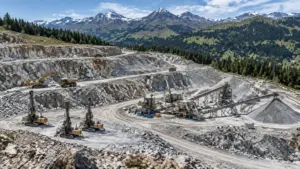
Large-scale mining equipment reflects the capital and infrastructure required to convert resources into production.
What operators and investors should monitor
Several indicators will determine whether the gold-price floor continues to strengthen:
- Central bank purchase volumes and disclosure trends.
- Federal Reserve guidance on real rates and inflation.
- U.S. dollar performance and Treasury yields.
- ETF inflows and institutional positioning.
- Global average AISC and royalty changes.
- Diesel, power, labor and consumables costs.
- Exploration results that demonstrate continuity, not only isolated grades.
- Permitting and infrastructure progress at advanced projects.
The central message from the 2026 gold mining news cycle is that demand and supply are moving in opposite directions. Official institutions are accumulating gold for strategic reasons, while new mine supply remains slow and expensive to build.
That does not remove downside risk. A stronger dollar, higher real rates or a prolonged decline in investment demand could still push prices lower. But the market’s support base appears broader than in previous cycles.
For producers, this is a period to convert strong margins into resilience. For explorers such as Goliath Resources, it is an opportunity to demonstrate that high-grade discoveries can grow into technically and economically credible projects. The companies best positioned for the next phase will be those that treat the elevated gold price as a source of discipline and investment: not as a substitute for it.
Shareable social snippets
LinkedIn: Gold near $4,290/oz is being supported by more than short-term safe-haven flows. Central banks bought 288.9 tonnes in Q2, while Goliath Resources expanded the Surebet system in British Columbia by 12% and reported assays up to 51.57 g/t gold. The next test is whether demand remains strong as mining costs rise.
X: Central banks bought 288.9 tonnes of gold in Q2, helping reset the market’s perceived floor near $4,290/oz. Meanwhile, Goliath’s Surebet system expanded 12%, with assays up to 51.57 g/t Au. Fed policy and mining costs remain the key risks. #Gold #GoldMining #MiningNews #CriticalMinerals