Remote copper-gold exploration terrain in central Alaska.

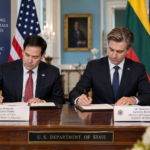
Vizsla Copper Corp. is acquiring 100% of Agnico Eagle’s Delta polymetallic project and Helm Bay gold project in Alaska in a transaction that will make the major gold producer one of the junior explorer’s largest shareholders.
The deal, reported by Global Mining Review and announced by the companies, gives Vizsla control of two exploration assets while allowing Agnico Eagle to retain exposure through shares, warrants, royalties and future milestone payments. The transaction is expected to close in the fourth quarter, subject to customary conditions including approval from the TSX Venture Exchange.
The structure reflects a broader shift in mining M&A in 2026: major producers are increasingly using strategic equity positions and contingent payments to maintain exposure to exploration upside without taking on the full cost of advancing every project themselves.
Deal structure puts Agnico near a 22% stake
Under the agreement, Vizsla Copper will issue Agnico Eagle 22,523,283 common shares at closing. The shares are valued at a deemed price of C$1.26 each and represent approximately 19.99% of Vizsla’s issued and outstanding shares at the time of the agreement.
A further 2,903,490 shares will be issued after disinterested shareholder approval, subject to the transaction terms. If issued, those shares would increase Agnico Eagle’s ownership to approximately 22%.

Agnico will also receive 3,041,480 warrants. Each warrant can be exercised for one Vizsla Copper share at C$1.95 for two years from issuance, although the warrants include ownership limitations designed to prevent Agnico from exceeding the applicable threshold through exercise.
The share consideration has an aggregate deemed value of approximately C$32 million.

| Transaction component | Terms |
|---|---|
| Initial consideration shares | 22,523,283 |
| Initial Agnico ownership | Approximately 19.99% |
| Deferred consideration shares | 2,903,490 |
| Potential post-approval ownership | Approximately 22% |
| Warrants | 3,041,480 at C$1.95 |
| Delta royalty | 2% net smelter return |
| Helm Bay royalty | 3% net smelter return |
| Delta resource milestone | C$5 million |
| Delta feasibility milestone | C$5 million |
| Delta production milestone | C$10 million |
Agnico will retain a 2% net smelter return royalty on Delta and a 3% royalty on Helm Bay. Vizsla will have the right to buy back 50% of each royalty for C$5 million.
The agreement also provides for three potential milestone payments tied to Delta. Vizsla may pay C$5 million when it discloses a mineral resource estimate containing at least 300,000 copper-equivalent tonnes, another C$5 million when it completes a feasibility study, and C$10 million when the project reaches commercial production.
Those payments may, subject to the agreement and securities rules, be made in cash or shares. The structure limits Vizsla’s upfront cash requirement but could result in additional dilution if the projects advance and milestone obligations are paid in equity.
Delta gives Vizsla a large polymetallic exploration platform
Delta is a volcanogenic massive sulphide, or VMS, project in central Alaska, approximately 60 kilometres southwest of Tok and near the Alaska Highway.
The property comprises 249 State of Alaska mining claims covering about 16,123 hectares. Previous operators drilled more than 25,000 metres and spent more than US$20 million on exploration, according to company disclosures.
Delta hosts several known massive sulphide lenses and a historical inferred resource estimate of 15.4 million tonnes grading:
- 0.6% copper
- 1.6% lead
- 3.8% zinc
- 62 grams per tonne silver
- 1.7 grams per tonne gold
Vizsla Copper cautions that the estimate is historical. The company has not completed sufficient work to classify it as a current mineral resource and is not treating it as such. Further drilling, data verification, resampling and technical work will be required before the historical estimate can be used in a current resource statement.
The exploration case rests partly on the presence of multiple mineralized lenses and several kilometres of electromagnetic conductors that have not been drill-tested. Those conductors are not, on their own, evidence of an economic deposit, but they provide additional targets across a large and relatively underexplored land package.

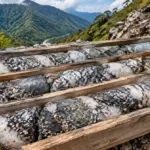
Polymetallic drill core undergoing geological review.
Helm Bay adds a separate gold option
Helm Bay is a different type of asset. The project is an orogenic gold property near tidewater in southeast Alaska, approximately 35 kilometres north of Ketchikan.
The package includes 33 State of Alaska mining claims and 642 unpatented federal mining claims. Previous exploration identified at least 17 historical gold occurrences and more than 10 kilometres of quartz-vein strike length.
Historical work focused on the Upper and Lower Gold Standard workings, which produced less than 10,000 ounces of gold before the Second World War. Historical sampling from the workings returned average grades of approximately 10.4 grams per tonne gold at Lower Gold Standard and 11.2 grams per tonne at Upper Gold Standard.
Those results are historical and have not been independently verified by Vizsla. The project remains an exploration opportunity rather than a defined development asset.
Helm Bay nevertheless gives Vizsla exposure to gold alongside Delta’s copper, zinc, lead, silver and gold mineralization. That diversification may help the company maintain investor interest across different commodity cycles, although it also creates a broader technical and capital-allocation challenge.

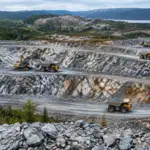
Rugged southeast Alaska terrain near the Helm Bay project area.
The Alaska deal complements Vizsla’s British Columbia portfolio
The transaction does not add projects in British Columbia. Delta and Helm Bay are both in Alaska.
They do, however, expand a broader portfolio that includes Vizsla Copper’s Palmer VMS project in southeast Alaska and its Poplar and Woodjam copper-gold projects in British Columbia. The result is a multi-asset exploration platform spanning copper, gold and polymetallic systems in two adjacent jurisdictions.
Vizsla says it expects to use its existing Alaska-based technical, environmental and permitting teams across the expanded portfolio. The potential benefit is shared knowledge and infrastructure across projects, although the properties are geographically distinct and will still require separate exploration programs, permits and funding.
The company’s Poplar project is a copper-gold porphyry project in British Columbia, while its Palmer VMS project provides a separate Alaskan base-metal development opportunity.
The portfolio approach is consistent with the district-consolidation theme shaping mining M&A in 2026. Buyers are often seeking more than a single deposit. They are looking for land position, infrastructure access, technical synergies and a pipeline of targets that can be advanced sequentially.
Skillings previously examined how valuation gaps, royalties and execution risk are influencing transaction structures across copper, gold and critical minerals.
Why Agnico Eagle is taking equity in a copper junior
Agnico Eagle’s decision to accept shares rather than an all-cash payment reflects the uncertainty attached to exploration-stage assets.
The company receives immediate economic value through the initial share issuance, while retaining upside if Vizsla advances Delta or Helm Bay successfully. Its potential ownership position also gives Agnico influence over a company holding a larger portfolio of copper and gold exploration assets.
The investor rights agreement will provide Agnico with the right to nominate one director while it maintains certain ownership thresholds. If Vizsla’s board expands to eight or more directors, Agnico could have the right to nominate two directors.
Agnico will also receive participation rights in certain future equity financings, allowing it to maintain or acquire an interest of up to 19.9% on a partially diluted basis. The company has separately committed to participate in Vizsla’s first post-closing financing, subject to conditions, for up to the lesser of C$5 million or 10% of the financing.
For Agnico, the arrangement offers several potential advantages:
- Exploration upside: exposure to new copper and gold discoveries without funding all exploration costs.
- Optionality: the ability to increase exposure if Vizsla’s technical results improve.
- Risk sharing: project advancement costs remain primarily with the junior.
- Strategic access: a significant equity position and board rights provide visibility into project decisions.
- Royalty income potential: future production from Delta or Helm Bay could generate revenue without Agnico operating the assets.
Agnico described the investment as part of a strategy of acquiring strategic positions in prospective opportunities with high geological potential. The company is not committing to develop the projects itself, and the transaction should not be interpreted as a production decision.
A Cramer-style screen, without the production hype
A Cramer-esque market screen would likely focus on three questions: Is the asset package large enough to matter? Is the strategic shareholder aligned with the junior? And can the company fund the technical work needed to turn exploration potential into a current resource?
Vizsla scores positively on strategic alignment. Agnico’s approximately 20% initial position, possible increase to 22%, board rights and financing commitment create a stronger relationship than a conventional asset sale.
The risks are equally clear. Delta’s resource estimate is historical, Helm Bay has limited historical production, and both projects remain exposed to permitting, exploration and financing risk. The transaction also adds potential dilution through deferred shares, warrants and milestone payments.
The practical takeaway is therefore not a direct trading call. It is that the deal should be viewed as a strategic exploration platform transaction, not as an acquisition of near-term copper or gold production.
The key indicators to monitor are:
- TSX Venture Exchange approval and transaction closing.
- Disinterested shareholder approval for the deferred shares.
- Vizsla’s first post-closing financing.
- New drilling and data verification at Delta.
- A current resource estimate that replaces the historical estimate.
- Exploration results from Helm Bay and the company’s British Columbia projects.
- Any evidence that Agnico will increase its ownership or provide additional technical support.
District consolidation can create value when projects share infrastructure, geological models or operating teams. It can also spread capital too thinly when a junior adds too many targets at once.
Vizsla’s challenge will be to demonstrate that the Agnico transaction creates more than a larger claim portfolio. The next test is whether the company can convert that portfolio into verified resources, prioritized exploration targets and a credible sequence toward development.
For related coverage, see Skillings’ analysis of the copper market and smelter treatment charges and the wider critical-minerals supply chain.