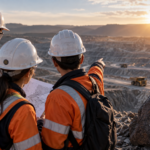
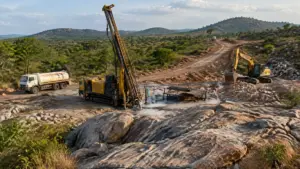
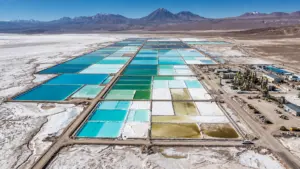
Exploration drilling in a tropical Brazilian gold district.

G Mining Ventures has identified a new near-surface gold discovery at its Gurupi project in Brazil, adding exploration momentum to a portfolio anchored by the producing Tocantinzinho mine.
The Grodiocal target, along the Chega Tudo–Mandiocal corridor, returned a 23-metre intercept grading 1.97 grams of gold per tonne from 51 metres, including 9 metres at 4.24 grams from 55 metres, the company said in results reported by The Northern Miner. A second hole returned 10 metres grading 3.42 grams from only 23 metres downhole.
The results are significant because the mineralization begins close to surface and appears within a broader, underexplored structural corridor. That geometry could support future open-pit evaluation, although additional drilling, resource modelling, metallurgical work and permitting would be required before any development decision.
The announcement also included new drilling from Tocantinzinho, G Mining’s operating gold mine in neighbouring Pará state. The combined results point to a two-track growth strategy: expand the resource base at Gurupi while testing deeper and satellite mineralization around the existing Tocantinzinho operation.
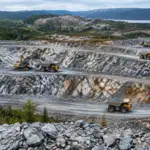
Grodiocal adds a new near-surface target
G Mining’s maiden drilling campaign at Grodiocal formed part of a 17,667-metre, 127-hole program across Gurupi. The campaign identified multiple zones of near-surface mineralization along a corridor approximately 5 kilometres long and up to 1 kilometre wide.

The strongest reported Grodiocal results were:
| Drill hole | Interval | Gold grade | Starting depth |
|---|---|---|---|
| GUR-26-068 | 23 metres | 1.97 g/t Au | 51 metres |
| Including | 9 metres | 4.24 g/t Au | 55 metres |
| GUR-26-066 | 10 metres | 3.42 g/t Au | 23 metres |
The intercepts are not yet a mineral resource or economic reserve. However, their shallow position gives the discovery a different development profile from deeper underground targets. For an open-pit concept, the key questions will include grade continuity, strip ratio, dilution, metallurgical recovery and the relationship between the mineralized zones.
Grodiocal is located along the prospective Chega Tudo trend, where the company said there had been no historical drilling before the maiden campaign. That makes the early results relevant beyond the individual intercepts: they provide evidence that the broader corridor may host additional mineralized centres rather than only the deposits already defined by previous operators.

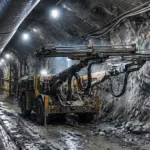
Gold exploration in the Gurupi district is testing structurally controlled mineralization in altered rock and quartz-bearing zones.
Gurupi’s existing resource provides the development base
Gurupi already contains a substantial resource inventory. G Mining’s 2025 estimate outlined 43.5 million indicated tonnes grading 1.31 grams per tonne for 1.83 million ounces of contained gold, together with 18.5 million inferred tonnes grading 1.29 grams for 770,000 ounces.
The company acquired the project, formerly known as CentroGold, from BHP in late 2024. The asset covers approximately 1,900 square kilometres across 47 contiguous tenements and includes the Blanket, Contact and Chega Tudo deposits along an 80-kilometre mineralized trend.
Further drilling has extended mineralization outside the limits of the 2025 resource and pit shells. At Blanket, hole GUD-26-026 returned 79.6 metres grading 1.78 grams per tonne from 146 metres. Hole GUD-26-021 intersected 63.5 metres grading 1.28 grams from 170 metres.
At Mandiocal, drilling extended mineralization as much as 125 metres below the 2025 resource pit shell. Hole GUD-26-028 returned 48.4 metres at 1.32 grams from 277 metres, including 5 metres at 3.55 grams from 309 metres.
The results suggest that Gurupi’s potential may come from both near-surface additions and deeper extensions. The immediate corporate objective is to translate exploration success into a larger resource base and a clearer development case.
G Mining’s Gurupi project overview describes the property as an advanced exploration project within a large orogenic gold system. The company’s technical description identifies quartz-carbonate-sulfide veins and disseminated pyrite within structurally altered host rocks.
Can Gurupi become a satellite feed source?
Gurupi is increasingly being positioned as a future growth asset alongside Tocantinzinho and the company’s Oko West project in Guyana. The strategic appeal is straightforward: G Mining already has an operating platform in northern Brazil, while Gurupi could provide additional ounces from a separate but regionally connected development project.
The timing matters. Tocantinzinho reached commercial production in September 2024 and achieved nameplate capacity during 2025. G Mining reported 171,871 ounces of production in 2025, with 2026 guidance of 160,000 to 190,000 ounces.
That operating base could eventually provide technical, procurement and management advantages for Gurupi. It may also allow the company to evaluate whether some future Gurupi material could be treated through existing or expanded regional infrastructure.
However, Gurupi is not currently a confirmed satellite feed source for Tocantinzinho. The projects are in different areas of northern Brazil, and any shared-processing or regional-feed strategy would need to be supported by transport studies, metallurgical testwork, mine scheduling, permitting analysis and capital estimates.
A more immediate interpretation is that Gurupi represents a second Brazilian growth platform. Its near-surface discoveries could support a standalone open-pit concept, while the existing Tocantinzinho operation offers a benchmark for G Mining’s construction, commissioning and operating capabilities.
At Tocantinzinho, the company is also testing mineralization below the current open-pit design. Hole BRZ-26-134 returned 7.8 metres grading 6.42 grams per tonne from 382 metres within a broader 51-metre interval grading 1.31 grams. Hole BRZ-25-121 returned 10.5 metres grading 4.62 grams from 503 metres.
The mine’s regional exploration corridor measures approximately 15 kilometres by 3 kilometres and includes the main deposit and several satellite targets. Success there could extend mine life, but deeper mineralization would likely require a different mining method or an expanded pit design.

Tocantinzinho provides G Mining with an operating anchor as it advances additional Brazilian growth opportunities.
Brazil’s permitting path remains a central risk
Gold development in Brazil requires both a mining title and environmental approvals. The Agência Nacional de Mineração, or ANM, administers exploration rights and mining concessions, while environmental licences are issued by the competent federal, state or municipal authority.
For a large industrial project, the environmental process generally moves through three stages:
- Licença Prévia: approval of the project’s location and environmental viability.
- Licença de Instalação: authorization to build mine, plant, tailings and related infrastructure.
- Licença de Operação: authorization to begin and continue commercial operations.
The competent authority depends on the project’s location and environmental characteristics. In Maranhão, where much of Gurupi is located, state-level licensing is generally central to the process. In Pará, environmental licensing for some mining activities can involve municipal authorities under delegated arrangements, while federal agencies such as IBAMA may retain jurisdiction for projects with interstate impacts or other federal triggers.
The process can also require environmental impact studies, public consultation, water-use approvals, vegetation-clearance permits and engagement with affected communities. Those requirements make permitting a material part of the development timeline, not a procedural step that can be assumed after exploration success.
For G Mining, Tocantinzinho demonstrates that it can complete the permitting process in Brazil. The mine received operating licences from the Pará environmental authority in August 2024, covering mining, the processing plant, tailings facilities and the airstrip. Gurupi will nevertheless face its own site-specific environmental and social review.
What the results mean for GMIN
G Mining shares rose 2.4% to C$50.27 in Toronto following the announcement, valuing the company at approximately C$15 billion, according to The Northern Miner. The shares had traded between C$23.22 and C$58.74 over the previous year.
The market case now rests less on a single exploration intercept than on whether G Mining can convert a sequence of discoveries into a repeatable growth pipeline.
| Growth driver | Evidence released | What investors will need to see |
|---|---|---|
| Gurupi near-surface growth | Grodiocal intercepts from shallow drilling | Continuity, resource growth and pit-constrained ounces |
| Gurupi district potential | Mineralization across an 80-km trend | Additional discoveries and coherent mine planning |
| Tocantinzinho depth | High-grade intervals below the pit design | Mine-life extension and development economics |
| Operating platform | 171,871 ounces produced in 2025 | Sustained costs, recovery and cash generation |
| Brazil development pathway | Existing permitting experience at Tocantinzinho | Gurupi-specific studies, licences and capital requirements |
The constructive reading is that G Mining has a producing asset, an expanding exploration portfolio and multiple potential sources of future ounces. The risk is that exploration success does not automatically become mineable reserves or free cash flow.
The next valuation catalysts are likely to be an updated Gurupi resource estimate, further drilling at Grodiocal and the broader Chega Tudo corridor, a preliminary economic assessment, and clarity on how the company would develop and process any future Gurupi production.
For now, the results strengthen the view of G Mining as a multi-asset gold producer with a growing Brazilian pipeline. They do not yet establish a mine plan for Gurupi, but they move the project closer to the point where resource scale, permitting and development economics can be tested.
Sources: The Northern Miner; G Mining Ventures’ Gurupi project page; G Mining Ventures.
Related Skillings coverage: Gold and silver market analysis, Mining ESG compliance and permitting, and Mining M&A valuation and execution risk.